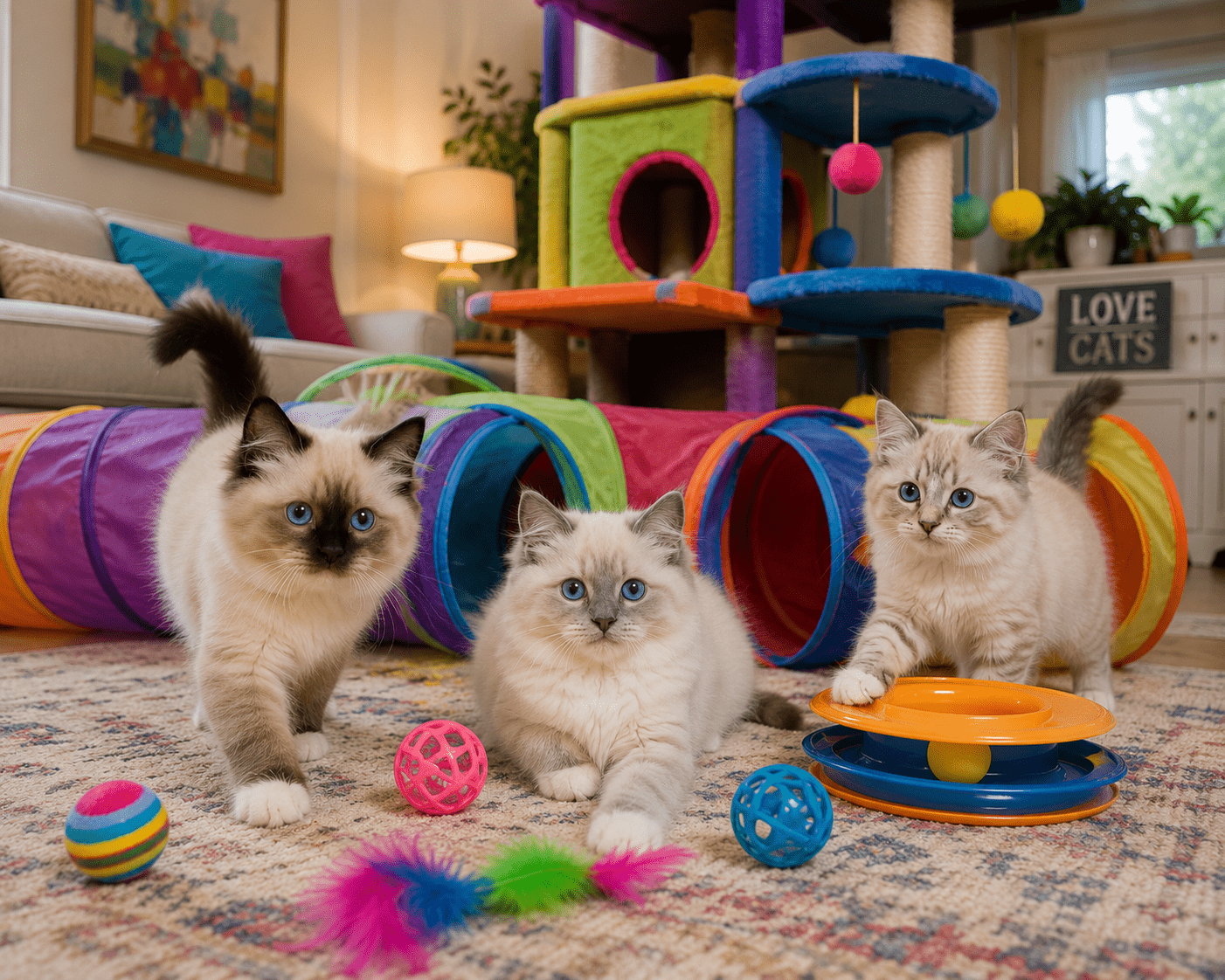

Why a Ragdoll Kitten Changes Places at Home
One of the most easily overlooked parts of Ragdoll kitten behavior is the way a kitten’s favorite location can change from week to week. A new arrival may begin behind a chair, move to the side of a sofa, and eventually settle beside your feet in the busiest room of the home.
That movement does not necessarily mean the kitten has become less settled. Often, it shows that the home is becoming understandable. The kitten is learning which paths are safe, which household sounds are ordinary, and where it can rest while still keeping track of the people it has started to trust.
Familiarity changes more than a kitten’s confidence
When a Ragdoll kitten first arrives, a quiet edge of the room can offer several advantages at once. It provides cover, a clear view of the doorway, and an easy way to retreat without crossing a large open space. These details matter to a small animal entering an unfamiliar environment, even when the kitten has a naturally gentle or social temperament.
As the room becomes predictable, the same kitten may begin choosing a more exposed position. A spot beside a coffee table, at the end of a hallway, or near the chair where you work can become appealing because it combines visibility with security. The kitten is not simply seeking the softest surface. It may be choosing a place that allows it to observe movement, hear familiar voices, and leave comfortably.
This is particularly interesting with Ragdolls because many develop a strong interest in staying near their people. “Near” does not always mean directly on a lap. For one kitten, it may mean lying under the dining table while everyone talks. For another, it may mean resting on the far side of the room with a line of sight to its owner. Individual preferences vary, but social proximity can influence location as much as warmth or comfort.
Why the quiet corner may give way to the social edge
Prospective owners sometimes imagine that a Ragdoll kitten will immediately occupy the center of family life. In reality, even a people-oriented kitten may first prefer the boundary of an active room. The edge of a rug, the side of a sofa, or the space beside a cabinet can function as a halfway point between participation and retreat.
That halfway point is easy for humans to overlook. A kitten sitting near the room’s activity may look as though it is merely resting, but its position can reveal growing confidence. It has chosen to remain present without needing to be handled or encouraged. Over time, it may shorten the distance between its resting place and the people it is watching.
Another subtle change is route familiarity. At first, a kitten may repeatedly travel between only two known points. Once those paths feel ordinary, it may use furniture and doorways differently, pausing at a threshold or taking a longer route to reach a person. This is not random wandering. It can be a sign that the home’s layout has become part of the kitten’s mental landscape.
Small layout details that matter to a Ragdoll kitten
A Ragdoll kitten does not need a specially designed room to settle well, but the arrangement of ordinary furniture can influence where it feels comfortable. Before moving everything around, notice whether the kitten appears to value a particular combination of features:
- A view without exposure: The kitten can see people approaching but is not placed in the middle of foot traffic.
- An easy exit: There is a clear way to leave the resting spot without being cornered by furniture or a closing door.
- Social sound at a tolerable distance: Voices and normal household activity are audible, but the kitten is not beside the loudest movement.
- A consistent landmark: The sofa arm, table leg, or doorway remains familiar even as the kitten explores farther.
- A comfortable surface at floor level: A stable bed or blanket gives the kitten a predictable place to return to without requiring it to climb.
The overlooked point is that stability can matter more than novelty during the settling-in period. If a kitten has just begun using one corner confidently, changing the whole arrangement may remove the visual landmarks that helped it feel secure. Small adjustments are usually easier for a new kitten to understand than constant redecorating.
What changing favorite spots can tell you
Watch the relationship between location and household activity rather than judging a spot in isolation. A Ragdoll kitten that moves from a quiet room to the living room when people gather may be showing a preference for company. A kitten that chooses the hallway during busy moments may want to remain informed without being in the middle of activity. Neither response is automatically better.
Notice whether the kitten’s position changes when you change yours. Some Ragdolls will gradually relocate from a separate resting place to the room where their owner is reading, working, or preparing for the day. Others remain in one place but turn their body toward the person or raise their head when that person moves. These small choices can be more revealing than whether the kitten follows closely.
It is also worth noticing how a familiar object changes meaning. A chair that initially offers cover may later become a lookout point. The space beneath a table may begin as a retreat and later become a preferred place to watch conversations. The furniture has not changed; the kitten’s interpretation of it has.
Persian and Ragdoll kittens in a settling home
When comparing how kittens settle into a home, Persian and Ragdoll patterns can feel different, though individuals vary. Many Ragdolls are inclined to keep people within sight as they become confident, so their chosen spot may migrate from a sheltered edge to a rug beside your chair or a hallway where household movement is visible. Persian kittens often appreciate a quieter, more contained base and may take longer to make busy central areas part of their regular territory; their preference can be expressed through returning to a calm room rather than following a person. Neither pattern predicts a fixed personality. A Ragdoll is not guaranteed to be outgoing, and a Persian is not automatically aloof. For both, stable furniture, low-stress introductions, and the freedom to retreat make home exploration easier. Compare location preferences, not stereotypes.
Let the kitten show you how the home works
For someone considering a Ragdoll kitten, this gradual change is useful to expect. A kitten may not reveal its full social style on the first day, and its early hiding place is not necessarily a permanent personality statement. Give it time to decide which parts of the home feel connected, predictable, and comfortable.
Instead of repeatedly placing the kitten where you would like it to be, observe where it chooses to be and why. A spot that looks inconvenient to a human may offer the exact balance of visibility, escape, and companionship the kitten needs. Once you understand that balance, arranging the room becomes less about directing the kitten and more about making its preferred way of living easy.
For more guidance on choosing and enjoying life with a Ragdoll kitten, explore the breed resources at CTkittens.com.

Rachel Cohen is a journalist and producer with a passion for audio storytelling, health and science reporting, and feline companions.
A graduate of Middlebury College, Rachel spends her weekends exploring the mountains and when she isn’t outdoors or chasing a story, she can usually be found hanging out with her cats.