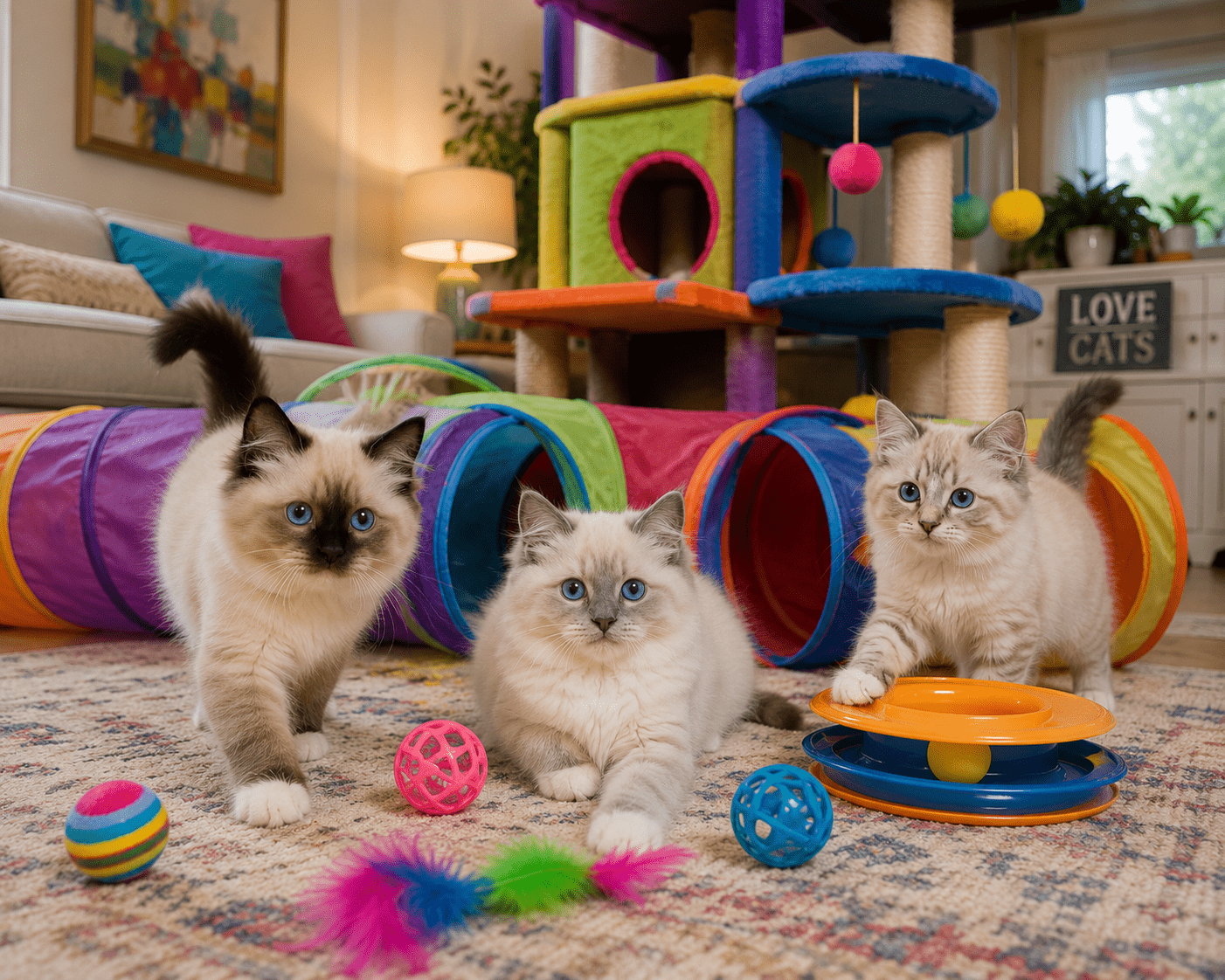

Why Your Ragdoll Kitten Wants to Be Near You, Not Held
A Ragdoll kitten may follow you from room to room in the morning, wait outside the bathroom, or appear beside your chair just as you sit down. Then, when you offer your lap, the kitten may step away and settle a short distance from you instead.
This is not necessarily mixed messaging. For many Ragdolls, bonding means being included in your movement and daily rhythm. Physical closeness can be welcome, but being picked up or held is only one possible form of contact. The overlooked detail is that your home layout can either support this choice or turn a gentle social moment into a struggle over space.
The overlooked part of a Ragdoll kitten’s morning greeting
Ragdolls are often described as people-oriented, and many kittens do enjoy following a trusted person. However, a social kitten is not automatically a kitten that wants uninterrupted handling. Your Ragdoll may be gathering information, checking where you are going, and choosing a comfortable place from which to remain involved.
Watch the sequence rather than focusing only on the final action. A kitten might approach your ankles, pause when you move, walk ahead, and then sit where it can see both you and the doorway. That position provides companionship without trapping the kitten in a lap or between furniture.
Another common pattern is the “nearby retreat.” Your kitten comes close when you are standing, moves away when you bend down, and returns once you are seated. The change may reflect the difference between a moving person and a predictable person, not a rejection of affection.
Arrange the morning room for voluntary closeness
The most useful adjustment is often not adding more equipment. It is making the places where you already spend time easier for your kitten to approach and leave. This matters particularly in the morning, when you may be moving between a bedroom, kitchen, hallway, and living area before the household becomes settled.
Give the greeting a comfortable landing place
Place a small, stable resting surface near your usual morning chair or desk, but not directly in the path of feet. A low bed, firm cushion, or washable mat can work if it does not slide when the kitten steps onto it. The ideal position gives your Ragdoll a clear view of you and an unobstructed route away.
Do not tuck the spot into a dead-end corner simply because it looks tidy. A kitten that wants social contact may prefer the edge of the room, where it can watch your hands and face while still seeing the exit. This is one reason a resting place beside a chair can be more socially useful than an isolated bed across the room.
Make your own seat easy to approach
Large, deep chairs and sofas can accidentally create a barrier. If cushions spill into the floor space, your kitten may have to climb over your legs or squeeze between furniture to reach you. Leave a clear approach on at least one side of your seat. Sitting slightly sideways can also help, since a full frontal lean may feel more intense than a relaxed shoulder turned toward the kitten.
Keep the kitten’s preferred approach consistent when possible. If a Ragdoll repeatedly comes from the hallway and settles beside the left side of your chair, avoid blocking that route with a bag, footstool, or folded blanket. Small changes in traffic can affect whether a kitten chooses to remain nearby.
Offer height carefully, without forcing a perch
Some Ragdolls enjoy observing from a low platform, while others prefer the floor beside their person. Because individual kittens differ in confidence, balance, and jumping habits, a sturdy low surface is more appropriate than a precarious high position. The purpose is not to make your kitten climb; it is to provide another way to share the room.
A low viewpoint beside your morning seat can be especially helpful for a kitten that likes eye-level interaction but dislikes being lifted. From there, your Ragdoll can watch you drink coffee, read, or prepare for the day and decide whether to come closer.
Read the response before changing the arrangement
Ragdoll kitten behavior becomes easier to understand when you observe what happens after you make space for choice. Look for these less obvious signals:
- Approaches, then turns sideways: Your kitten may be comfortable near you without requesting direct touch. A relaxed sideways posture is often a better invitation for gentle contact than a kitten facing away and tensing.
- Settles just beyond arm’s reach: This can be successful social contact. The kitten has chosen your company while preserving control over distance.
- Leaves when you lean forward, then returns: Try remaining still for a moment instead of reaching again. Your stillness may be what allows the kitten to close the distance on its own.
- Watches from the doorway: The doorway may be a deliberate observation point, especially during a busy morning. It lets your kitten track several parts of the household without being in the center of activity.
These observations are more useful than trying to make every greeting end with a cuddle. If your kitten chooses the nearby mat repeatedly, treat that preference as information. You can offer a hand for sniffing or a brief stroke when the kitten approaches, but allow the kitten to decide whether the interaction continues.
Persian and Ragdoll kittens in the same morning setting
Persian kittens may also enjoy quiet companionship, but their social style is often expressed through calm presence rather than following every household movement. A Persian may prefer a settled cushion near a person who stays in one place, while a Ragdoll kitten may be more likely to trail someone between rooms before choosing a resting spot. Persians often have a rounder, lower visual profile, so a clear floor-level space can be especially inviting. Ragdolls are larger-framed as they mature and may appreciate a broad, stable surface with an easy exit. Neither breed should be assumed to want constant handling. With both, the useful comparison is not which is more affectionate, but how each individual kitten chooses to remain part of the morning.
Small changes that protect the bond
You do not need to redesign the entire home. Start with the places where your kitten already tries to join you. Move one obstacle, widen one approach, or place a stable resting surface where your kitten naturally pauses. Then give the adjustment several mornings before deciding whether it works.
Keep human routines predictable where possible, but do not demand that your kitten match your schedule. A Ragdoll may greet you enthusiastically at one point and prefer observation later. Leaving a clear path and a nearby resting option lets the kitten participate without being carried, cornered, or repeatedly called over.
The result is a more accurate understanding of Ragdoll kitten behavior: affection may look like a shadow in the hallway, a quiet body beside your chair, or a kitten watching you from the edge of the room. When your layout supports those choices, proximity becomes a conversation rather than a negotiation.
For more practical guidance on living comfortably with Persian and Ragdoll kittens, explore the kitten care and breed resources at CTkittens.com.

Rachel Cohen is a journalist and producer with a passion for audio storytelling, health and science reporting, and feline companions.
A graduate of Middlebury College, Rachel spends her weekends exploring the mountains and when she isn’t outdoors or chasing a story, she can usually be found hanging out with her cats.