
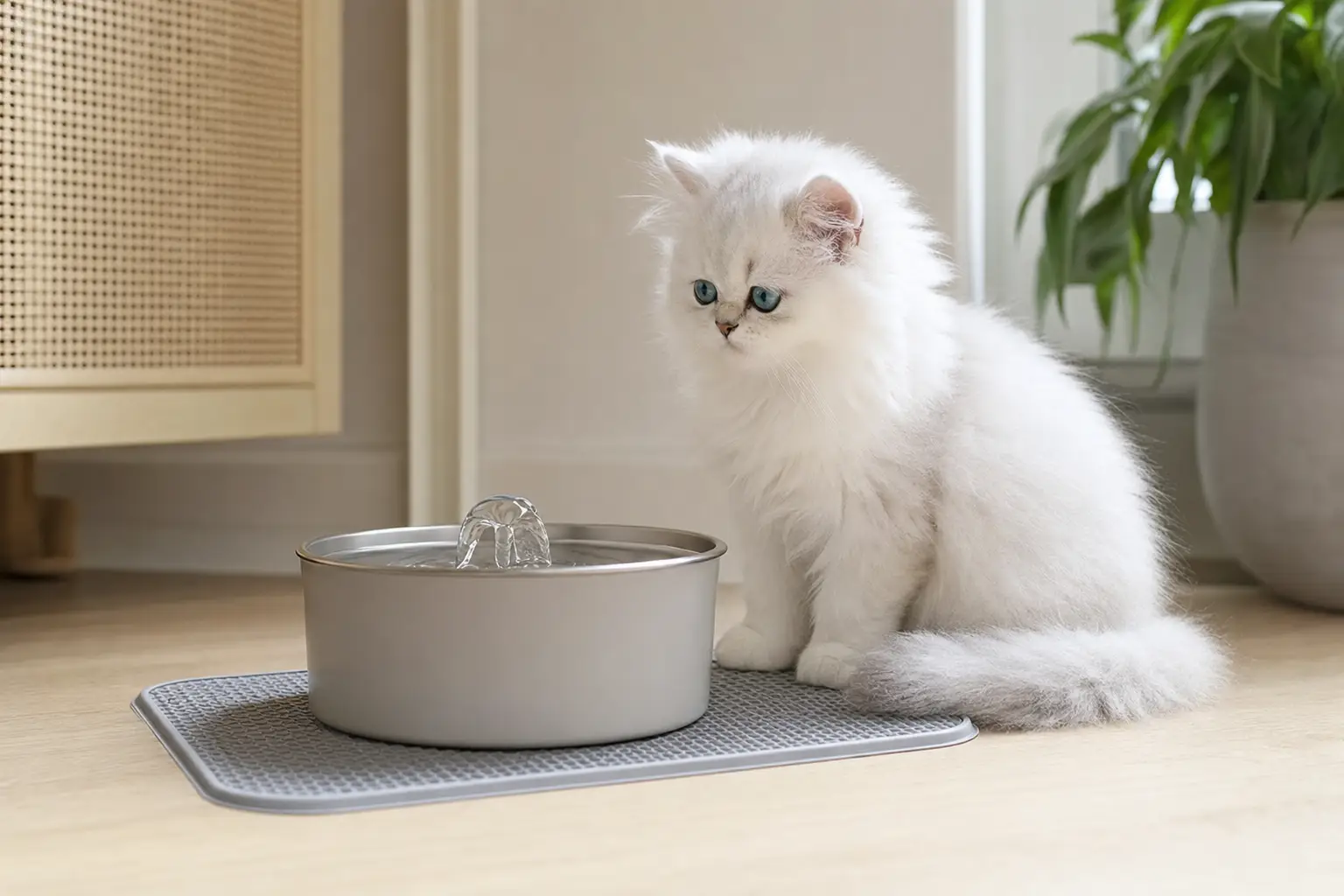
Water Fountain for Persian Kittens: Simple or Elaborate?
For most Persian kittens, simple is the better place to start. A quiet, low-profile fountain with fresh water, a stable base, and an easy-to-clean design is usually more useful than a complicated “hydration station.” The goal is not to persuade every kitten to love running water. It is to offer an appealing, accessible choice while keeping a familiar bowl available.
Some kittens take to a fountain immediately. Others are cautious about the sound, movement, reflections, or unfamiliar shape. Persian kittens may also benefit from a shallow drinking area because some have short, broad facial structures that make deep or narrow bowls awkward. A thoughtful introduction matters more than an elaborate product.
Simple or elaborate: which approach is best?
A simple setup has one fountain, one backup bowl, a non-slip mat, and a quiet location away from the litter tray. It is easy to monitor and easier to keep hygienic. This approach works well for a young kitten who is still learning household routines.
An elaborate setup might include a larger reservoir, multiple water stations, a filter, a monitoring app, or a decorative feeding area. Those features can be convenient, especially in a large home or a household with several pets, but they do not automatically make water more attractive or safer. Every extra part also creates another surface, cord, pump, or filter to inspect.
| Approach | Advantages | Possible drawbacks |
|---|---|---|
| Simple | Easy to clean, quiet, affordable, and straightforward to monitor | May need more frequent refilling; fewer features for multi-pet homes |
| Elaborate | Can offer more capacity, filtration, or several drinking points | More parts to clean, more noise or maintenance, and potentially more distractions |
Choose based on your kitten’s behavior and your ability to maintain the equipment. A fountain that is neglected because it is difficult to disassemble is a poor choice, no matter how attractive it looks.
What makes a good fountain for a Persian kitten?
Look for practical features rather than novelty. The fountain should be stable enough that a kitten cannot easily tip it, with a drinking surface that is low and open. Stainless steel or glazed ceramic can be convenient materials because they are smooth and generally easy to wash. Plastic may also work if it is sturdy, intact, and cleaned according to the manufacturer’s instructions.
- Low, accessible drinking area: A kitten should not need to push its face into a deep opening to reach the water.
- Quiet operation: A soft trickle is more likely to be accepted than a loud pump or splashing stream.
- Stable construction: A broad base and non-slip mat can prevent spills and startling movement.
- Easy disassembly: You should be able to remove the pump, reservoir, and small parts for cleaning.
- Protected cord: Keep electrical cables out of reach of a kitten that likes to chew or play.
- Visible placement: The fountain should be in a calm area, not hidden behind furniture where it can be forgotten.
Capacity is mainly a convenience. A large reservoir does not mean the water can be left unattended for long periods. Freshness, cleanliness, and reliable access matter more than size.
How to create the right quiet corner
A quiet corner should feel peaceful without becoming isolated. Place the fountain where your kitten can approach and leave easily, with a clear view of the room and no need to squeeze behind furniture. Avoid placing it beside a litter tray, in a busy walkway, or directly next to a noisy appliance.
Many cats prefer some separation between food and water, although individual preferences vary. If your kitten ignores a fountain beside its food, try moving it a short distance away rather than assuming the fountain itself is the problem. In a large home, or where another pet can block access, a second water bowl in another room may be more helpful than a more advanced fountain.
Use a washable mat beneath the station. Persian kittens can have long coats that collect splashes, so check the chin and facial fur after drinking. If the fur becomes damp, gently pat it dry. Do not place the fountain so close to a wall that a kitten must rub its face against the surface to drink.
How to introduce a water fountain gradually
Do not remove your kitten’s familiar water bowl the moment the fountain arrives. A sudden change can create uncertainty and makes it difficult to tell whether the kitten is drinking normally. Keep the original bowl available throughout the transition.
A calm introduction plan
- Set up the fountain while it is unplugged. Place it near, but not directly beside, the usual bowl. Let your kitten investigate the shape and smell without the sound of a motor.
- Fill it with fresh water. Check for sharp edges, loose parts, or a slippery base before switching it on.
- Run it at the quietest setting. Watch your kitten’s reaction. If the pump vibrates, splashes, or makes a high-pitched sound, reposition it or use a different model.
- Offer both options. Leave the familiar bowl and fountain available for at least several days. Avoid carrying the kitten to the fountain or placing its paws near the stream.
- Follow the kitten’s choice. Praise calm investigation, but do not force contact. A kitten that drinks from the bowl is still using an appropriate water source.
Some kittens are interested in moving water but dislike the sound. Others prefer a still pool within the fountain rather than a bubbling stream. Adjust the flow, water level, and location one at a time so you can identify what helps.
If the fountain causes repeated startling, hiding, or avoidance, turn it off and return to the bowl for a while. You can try again later, or decide that a well-maintained bowl suits your kitten better. A fountain is an option, not a requirement.
Cleaning matters more than the filter
Filters can catch hair and debris, but they do not replace washing. A fountain may look clear while the pump and hidden channels collect slime, food particles, or hair. Read the manufacturer’s cleaning instructions and inspect the water daily.
Refresh the water every day rather than simply topping it up indefinitely. Wash the bowl or reservoir regularly, and take the pump apart as directed so its small passages can be cleaned. In a kitten household, frequent inspection is sensible because playful paws, shed fur, and food crumbs can enter the water quickly. Replace filters on the schedule provided by the manufacturer, or sooner if they look dirty or the water develops an odor.
Use plain, safe drinking water. Do not add milk, flavorings, salty broth, or homemade additives to tempt a kitten to drink. Ingredients such as onion and garlic can be harmful to cats, and sweet or salty additions can create other problems. If you are unsure whether your tap water is suitable, ask your veterinarian about an appropriate alternative.
For general feline water guidance, International Cat Care’s advice on water is a useful reference. Your veterinarian should be the source for advice tailored to a particular kitten’s diet or health.
When a fountain may be especially useful
A fountain can be convenient for a kitten that enjoys moving water, for a household where water becomes stale quickly, or for owners who want a larger reservoir between cleanings. It may also help make water more noticeable in a calm room. However, it should not be treated as a cure for poor drinking, urinary disease, kidney disease, or dehydration.
Kittens eating wet food may appear to drink less from a bowl because they receive a significant amount of moisture through their meals. That does not make a fountain necessary, and visible drinking alone cannot tell you whether a kitten is healthy. Look at the whole picture: appetite, energy, urination, stools, and behavior.
Contact a veterinarian promptly if your kitten suddenly stops drinking and eating, becomes weak or unusually sleepy, vomits repeatedly, has diarrhea, produces very little urine, or seems painful. A male kitten straining to urinate or passing no urine needs urgent veterinary attention. Do not delay care while experimenting with a different fountain.
Common questions
Should I leave the bowl if my kitten starts using the fountain?
Yes. Keeping a clean bowl available provides a familiar backup if the pump stops, the power fails, or your kitten changes its preference. It also makes the transition less stressful.
Is stainless steel or ceramic better?
Both can be practical when they are smooth, intact, and easy to clean. Choose the material that your kitten accepts and that you can maintain consistently. Avoid damaged surfaces and replace any item with cracks, rough chips, or deep scratches.
How much water should a Persian kitten drink?
There is no useful single target for every kitten. Water needs vary with body size, age, activity, temperature, and whether meals are wet or dry. A veterinarian can assess a kitten’s needs more accurately than a fountain’s fill line.
What if my kitten ignores the fountain?
That is normal. Check that it is quiet, clean, stable, and easy to access, then continue offering the bowl. If your kitten is otherwise eating, active, and urinating normally, there is no need to force a preference for running water.
The best setup is the one you can maintain
For a Persian kitten, start with a clean, quiet, low-sided fountain and a familiar bowl in the same general area. Introduce the new sound gradually, keep cords and small parts secure, and make cleaning part of the daily routine. Add extra stations or more advanced features only when they solve a real problem in your home.
Looking for more thoughtful guidance on welcoming a Persian kitten home? Explore CTkittens.com for practical kitten-care resources and Persian kitten information.

Rachel Cohen is a journalist and producer with a passion for audio storytelling, health and science reporting, and feline companions.
A graduate of Middlebury College, Rachel spends her weekends exploring the mountains and when she isn’t outdoors or chasing a story, she can usually be found hanging out with her cats.

