
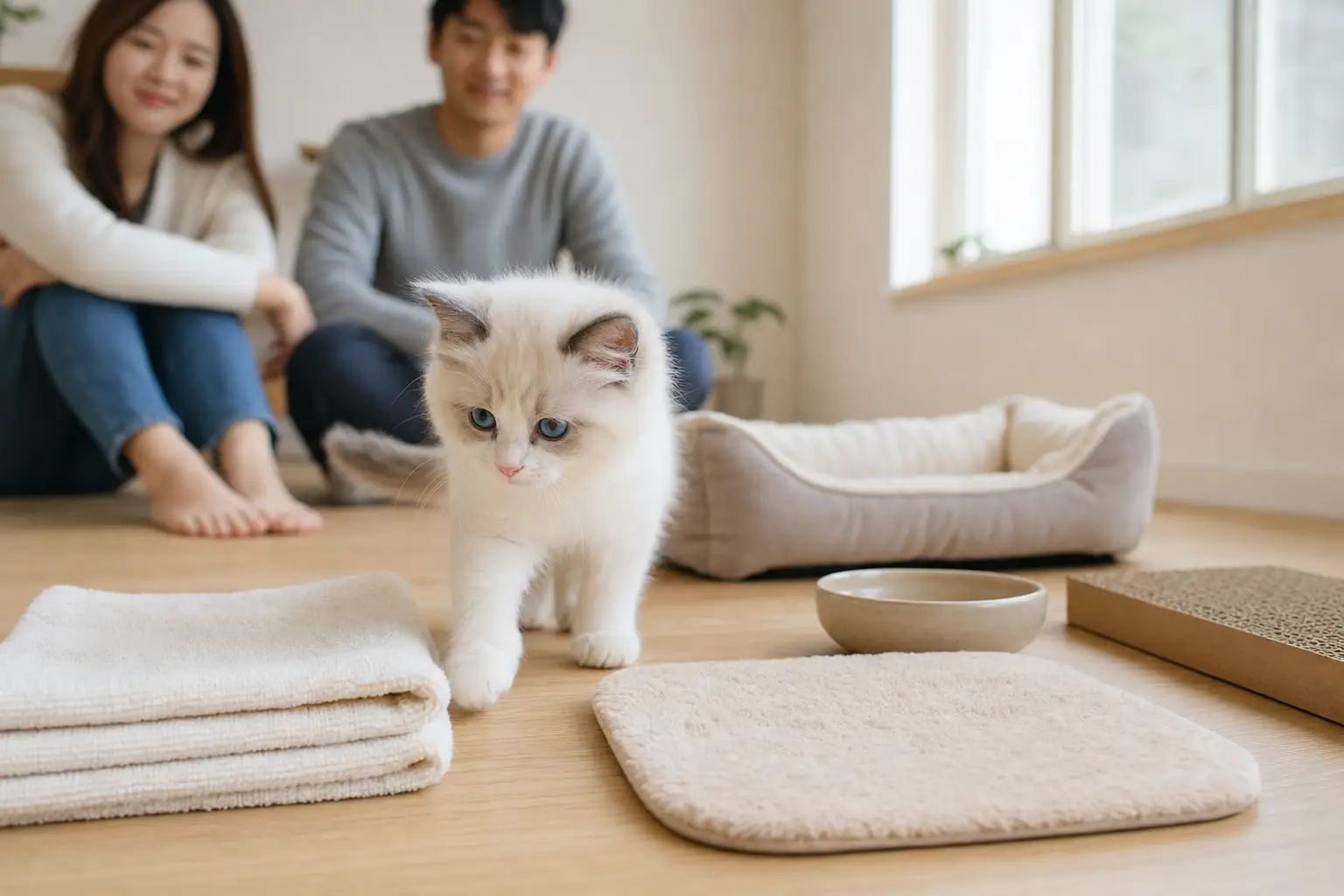
During a kitten’s first week, small observations can make settling in easier. This illustrative family story shows how noticing a Ragdoll kitten’s preferred bedding, feeding, scratching, and handling textures helped create a calmer routine without forcing a choice.
Quick answer: The best way to learn a Ragdoll kitten’s favorite textures is to offer a few safe, simple options in the same setting, change only one variable at a time, and watch what the kitten chooses repeatedly. A preference for cotton over fleece, cardboard over sisal, or a shallow dish over a deep bowl can be useful information—but it is not a breed rule or a medical diagnosis.
For the first week, consistency matters more than creating a perfect kitten room. Keep the food, litter, and daily rhythm familiar whenever possible. Then use small, low-pressure observations to make the space more comfortable.
Ragdoll Kitten First Week: One Family’s Small Wins With Textures
A note about the family story
The household in this article is an illustrative composite, not a claimed customer testimonial or a report from a named family. The details are designed to show a practical way to observe a new kitten while keeping expectations realistic.
What a kitten’s texture preference can mean
Texture is more than whether a surface feels soft. A kitten may respond to how much a material gives under its paws, whether claws catch in it, how warm it feels, whether it makes noise, and whether it carries a familiar scent.
That is why a fluffy bed may be ignored while a folded cotton towel becomes the favorite sleeping spot. The towel may be easier to knead, less warm, less slippery, or simply more familiar from the kitten’s previous home. One observation rarely tells the whole story. A repeated choice in similar circumstances is more informative.
During the first week, families can gently observe preferences in four areas:
- Resting: cotton, fleece, a washable mat, or a firm cushion.
- Eating: the height and shape of a clean food dish, while keeping the food itself consistent during the initial transition.
- Playing and scratching: horizontal cardboard, a stable sisal surface, or another kitten-safe material.
- Handling: whether the kitten settles more easily on bare clothing, a smooth towel, or a soft blanket.
A texture preference should never be treated as a test the kitten must pass. The goal is to give the kitten a choice and make the environment easier to understand.
The first-week small-wins story
Day one: familiar beats fancy
The family prepared a quiet room with a bed, litter box, food, water, and two resting surfaces. One was a deep plush bed. The other was a folded cotton towel placed inside a low-sided basket.
The new Ragdoll kitten walked past the plush bed and tucked into the towel. Rather than moving the kitten or repeatedly presenting the softer bed, the family left both options in place. They also used a blanket carrying a familiar scent from the kitten’s previous home, if one was available.
The first small win was not getting the kitten to use the expensive bed. It was seeing the kitten rest, wake, and explore without being pressured.
Day two: repeating the observation
On the second day, the kitten again chose the cotton surface after a short play session. That made the preference more interesting, but the family still avoided declaring that cotton was the kitten’s permanent favorite. Temperature, location, and scent could all have influenced the choice.
They kept the towel in the same quiet corner and washed a spare towel with unscented detergent. Having a second washable option made cleanup easier without removing the texture the kitten seemed to trust.
Day three: a feeding adjustment
The kitten was eating, but tended to step away from a deeper bowl. The family did not immediately change the food. Instead, they offered the same meal in a clean, low-sided dish and watched from a distance.
The kitten ate more comfortably from the shallow dish. That may have been related to the dish’s shape, position, or the kitten’s general adjustment—not necessarily a specific sensory problem. A wide, stable dish was a reasonable practical choice because it was easy to clean and less likely to tip.
This distinction matters: a useful environmental change is not the same as diagnosing a condition. If a kitten repeatedly refuses food, seems painful while eating, or develops other symptoms, a veterinarian should be contacted.
Day four: finding the right kind of resistance
For scratching, the family placed a flat cardboard scratcher near the kitten’s resting area and a sturdy vertical sisal post nearby. The kitten used the cardboard first, possibly because its surface offered a different kind of resistance under small claws.
They praised the choice with calm attention and left the post available. There was no need to place the kitten’s paws onto the scratcher or punish exploration elsewhere. A stable scratcher with no loose strings or dangling pieces is safer than a complicated toy that can shed parts.
Day five: a handling preference
The kitten seemed comfortable being stroked along the cheeks and shoulders but wriggled when a fuzzy robe brushed against its back. The family changed the texture of the clothing rather than increasing restraint.
Short, quiet handling sessions worked better than long cuddles. The kitten was supported under the chest and hindquarters, kept close to a safe surface, and allowed to pause. A relaxed moment was treated as an invitation to stop on a positive note—not a reason to keep handling until the kitten became overwhelmed.
Days six and seven: turning observations into a routine
By the end of the week, the family had a simple texture map:
- A folded cotton towel was the preferred resting surface.
- A low, stable dish was easier for meals.
- Flat cardboard was the first-choice scratching material.
- Slow cheek and shoulder strokes were better tolerated than contact with fluffy clothing.
They did not remove every other option. The plush bed remained available, the vertical scratcher stayed in place, and the kitten’s food and litter routine remained steady. The small win was learning how to make good choices easier while allowing the kitten to develop at its own pace.
How to test textures without overwhelming a new kitten
You do not need a room full of products. A controlled, low-pressure comparison usually gives better information than constantly rearranging the environment.
- Start with a baseline. Keep the food, litter, familiar bedding, and daily schedule as consistent as possible for the first few days.
- Offer two safe choices. For example, place a folded cotton towel beside a washable fleece mat in the same quiet area.
- Change one thing at a time. Do not switch the bedding, bowl, food, and litter on the same day. If the kitten reacts, you will not know which change mattered.
- Observe without hovering. Note whether the kitten approaches, settles, scratches, eats, or returns to a surface. Give the kitten room to choose.
- Repeat before deciding. A single choice may reflect heat, scent, position, or timing. Look for a pattern over several calm opportunities.
- Keep hygiene and safety first. Wash bedding regularly, remove loose threads, avoid small detachable parts, and supervise toys that can be chewed or swallowed.
A small notebook or phone note can help: date, material, location, activity, and the kitten’s response. This turns vague impressions into useful observations without making the first week feel like a laboratory experiment.
Texture choices that are worth treating carefully
| Area | Practical approach | What to avoid |
|---|---|---|
| Bedding | Offer a washable, low-sided resting place and a familiar-smelling cloth when appropriate. | Loose loops, frayed fabric, or bedding that can cover the kitten’s face. |
| Food and water | Use clean, stable dishes and keep the initial diet consistent with the kitten’s transition plan. | Making several diet changes at once or leaving dishes dirty. |
| Scratching | Try both a horizontal and vertical surface if space allows. | Unstable posts, exposed staples, strings, and punishment for scratching. |
| Litter | Begin with the substrate and box style the kitten already knows when possible; ask your veterinarian about changes. | Strongly scented products, abrupt changes, or a box that is difficult to enter and keep clean. |
| Handling | Use brief sessions, support the body, and stop when the kitten signals discomfort. | Chasing, gripping the legs, forcing contact, or holding the kitten in an unsafe position. |
What not to infer from a Ragdoll kitten’s preferences
A Ragdoll kitten choosing a towel does not prove that all Ragdolls prefer cotton. Breed descriptions can offer general context, but an individual kitten’s history, temperature, mood, scent, and learning all influence behavior.
Likewise, avoiding a particular blanket is not automatically a sign of fear or illness. Look at the full picture. Is the kitten eating, drinking, using the litter box, sleeping, and having short periods of normal curiosity? Are the choices consistent, or did the behavior change suddenly?
Do not rely on the idea that a Ragdoll should simply go limp when held. Every kitten needs gentle, supported handling and the opportunity to move away. A breed reputation should never override the individual animal’s signals.
When a texture preference may need veterinary attention
Environmental observations are helpful, but they cannot replace veterinary care. Contact a veterinarian promptly if a young kitten refuses food, is unusually weak or difficult to rouse, has repeated vomiting or diarrhea, shows pain, develops breathing difficulty, or has a significant change in urination. Collapse, severe breathing trouble, or inability to urinate should be treated as urgent.
Arrange the kitten’s first veterinary visit according to the adoption plan and your veterinarian’s advice. Bring health records and ask about vaccination timing, parasite prevention, nutrition, and what changes should trigger a call. General cat-care information is also available from the Cornell Feline Health Center and the ASPCA cat-care guide.
Frequently asked questions
Should I buy many different textures before bringing my kitten home?
No. Begin with a few safe, washable basics and, when possible, familiar bedding or litter. You can add options after you see what your kitten actually uses.
What if my kitten ignores the bed I bought?
Place it near a preferred resting area, add a safe familiar-smelling cloth, or move it away from drafts and busy walkways. The bed may be fine; the location or temperature may be the issue.
Can a sudden texture preference indicate illness?
It can be relevant when it appears alongside appetite loss, lethargy, pain, vomiting, diarrhea, breathing changes, or altered bathroom habits. A preference by itself usually offers limited information, so contact your veterinarian when the overall behavior seems different.
The first week is built from small wins
A new kitten does not need to love every bed, toy, or blanket immediately. A calm meal, a successful litter-box visit, a few minutes of comfortable play, and a chosen resting place are meaningful progress.
For a Ragdoll kitten first week at home, the most useful question is not Which product will my kitten love? It is What is my kitten showing me, and how can I respond safely? Observe, simplify, and let trust grow one small choice at a time.
Ready for more thoughtful kitten-care guidance? Explore CTkittens.com for more resources about welcoming and caring for Ragdoll kittens.

Rachel Cohen is a journalist and producer with a passion for audio storytelling, health and science reporting, and feline companions.
A graduate of Middlebury College, Rachel spends her weekends exploring the mountains and when she isn’t outdoors or chasing a story, she can usually be found hanging out with her cats.

