
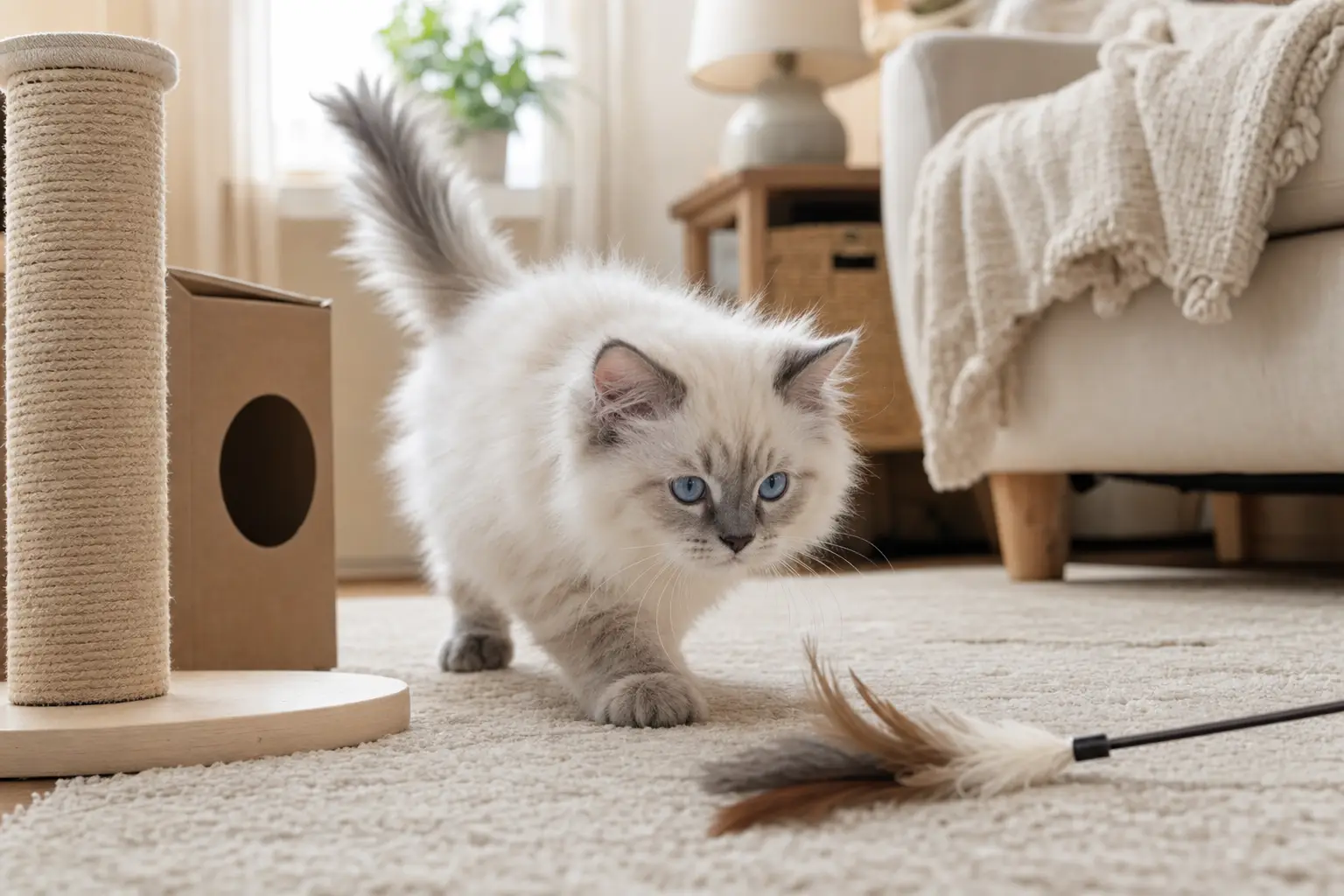
Wand Toy Routine for Ragdoll Kittens: 10 Gentle Upgrades
Quick answer: The best wand toy routine for Ragdoll kittens is short, predictable, mostly floor-level, and built around giving the kitten a chance to stalk, pounce, catch, and settle. In a small living room, thoughtful toy movement matters more than having a large amount of open space.
You do not need to turn the room into an obstacle course. Clear a safe route, use a stable surface for landings, move the toy like realistic prey, and stop while your kitten is still enjoying the game. Start with one or two brief sessions and adjust the length to your kitten’s age, energy, coordination, and interest.
Ragdolls are often described as relaxed cats, but breed descriptions cannot predict an individual kitten’s play style. Some want a lively chase; others prefer a slow ambush from behind a chair. The routine below is designed to be flexible rather than based on the assumption that every Ragdoll kitten behaves the same way.
What makes a wand-toy routine gentle?
Gentle play is not passive play. It gives a kitten room to make choices without forcing repeated jumps, using your hands as targets, or keeping the toy just out of reach indefinitely. A useful session has a beginning, a middle, and an end:
- Beginning: invite attention with a quiet cue and low, easy movements.
- Middle: alternate stalking, chasing, pouncing, and pauses.
- End: allow a real catch, then put the toy away and offer a calm transition.
This pattern supports both physical movement and mental engagement while keeping the living room manageable.
10 gentle upgrades for your routine
1. Create a clear three-step route
Before picking up the wand, remove breakable objects, loose cords, unstable decorations, and anything with a sharp edge. Then identify three safe areas: a starting point, a stalking area, and a landing or catching area.
The route can be as simple as rug to sofa edge to a low cardboard box. A small room works well when the toy travels around existing features instead of asking the kitten to sprint across the entire floor. Keep pathways open and make sure furniture will not slide when a kitten pushes off.
2. Add a quiet start cue
Choose a consistent cue such as placing the wand on the floor and saying, “Ready?” in a calm voice. Wait a moment before moving it. This gives your kitten a chance to orient toward the toy rather than being surprised by a sudden sweep.
A start cue also helps separate interactive play from random movement around the room. If your kitten walks away, do not follow with the wand. That is useful information: try again later, change the toy, or shorten the session.
3. Make the toy behave like prey
Many kittens respond better to a toy that pauses, hides, and changes direction than to one that is waved constantly in the air. Pull it slowly along the edge of a rug, let it disappear behind a box, pause, and then make a short escape movement.
Vary the pace without creating frantic motion. A gentle scrape, a pause, and a brief dash often give the kitten more opportunity to watch and decide when to pounce. Keep the wand away from your hands and feet so the game does not teach your kitten to attack people.
4. Keep jumping optional
Growing kittens are still developing coordination. A wand toy does not need to be held high to provide good exercise. Spend most of the session at floor level, with occasional low movements onto a sturdy cushion or cat tree platform if your kitten chooses to climb.
Do not repeatedly pull the toy upward to make a kitten leap, especially on slippery flooring or near furniture edges. Place a washable runner or rug along the main route if the floor is slick. The goal is confident movement, not the highest jump.
5. Let your kitten win regularly
A chase that never ends can become frustrating. Every few passes, slow the toy down and let your kitten catch it with both paws. Keep the wand still for a moment while the kitten investigates, bats, or bites the toy portion.
You can then release it and begin another round, or make that catch the end of the session. Allowing a successful capture makes the game feel complete and gives you a natural stopping point.
6. Match the session to the kitten in front of you
There is no universal perfect play length. One kitten may be ready for several short bursts; another may lose interest after a few minutes. Watch the quality of movement rather than trying to reach a fixed number of minutes.
Good signs include following the toy, pausing to watch, pouncing with control, and returning after a brief break. Stop or slow down if your kitten begins hiding, flattening the ears, lashing the tail, biting abruptly, or avoiding the toy. A single signal can have several meanings, so consider the whole body and the context.
7. Divide the room into three mini-games
Instead of repeating one long chase, use a simple circuit:
- Peek: move the toy behind a box, cushion, or the safe side of a sofa.
- Pounce: bring it into an open floor area for a short chase and catch.
- Climb or stretch: invite a low reach toward a stable scratching post or platform, only if your kitten wants to participate.
Return to the first zone after a pause. This variation makes a small room feel more interesting without adding more equipment or encouraging wild leaps.
8. Attach play to a realistic daily rhythm
Choose times when your household can be consistent, such as before a meal or after a nap. A predictable invitation is more useful than an ambitious schedule that is difficult to maintain.
After a successful catch, many cats appreciate a quiet transition: fresh water, a meal if that fits your feeding plan, gentle grooming, or a comfortable resting place. This is not a rule that every kitten must follow, but it can help the room move from excitement to rest.
9. Rotate toys, but inspect them every time
Keep a small selection available rather than leaving every toy on the floor. Rotating different textures and shapes can make familiar play feel less repetitive. You might use a feather attachment one day and a fabric mouse attachment another day.
Check for loose feathers, torn fabric, exposed wire, cracked plastic, or detached bells before each session. Store wand toys in a closed drawer or container when play is over. Strings, ribbons, and similar linear pieces can be dangerous if swallowed, so they should only be used with direct supervision.
10. Build in a calm finish
End with a catch instead of abruptly pulling the toy away at peak excitement. Hold the toy still, let your kitten release it, and then put the wand out of sight. Offer a quiet resting area rather than immediately starting another stimulating game.
Take a quick mental note of what worked: floor-level movement, a particular hiding place, a slower pace, or a certain attachment. That observation is more useful than trying to make every session identical. Over time, you can create a routine that suits your kitten and your room.
A practical small-living-room example
The following is a flexible template, not a prescription. Shorten it if your kitten loses interest and repeat the catch-and-rest pattern rather than pushing through fatigue.
| Stage | What to do | Why it helps |
|---|---|---|
| Set up | Clear the route and place a rug, box, or stable scratcher nearby. | Improves traction and gives the kitten safe choices. |
| Warm-up | Drag the toy slowly along the floor, with pauses. | Lets the kitten watch, orient, and decide whether to engage. |
| Chase | Use two or three short escapes around the box or sofa edge. | Adds movement without requiring a long sprint. |
| Catch | Stop the toy and let the kitten grab it. | Provides a satisfying finish to the chase. |
| Settle | Put the wand away and allow quiet time. | Creates a clear boundary between play and rest. |
Wand-toy safety in a home with a kitten
Interactive toys are safest when a person is actively supervising. Never leave a wand, string, ribbon, elastic, or feather attachment where a kitten can chew it alone. If part of a linear toy is swallowed, or if you see string coming from the mouth or rear, do not pull it. Contact a veterinarian promptly for advice.
Stop play if your kitten appears painful, develops a limp, has trouble breathing, or cannot settle after stopping. A sudden change in interest in play can also deserve veterinary attention, particularly when it appears with poor appetite, vomiting, diarrhea, unusual tiredness, or hiding. Play should be enjoyable; it should not be used to push through signs of illness or discomfort.
For broader guidance on creating a cat-friendly home, see the AAFP and ISFM Feline Environmental Needs Guidelines. For information about the risks of swallowed string and similar objects, review this veterinary overview of linear foreign bodies in cats.
Frequently asked questions
How long should a Ragdoll kitten play with a wand toy?
Begin with a brief session and stop while your kitten is still engaged, rather than aiming for a rigid duration. Several short sessions may suit a kitten better than one long workout. Let your kitten’s movement, interest, and ability to settle guide the routine.
What if my kitten ignores the wand?
Try a slower movement, a quieter time of day, or a different attachment. Some kittens prefer a toy that stays near the floor and disappears behind an object. If a kitten who normally plays suddenly loses interest along with other changes in behavior or health, contact your veterinarian.
Can I leave the wand toy out between sessions?
No. Store wand toys and any toy with string, ribbon, elastic, feathers, or small detachable parts when you are not supervising. Leaving out a simple, purpose-made toy without loose parts may be appropriate, but inspect it regularly and follow the manufacturer’s safety guidance.
With a clear route, realistic toy movement, regular catches, and a calm finish, even a compact living room can become a rewarding play space. The most successful routine is the one your kitten enjoys and your household can repeat safely.
Ready to make your kitten’s space more comfortable? Explore more practical kitten-care ideas and Ragdoll resources at CTkittens.com.

Rachel Cohen is a journalist and producer with a passion for audio storytelling, health and science reporting, and feline companions.
A graduate of Middlebury College, Rachel spends her weekends exploring the mountains and when she isn’t outdoors or chasing a story, she can usually be found hanging out with her cats.
Only bit I’d push back on is ending while they’re still hyped, cuz my kitten needs one last boring lil “dead prey” catch or dude starts hunting my ankles instead lol.
Ngl the “let them win” bit explains why my kitten gets salty and walks off when I keep yoinking the toy away, gonna fix that lol.
Low-key the “let them win” tip fixed my kitten’s whole vibe, turns out endless chasing was just making the lil dude mad lol.
The catch-and-settle bit lowkey shows a bigger pet-care truth, giving animals some choice usually work way better than forcing em into our idea of “exercise.”
Anyone else notice their kitten gets way less bitey after you let em actually catch the wand instead of teasing forever, cuz mine chills out sooo much faster lol?
Only bit I’d push back on is the “put it away after a catch” thing, cuz my kitten needs like three fake endings before she’s actually done lol.
Only thing I’d tweak is the pre-meal timing, my kitten gets way too feral when hungry so post-nap play works heaps better lol.