
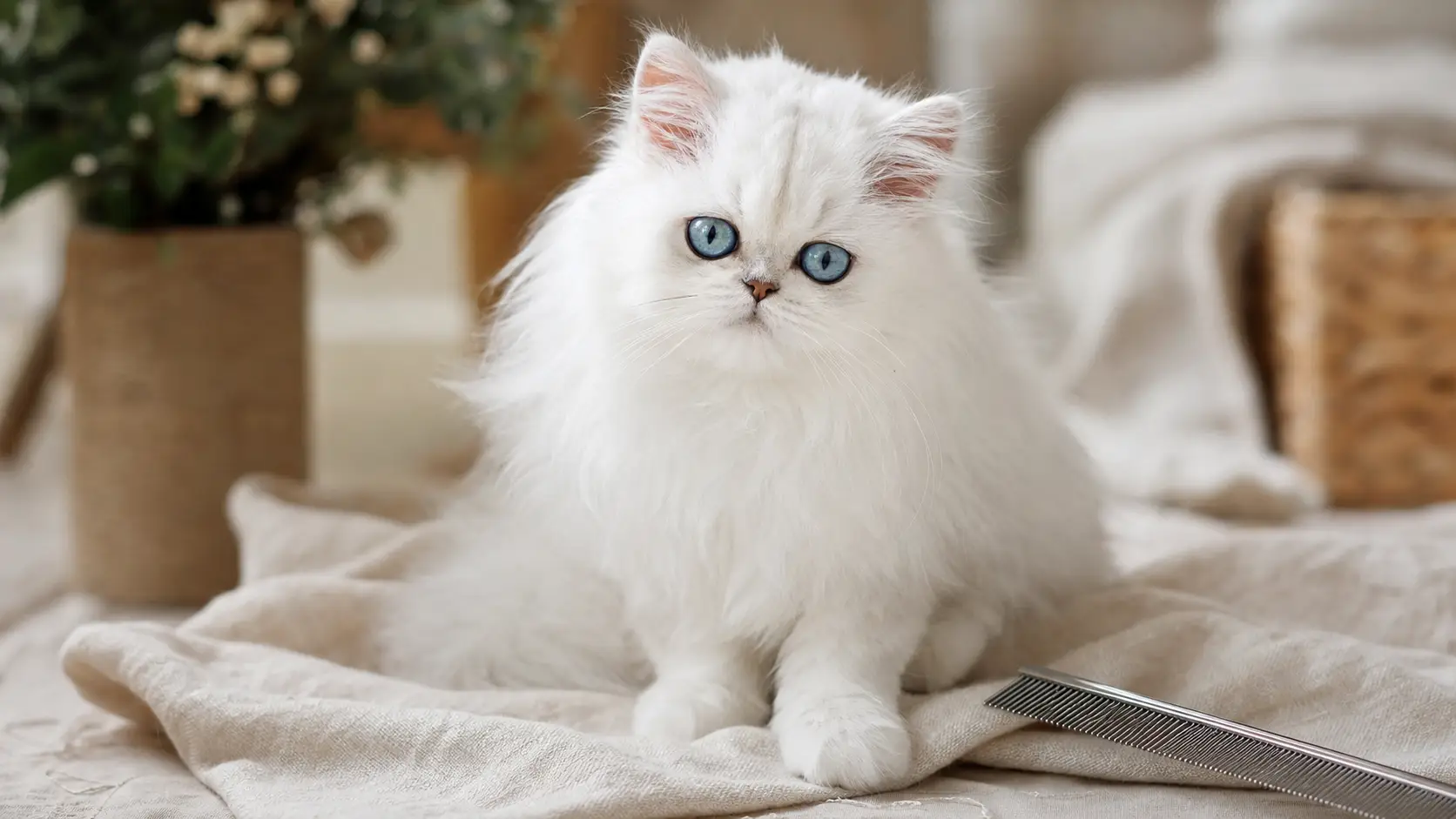
For family photos, Persian cat chest ruff grooming is usually a small finishing job rather than a last-minute makeover. Use your fingers to find loose tangles, work in small sections with a gentle brush and comb, and stop before your cat becomes frustrated. A short touch-up can leave the ruff smooth and full while keeping the experience comfortable for your Persian kitten or adult cat.
The best results come from grooming before photo day, not trying to solve a serious mat moments before the camera arrives. If the coat is tightly tangled, painful, damp, or stuck close to the skin, skip the scissors and ask a professional groomer or veterinarian for help.
Why a Persian cat’s chest ruff needs special care
The chest ruff is the long, soft hair that frames the face and front of the body. It is one of the most visible parts of a Persian’s coat, but it can also be easy to overlook during a quick brushing session. Hair around the neck and chest moves as a cat walks, turns, eats, and grooms. Friction and loose shed hair can allow small tangles to develop beneath the surface.
A fluffy-looking ruff is not necessarily a tangle-free ruff. The outer hairs may look smooth while a knot is forming nearer the skin. That is why a comb is useful after brushing: it helps you check whether you have reached through the coat instead of only smoothing the top layer.
Persian kittens may also have coats that change as they mature. Their hair can be softer, uneven, or less predictable than an adult coat. Keep kitten sessions brief and positive rather than expecting a perfectly styled ruff every time.
What to gather before you start
You do not need a large collection of grooming products for a family portrait. A few simple tools are enough:
- A stainless-steel comb: Choose a smooth, wide-toothed comb for checking the ruff gently down to the skin.
- A soft slicker brush: Use light strokes to lift loose hair and tidy the surface. Do not press the pins into the skin.
- Your fingers: Fingers are often the safest first tool for separating a small knot and locating a mat.
- Small treats or a favorite toy: These help your cat associate handling with something pleasant.
- A stable, nonslip surface: A towel on the floor or a secure table can help your cat feel balanced.
If you use a detangling product, choose one made specifically for cats and follow its label. Avoid human hair products, essential oils, and anything strongly fragranced. Cats may lick product from their coat, and a product that is suitable for people is not automatically suitable for cats.
How to brush a Persian cat’s chest ruff
Choose a quiet time when your cat is relaxed but not deeply asleep. Keep the first session short, especially if your Persian kitten is still learning to accept grooming.
- Let your cat settle. Sit beside your cat and offer a few gentle strokes before bringing out the brush. Keep paws on a secure surface, and never hold or suspend a cat by the scruff.
- Inspect with your fingers. Separate the ruff into small sections. Feel for knots, damp areas, crusts, or skin that seems sore. If your cat reacts sharply to one spot, do not keep working over it.
- Start at the ends. Hold the hair above a loose tangle so your hand, rather than your cat’s skin, absorbs any movement. Use your fingers or a comb on the ends first, then gradually work upward. Avoid pulling from the skin outward in one forceful stroke.
- Work in narrow sections. Lift a small layer of hair and brush outward from the base toward the tips. This line-brushing approach is slower than sweeping over the entire ruff, but it is more likely to reach hidden tangles without repeated tugging.
- Use the comb as a check. Once a section looks smooth, pass the comb gently through it. If the comb catches, return to the ends and loosen that area rather than pulling harder.
- Handle the chin area carefully. If your cat willingly lifts the head, you can brush the hair under the chin with short, outward strokes. Never press a tool against the throat, force the head upward, or continue if your cat is trying to pull away.
- Finish with a light surface pass. A few gentle brush strokes can arrange the ruff for the camera. Stop while your cat is still calm so the next grooming session remains easier.
Do not keep brushing the same spot simply because it does not look perfectly symmetrical. Natural coat movement usually photographs better than a flattened or overworked ruff, and excessive brushing can irritate the skin.
A practical photo-day grooming plan
A little scheduling removes much of the pressure. This simple plan works for many cats, but your cat’s tolerance should determine the timing.
| When | What to do |
|---|---|
| Two or three days before | Try a calm grooming session and deal with small tangles while there is still time to seek help if needed. |
| The day before | Do your cat’s normal coat care. Avoid experimenting with a new brush, bath, spray, or styling routine. |
| Photo day | Give the chest ruff a brief inspection and touch-up. A few minutes is usually better than a full grooming session. |
A bath is not necessary just because photos are planned. Bathing can be useful when a coat is genuinely dirty, but it should be part of a familiar grooming routine. Introducing water, shampoo, and blow-drying immediately before a photo session may leave a cat anxious or unwilling to participate. If a bath is part of your Persian’s normal care, brush out tangles as directed by your groomer before bathing, since water can make existing mats harder to manage.
Keeping the family photo session comfortable
The most photogenic Persian is usually the one that feels safe. Set up the background, camera, and lighting before bringing your cat into the room. Soft window light often creates a natural look and avoids the startling effect of a sudden bright flash. Keep the room comfortably cool, especially for a flat-faced cat or any cat that becomes warm or breathless easily.
- Let your cat choose whether to sit, stand, or move between shots.
- Use treats placed near the camera rather than holding the cat’s head in position.
- Keep children calm and give the cat an easy route to leave.
- Take several short sets of photos instead of demanding one long session.
- Use your hand to arrange the ruff between shots, rather than repeatedly brushing it.
- If your cat wears a collar, remove it only in a secure indoor setting and replace it afterward.
Watch for signals that your cat needs a break: tail lashing, flattened or sideways ears, repeated attempts to leave, growling, skin twitching, or sudden agitation. Stop before those signals become a struggle. Open-mouth breathing, heavy breathing, weakness, or severe distress calls for immediate rest and, when appropriate, veterinary advice.
When not to remove a chest mat at home
A small, loose knot may separate with patient finger work. A dense mat is different. If a comb cannot pass through the area, the mat feels firm against the skin, or your cat cries, bites, or repeatedly jerks away, do not force it.
Never cut a mat close to the skin with household scissors. Cat skin can be pulled up into a mat, making it easy to cut accidentally. A professional groomer can assess whether careful clipping is appropriate, while a veterinarian should be involved if the skin is red, wounded, infected, painful, or if your cat suddenly stops grooming normally.
Do not try to disguise a serious coat problem for photographs. A calm cat with a slightly uneven ruff is a better family memory than a polished-looking cat that has been frightened or hurt.
Common mistakes to avoid
- Waiting until the camera is ready: Last-minute grooming encourages rushing and pulling.
- Brushing only the visible surface: Hidden tangles often sit closer to the skin.
- Using more pressure when a tool catches: A catch is a signal to change your approach, not pull harder.
- Holding the cat tightly: Restraint can turn ordinary grooming into a frightening event.
- Using human styling products: Cats can ingest residue while grooming themselves.
- Chasing perfect symmetry: A natural, relaxed ruff usually looks better than an over-brushed one.
FAQ
Should I brush my Persian cat immediately before family photos?
Yes, if your cat already accepts grooming. Make it a short touch-up rather than a deep session. Check for tangles, comb through the ends, and use a few light strokes to arrange the ruff. If grooming makes your cat restless, stop and photograph the coat naturally.
How often should a Persian cat’s chest ruff be brushed?
Many Persian cats need frequent, sometimes daily, coat checks because their long hair can tangle quickly. The right schedule depends on coat density, length, activity, and how well your cat tolerates grooming. A quick daily check is often more comfortable than waiting for a large mat to form.
Can I use a regular human hairbrush?
A human brush may smooth the surface without reaching the coat underneath, and some brushes are not designed for a cat’s skin. A cat-appropriate slicker brush and a smooth metal comb give you better control. Use light pressure and inspect the skin regularly.
What should I do if my kitten will not sit still?
Break grooming into tiny sessions. Touch the chest, offer a treat, make one or two strokes, and stop. Repeat later. Young kittens do not need to tolerate a long styling session immediately; predictable, gentle practice is more useful than holding them still until they become upset.
Reliable grooming guidance
For broader coat-care and handling information, review the ASPCA cat-grooming guidance and International Cat Care’s advice on grooming cats. This article is general grooming information, not a diagnosis or substitute for veterinary care.
With regular, gentle maintenance, your Persian’s chest ruff can be ready for family photos without turning photo day into a grooming battle. For more Persian kitten care tips and helpful guidance for welcoming a cat into your home, explore CTkittens.com.

Rachel Cohen is a journalist and producer with a passion for audio storytelling, health and science reporting, and feline companions.
A graduate of Middlebury College, Rachel spends her weekends exploring the mountains and when she isn’t outdoors or chasing a story, she can usually be found hanging out with her cats.


That bit about using the comb as a check after brushing is lowkey the smartest detail, cause fluffy on top dont mean there isnt a sneaky knot underneath.
Only bit I’d push back on is treats by the camera, cuz my Persian would yeet herself at the lens and turn family photo day into a furry crime scene lol.
Ngl, setting up the lights before bringing the cat in is the real pro move, cause no fancy ruff gonna save pics of a Persian thats already plotting their escape.
Kinda wondering if water-bowl dribble makes the chest ruff mat faster, cause my Persian somehow soaks his whole front every dang time he drinks lol?
Anybody else find their Persian actually chills out more when you groom the ruff in tiny sessions days ahead, or is mine just a weird lil diva?
The tip about using the comb as a check after brushing is legit useful, cause fluffy on top dont mean there ain’t a sneaky knot underneath lol.
That tip about using the comb as a check after brushing is legit, fluffy coats can look fine on top while hiding tiny knot gremlins underneath lol.