
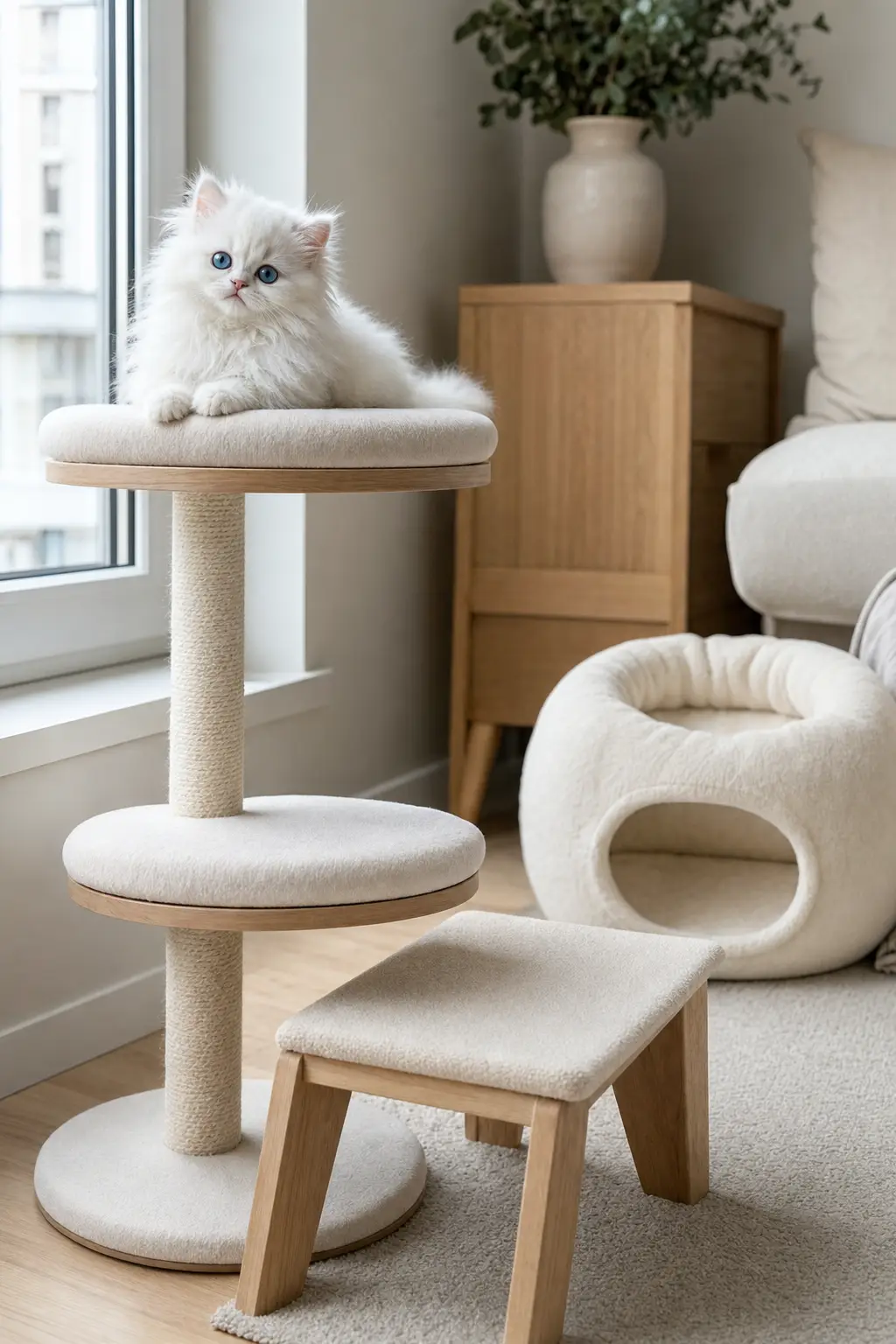
Vertical Space for Persian Kittens Without Permanent Wall Changes
The simplest way to create vertical space for Persian kittens is to stop thinking of it as a wall-installation project. You do not need a gallery of mounted shelves or a towering cat condo. Instead, build a stable, visually calm route using freestanding furniture, broad platforms, and one or two easy steps.
This approach works especially well for Persian kittens because it prioritizes access, comfort, and choice rather than height alone. A kitten can climb, pause, look around, or retreat without having to make a difficult leap. It also gives renters and style-conscious households a practical way to enrich a room without permanent changes.
Why beautiful vertical space can feel difficult
Vertical enrichment sounds straightforward until you consider everything competing for attention: stability, floor space, window safety, cleaning, the kitten’s confidence, and the appearance of the room. A tall cat tree may solve the height problem while creating a new visual problem. A narrow shelf may look elegant but offer too little room for turning or resting. A tension pole may avoid drilling but still wobble if it is poorly fitted or placed on an uneven floor.
Persian kittens add another layer of planning. Every cat is an individual, but Persians are often better served by broad, comfortable platforms and gradual changes in height than by a design based on athletic leaps. Their long coats can also make loose loops, exposed fasteners, rough fabric, and poorly finished edges worth avoiding.
Some Persians have brachycephalic facial anatomy, which can affect breathing or heat tolerance. That does not mean a Persian kitten cannot climb. It does mean the climbing area should be cool, well ventilated, easy to leave, and matched to the individual kitten. If your kitten tires quickly, breathes noisily, struggles in warm rooms, or avoids movement, discuss the behavior with a veterinarian rather than simply adding more climbing challenges.
Think in terms of a route, not a tower
A useful vertical setup has three functions:
- Access: a low step, ramp, or wide base that makes the first move easy.
- Observation: a platform where the kitten can watch the room without being disturbed.
- Retreat: a comfortable place to rest, hide, or move away from household activity.
These functions can be provided by separate pieces. For example, a low upholstered bench can lead to a broad freestanding cat tree, while a nearby covered bed provides a quiet retreat. The pieces do not need to touch. What matters is that the kitten can move between them without a large gap or a high-risk jump.
Start low. Watch how your kitten approaches the setup, where they hesitate, and whether they prefer looking out a window, watching people, or resting in a quieter corner. You can then adjust the route instead of buying a much taller structure immediately.
Renter-friendly ways to add height
| Option | Why it works | What to check |
|---|---|---|
| Wide-base cat tree | Provides several levels in one freestanding unit. | Choose a heavy, broad base and platforms large enough for turning and resting. |
| Modular freestanding cubes | Can be rearranged as the kitten grows or the room changes. | Use only modules designed to connect securely; do not stack loose boxes. |
| Low bench plus pet furniture | Creates a gentle step-up route without dominating the room. | Make sure the bench cannot slide or tip when the kitten jumps onto it. |
| Freestanding window perch | Offers observation without attaching anything to the glass or wall. | Keep it away from hot direct sun and ensure the window itself is secure. |
| Tension-mounted system | Can use unused vertical space without drilling. | Follow the manufacturer’s instructions, inspect it often, and do not assume tension alone makes it fail-proof. |
A suction-cup perch deserves particular caution. Suction can weaken because of dust, temperature changes, condensation, or an imperfect surface. If you use one, treat it as a supplemental option rather than the only elevated resting place. Never place it where a fall could lead to a sharp edge, hot radiator, or open window.
How to make cat furniture look intentional
The most attractive setups usually have one clear visual anchor instead of several unrelated pieces. A single well-proportioned cat tree in a quiet corner often looks better than a collection of small climbing products scattered around the room.
Use a simple design formula
- Choose one anchor: a cat tree, freestanding tower, or stable window unit.
- Add one lower transition: a bench, ottoman, or broad step that makes access easier.
- Repeat one or two materials: for example, light wood with cream fabric or a neutral frame with washable cotton covers.
- Keep the floor visually open: avoid adding several narrow towers that make the room feel crowded.
- Hide supplies nearby: a lidded basket can hold toys, grooming tools, and spare covers without turning the area into a pet-supply display.
Neutral colors are not required, but a consistent palette helps the setup feel like part of the room. More important than color is proportion. A very tall, narrow object can look unstable even when it is not, while a lower unit with generous platforms tends to feel calmer and more useful.
Choose washable surfaces wherever possible. Persian coats can carry loose hair into fabric, and kittens may track litter onto lower platforms. Removable covers, tightly woven upholstery, and smooth areas that can be wiped clean usually make the setup easier to live with than heavily shagged or difficult-to-vacuum materials.
Safety matters more than height
A cat product being marketed as a climbing structure does not guarantee that it is suitable for your particular room or kitten. Before introducing it, check the full route from floor to highest platform.
- Test for wobble: push the structure gently from several directions. It should not rock, twist, or slide.
- Prefer broad platforms: a kitten should have room to stand, turn, and settle without balancing on a narrow ledge.
- Inspect every connection: tighten hardware and replace worn components according to the manufacturer’s instructions.
- Remove entanglement hazards: avoid dangling cords, loose loops, exposed staples, frayed rope, and small detachable parts.
- Keep escape routes open: do not place a tall unit where a kitten could become trapped between furniture, a wall, and a window.
- Protect windows: a perch does not make an open or poorly screened window safe. Use secure screens and keep cords out of reach.
- Watch the landing zone: keep the floor below clear of glass, hard-edged décor, heaters, and unstable objects.
- Introduce it gradually: supervise early exploration and use treats or a favorite toy to create a positive association.
Do not rely on an unsecured bookcase, stacked storage boxes, or a decorative ladder as cat furniture. If a tall item could tip onto a person or animal, follow appropriate anti-tip guidance even if that means the item is no longer completely free of wall attachments. Safety should take priority over a no-drill rule.
A Persian-friendly layout for a small room
Try this three-zone arrangement:
- Place a low, stable step near a room corner. It should be easy to approach and not block a doorway.
- Add a medium-height platform beside it. Choose a wide resting surface rather than a narrow ladder of shelves.
- Position a quiet bed or covered retreat nearby. The kitten should be able to leave the elevated area without crossing a busy walkway.
- Keep food, water, and the litter box separate. A climbing route should not force a cat to pass through a feeding or toileting area.
- Observe before expanding. If the kitten uses the lower levels but ignores the top, that is useful information—not a design failure.
Place the setup where the kitten can see something interesting, such as family activity or a secure window, but not in the loudest part of the home. Avoid direct heat from radiators, fireplaces, vents, and strong afternoon sun. For a Persian kitten, a cool, well-ventilated resting spot may be more valuable than an extra level.
When a lower setup is the better choice
Vertical enrichment is not a competition to reach the ceiling. A kitten recovering from illness, dealing with discomfort, or showing limited confidence may benefit from several low platforms instead of one high tower. Older cats and cats with joint or breathing concerns may also prefer gentle ramps, short steps, and floor-level hiding places.
If your Persian kitten repeatedly slips, lands awkwardly, refuses a route they previously used, or seems distressed after activity, remove the challenge and contact your veterinarian if the change persists. Do not interpret reluctance as stubbornness. It may reflect pain, poor footing, fear, or a health issue.
Frequently asked questions
Do Persian kittens need a tall cat tree?
No. A tall cat tree is one option, not a requirement. A stable arrangement of low and medium platforms may provide more useful enrichment, especially for a kitten that prefers gradual climbs or broad resting surfaces.
Are tension-mounted cat shelves safe without drilling?
They can be appropriate when correctly installed and regularly inspected, but they are not automatically risk-free. Follow the product’s weight and installation limits, check for movement, and use a lower setup if the ceiling, floor, or hardware does not provide a secure fit.
How high should the setup be?
There is no universal height. Base it on your kitten’s confidence, coordination, health, and the stability of the furniture. Begin low and add height only when the kitten uses the route comfortably and safely.
How can I keep a cat tree from looking out of place?
Use one main piece, repeat the room’s colors or materials, and keep accessories limited. A washable neutral cover, a nearby storage basket, and an uncluttered landing area can make cat furniture feel intentional rather than temporary.
The simplest design principle
Beautiful vertical space for Persian kittens comes from thoughtful transitions, not maximum height. Choose stable freestanding pieces, offer broad places to pause, keep the route cool and uncluttered, and let your kitten’s behavior guide the final arrangement. The result can be attractive to people, useful to cats, and easy to change when your home or kitten’s needs change.
For more guidance on welcoming and caring for Persian kittens, explore CTkittens.com.
Further reading
For a broader framework on feline environmental needs—including safe resting places, hiding areas, and opportunities for choice—see the AAFP/ISFM Feline Environmental Needs Guidelines.

Rachel Cohen is a journalist and producer with a passion for audio storytelling, health and science reporting, and feline companions.
A graduate of Middlebury College, Rachel spends her weekends exploring the mountains and when she isn’t outdoors or chasing a story, she can usually be found hanging out with her cats.
Calling ignored top levels “useful information, not a design failure” is such a smart detail, cause too many of us keep upgrading cat furniture like the kitten forgot to read the specs lol.
Ngl the “route, not a tower” idea finally explains why my Persian ignores the top perch but camps on the wide middle bit like she pays rent there.
Gonna try the bench-to-platform route instead of buying another giant cat tree, cuz my fluffy lil dude only uses the bottom half anyway lol.
Never thought of cat furniture as a “route” instead of a tower, but honestly that makes way more sense for fluffy lil Persians who aint exactly doing parkour all day lol.
Honestly the bit about ignoring the unused top level instead of calling it a design fail is lowkey smart, cats be voting with their paws anyway.
Kinda wild how “vertical” enrichment is really about giving the lil fluffball an easy escape route, not just yeeting them toward the ceiling lol.
The bit about checking the whole landing zone for radiators and sharp decor is lowkey the smartest detail here, cause people always test the tower but forget where kitty gonna fall.