
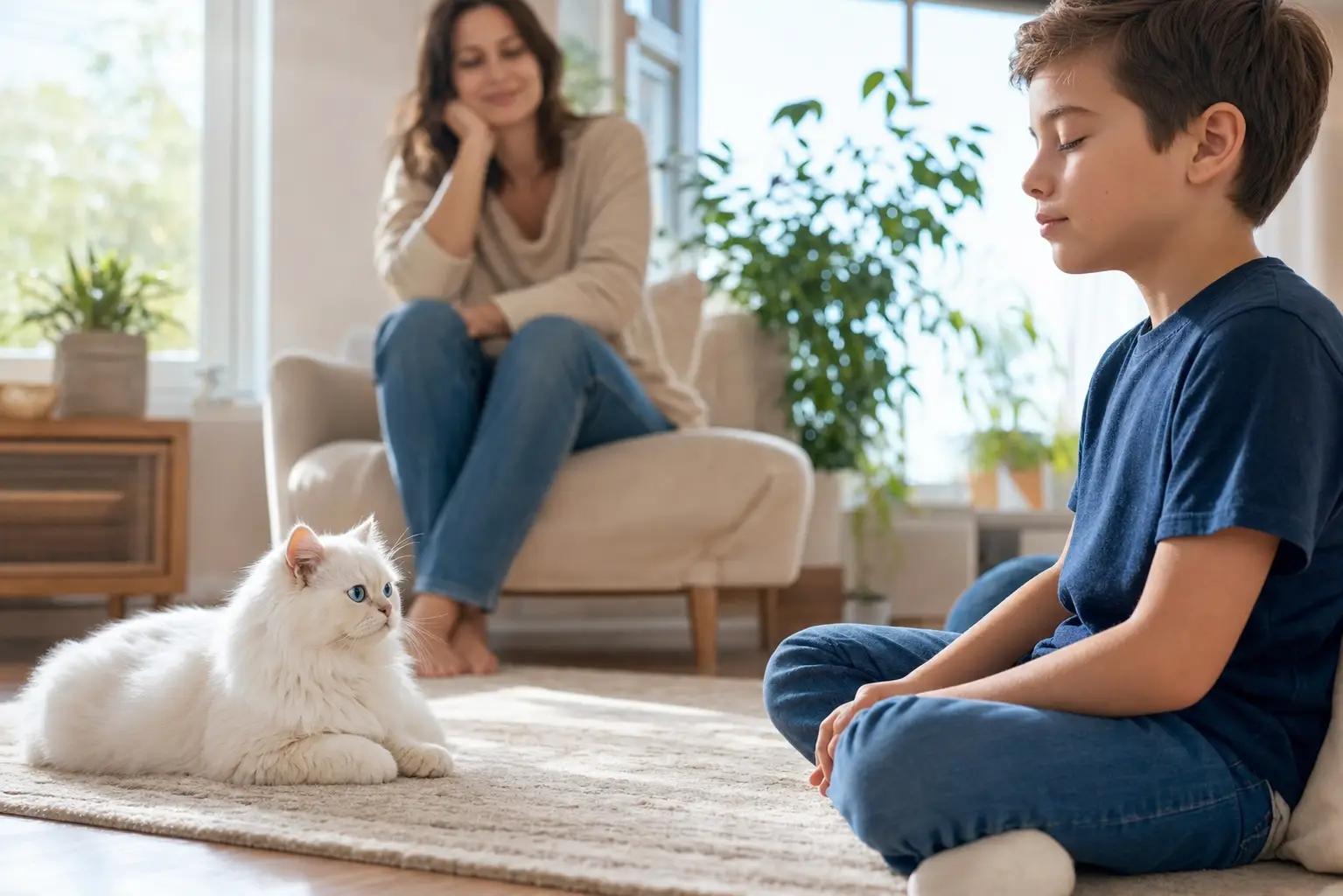
Persian Kittens: Teach a Child the Slow Blink Hello
Short answer: DIY is usually all you need to teach a child the slow blink hello. A mirror, a hand-drawn picture, and a calm adult demonstration can be more useful than an expensive product. Store-bought books, flashcards, or plush toys are optional supports for children who learn best through pictures and role-play.
The goal is not to make a Persian kitten perform on cue. A slow blink is a gentle invitation, not a command. The child offers the greeting, then gives the cat the choice to respond, approach, remain where it is, or walk away.
What the slow blink hello means
Cats often narrow their eyes during relaxed, positive interactions. People commonly describe this as a cat’s way of saying hello. A 2020 study published in Scientific Reports found that cats were more likely to approach a person after the person used slow eye-narrowing movements than after a neutral expression. The cats also responded with similar eye movements.
That research examined cat–human communication, not a child-specific training program. It also does not prove that every cat understands a slow blink in exactly the same way. The most accurate lesson for a child is simple: use a soft gaze, blink slowly once or twice, and never force the cat to interact.
A returned blink can be a pleasant response, but it is not the only one. A relaxed body, neutral ears, a loose tail, staying nearby, or choosing to come closer may also show that the cat is comfortable. If the kitten does nothing, the child has not failed.
How to teach a child the slow blink hello
Begin away from the kitten. Children usually learn this greeting more easily when they can practice the movement without feeling watched or rushed.
- Explain the purpose. Tell the child that a slow blink is a quiet greeting. It is different from staring, which can feel intense to a cat.
- Practice with a mirror. Ask the child to relax the forehead and cheeks, look softly toward their reflection, close both eyes slowly, pause briefly, and open them again.
- Use a relaxed posture. When the kitten is nearby, the child should sit still, turn slightly sideways, and keep a comfortable distance. Looming over the cat can be intimidating.
- Offer one or two slow blinks. The child can look toward the kitten’s face without locking into a hard stare, blink slowly, then glance away.
- Wait instead of moving closer. The cat decides what happens next. It may blink, look away, approach, stay still, or leave.
- End while everyone is calm. A short, successful interaction is better than repeating the exercise until the kitten becomes restless.
Teach the child not to put their face close to the kitten’s face. The slow blink works at a respectful distance. It is also not permission to pick up, hug, kiss, or touch the cat. If the child wants to pet the kitten, an adult can help them offer a hand from the side and pause to see whether the cat chooses contact.
DIY or store-bought: which option is better?
There is no special slow-blink device. The most important tools are patience, supervision, and an understanding of cat body language. Choose DIY materials if you want a low-cost, flexible lesson. Choose a store-bought aid if an illustrated book, plush animal, or child-friendly card set will make the idea easier to understand.
| Approach | Useful options | Best for |
|---|---|---|
| DIY | A mirror, a hand-drawn three-step card, a paper cat face, or a stuffed animal for role-play | Families who want a simple lesson without buying anything |
| Store-bought | An illustrated cat body-language book, age-appropriate flashcards, or a washable plush cat | Children who respond well to visual examples or pretend play |
A simple DIY teaching card
Draw three pictures on an index card:
- A child sitting quietly with a soft face.
- Eyes closing slowly for one gentle blink.
- The child looking away and waiting.
Add a fourth picture showing a cat walking away with the words Let the cat go. This is a valuable part of the lesson. Children can learn that respecting a boundary is a successful response, even when it does not produce a visible blink.
What to look for in a store-bought aid
Choose materials that show calm, realistic interactions rather than cartoons of children restraining cats. Good resources should explain several signals, not treat one eye movement as a universal translation tool. A book or card set should also show that cats need space when they are eating, sleeping, hiding, or using the litter tray.
Avoid products that promise to translate cat thoughts, flash lights into a cat’s face, create loud signals, or encourage forced eye contact. They are unnecessary for this skill and may make a kitten uncomfortable.
Tips that are especially useful with Persian kittens
Persian kittens are individuals, and breed does not guarantee a particular personality. Some are outgoing; others prefer quiet observation. A kitten’s early socialization, health, previous handling, and current mood matter more than a breed label when deciding how much interaction is appropriate.
Persian cats also have long coats and, depending on their individual facial structure, facial features that can make subtle expressions harder for a child to interpret. Teach the child to read the whole cat rather than concentrating only on the eyes.
Before offering a slow blink, look for signs that the kitten is settled:
- The body is loose rather than crouched or tense.
- The ears are in a neutral position, not pinned tightly back.
- The tail is relatively still rather than whipping from side to side.
- The kitten can move away freely and is not trapped in a corner, carrier, or bed.
If the kitten turns its head sharply, flattens its ears, crouches, hisses, growls, swats, or repeatedly lashes its tail, the child should stop looking toward the cat and give it space. Facial discharge, obvious eye discomfort, or difficult breathing is a health matter rather than a communication challenge and should be discussed with a veterinarian.
Make safety part of the lesson
School-age children can learn excellent cat manners, but an adult should supervise kitten interactions. Young cats can scratch or bite during play, and children may not notice early signs of overstimulation.
- Do not allow chasing, grabbing, tail-pulling, rough play, or forced cuddling.
- Keep hands away from the kitten’s mouth during play. Use an appropriate toy instead.
- Do not disturb the kitten while it is sleeping, eating, hiding, or using the litter tray.
- Give the kitten a child-free retreat with food, water, bedding, and a way to leave.
- Wash hands after handling the kitten and before eating, especially after contact with litter or food bowls.
- If the child is scratched or bitten, wash the area with soap and running water and ask a healthcare professional for advice if the wound is deep, becomes red or swollen, or causes concern.
Never punish a kitten for hissing, hiding, or walking away. Those signals are useful warnings. An adult can calmly separate the child and cat, then try again another day with more distance and less pressure.
A five-minute slow-blink lesson
This short routine works with either a DIY card or a store-bought book:
- One minute: Review the three rules: sit still, blink softly, and let the cat choose.
- One minute: Practice the blink in a mirror or with a plush toy.
- One minute: Watch the kitten from a distance without touching it. Ask the child to describe whether the body looks relaxed.
- One minute: Offer one slow blink, then look away and wait.
- One minute: Talk about what happened. The child can identify whether the kitten stayed, blinked, approached, or chose to leave.
Reward the child for waiting, noticing signals, and stopping appropriately—not for making the kitten respond. If a cat is allowed treats, an adult can offer a small, suitable reward after calm behavior, but food is not required to teach the greeting.
Frequently asked questions
Does every Persian kitten slow blink back?
No. A kitten may be relaxed without returning the movement, or it may simply be distracted, sleepy, or unfamiliar with the child. The absence of a blink is not automatically a sign of dislike.
Can a child teach a kitten to slow blink on command?
Not reliably. A child can model a calm greeting and create conditions in which the kitten may respond. The kitten remains free to choose whether to engage.
Do we need to buy a special product?
No. A mirror and a homemade picture card are enough. A store-bought book or plush toy is useful only if it helps the child understand gentle behavior and cat consent.
Sources and further reading
For the research behind the slow blink, see The role of cat eye narrowing movements in cat–human communication in Scientific Reports. For broader guidance on reading feline signals, consult International Cat Care’s cat body-language guidance. General information about safe interactions and hygiene around pets is available from the U.S. Centers for Disease Control and Prevention.
Ready to learn more about life with a Persian kitten? Explore CTkittens.com for more helpful kitten-care guidance.

Rachel Cohen is a journalist and producer with a passion for audio storytelling, health and science reporting, and feline companions.
A graduate of Middlebury College, Rachel spends her weekends exploring the mountains and when she isn’t outdoors or chasing a story, she can usually be found hanging out with her cats.
That fourth “let the cat go” picture is lowkey the smartest bit, since kids gotta learn that walking away counts as an answer too.
That “let the cat go” panel on the DIY card is lowkey the smartest bit, kids gotta learn that respecting a nope still counts as success.
Honestly, teaching kids that the kitten walking away still counts as a successful interaction is kinda huge, cause thats basically consent explained without making it weird.
That little “Let the cat go” picture on the DIY card is honestly the smartest bit, cuz kids gotta learn walking away still counts as a good interaction.
That “Let the cat go” fourth picture is lowkey the smartest detail here, cause kids gotta learn walking away counts as a good interaction too.
The bit about praising the kid for waiting instead of getting a blink back is lowkey the smartest part, cause it teaches consent without making it all preachy.
Kinda love that “the cat walking away” counts as a win here, coz teaching kids consent through kitten body language is honestly bigger than the slow blink itself.