
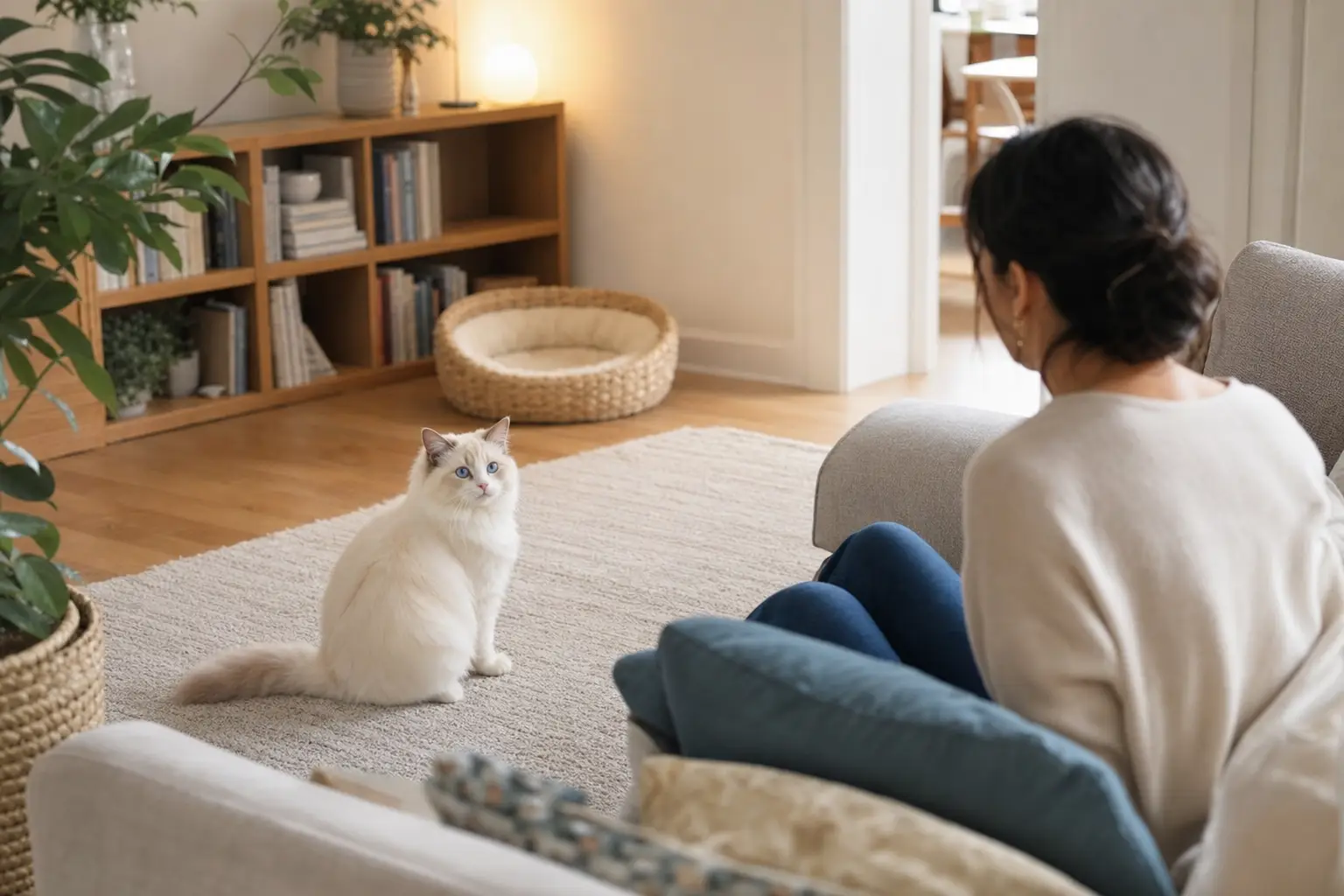
Ragdoll Kitten Body Language Around New Visitors
When a Ragdoll kitten keeps a loose, natural tail while a new visitor enters the room, that is usually an encouraging sign. It may mean the kitten is calm enough to observe rather than preparing to flee. But a relaxed tail is not a complete message by itself. The most reliable reading comes from the tail, ears, eyes, posture, movement, and the kitten’s ability to choose distance.
That distinction matters because the goal is not to make a kitten tolerate being approached. The goal is to help the kitten feel secure enough to decide what happens next. For many families, progress looks less like a dramatic cuddle and more like a tail that stays loose, a kitten that remains in the room, or a cautious sniff from across the rug.
A small-wins story about one relaxed tail
The following is an illustrative family example, not a reported case. It reflects the kind of gradual progress many kitten households may see.
When the fictional Harper family brought home their Ragdoll kitten, Nori, she disappeared behind a chair whenever someone unfamiliar visited. The family initially watched for a friendly approach, but that made each visit feel like a test. If Nori did not come out, they assumed she was frightened. If she did appear, they were tempted to reach toward her too quickly.
They changed the question from Will Nori greet the visitor? to Can Nori stay comfortable while the visitor is here? During one quiet afternoon, Nori remained beneath the edge of the sofa while a guest sat sideways and looked away. Her tail rested loosely beside her rather than being tucked tightly under her body or puffed up. She did not approach, but she also did not run.
That was the first small win. On later visits, Nori watched from the doorway, then accepted a treat placed several feet away from the guest. Eventually, she walked closer on her own. The family did not turn every appearance into a petting session. By protecting those early choices, they gave Nori a reason to remain curious.
The lesson is simple: a relaxed tail can mark a useful pause in the process. It says, in effect, that the kitten may be coping well enough to keep learning. It does not necessarily mean the kitten is ready to be picked up or touched.
What does a relaxed kitten tail look like?
A comfortable tail generally looks loose rather than rigid. It may rest on the floor, curve naturally beside the body, or point upward when the kitten is moving toward someone. The tail should not look tightly clamped, dramatically puffed, or driven by fast, forceful swishes.
Tail position can offer clues, but context changes the meaning. A kitten may gently move the tip while concentrating on a sound or watching a visitor. That is not automatically a sign of fear. The same movement during an overstimulating petting session may mean the kitten needs a break.
| Tail signal | What it may suggest | Helpful response |
|---|---|---|
| Loose and naturally positioned | Calm observation or reasonable comfort | Keep the room quiet and let the kitten choose distance |
| Upright with a soft curve | Interest, social confidence, or a friendly approach | Allow a voluntary greeting; avoid reaching over the head |
| Low, tightly tucked, or held close | Uncertainty, fear, or a wish to become less noticeable | Increase distance and remove social pressure |
| Puffed or bottle-brush shaped | Strong arousal, alarm, or a defensive response | Stop the approach and provide a quiet escape route |
| Fast lashing or sharp thumping | Agitation, frustration, or overstimulation | Pause interaction and give the kitten time alone |
A kitten’s tail can also move during play, hunting-style concentration, or excitement. A single tail gesture should never be treated as a diagnosis of mood. Look for a pattern that lasts across several moments.
Read the whole kitten, not just the tail
Good Ragdoll kitten body language interpretation is a whole-body exercise. A tail that looks relaxed is more reassuring when the rest of the kitten supports that impression.
- Body posture: A kitten who sits, lies down, grooms, or stretches normally may be coping better than one who stays rigid and ready to bolt.
- Ears: Neutral ears that move naturally are different from ears flattened tightly to the head.
- Eyes: Soft, ordinary observation is different from a fixed stare with very wide pupils. Lighting and excitement can also affect pupil size, so do not interpret the eyes alone.
- Whiskers: A natural position is generally less concerning than whiskers pulled sharply back or pressed close to the face.
- Weight and movement: A kitten who can turn away, retreat, or approach is showing choice. A frozen kitten may need more space even if the tail is not dramatic.
- Recovery: After a visitor shifts in a chair, does the kitten settle again, or does it hide for a long time? Recovery is useful information.
For a broader overview, the ASPCA guide to cat body language offers general feline signals. Breed does not replace observation: Ragdolls can be social, reserved, playful, or cautious, and the same kitten may respond differently depending on the person, room, and day.
How to help a Ragdoll kitten feel safe around visitors
Visitors do not need to win a kitten over. They need to become predictable and nonthreatening. These steps turn a meeting into a series of low-pressure choices.
1. Prepare a real escape option
Before the guest arrives, make sure the kitten can reach a familiar safe area. This might be a quiet room, a covered bed, a cat tree, or a space behind a baby gate. The area should not become a trap. The kitten needs to be able to leave the social space without being followed.
Keep food, water, bedding, and a litter box arranged so the kitten does not have to pass directly beside the visitor to meet basic needs. A calm layout reduces the pressure of the encounter.
2. Ask the visitor to ignore the kitten at first
The most helpful greeting can be no greeting. Ask the visitor to sit down, turn slightly sideways, keep their voice low, and avoid staring. Direct eye contact, reaching overhead, or leaning over a small kitten can feel intense even when the person means well.
Let the kitten notice the visitor without being called repeatedly. If the kitten stays in the room with a loose tail, that is already useful exposure.
3. Reward choice, not bravery
A treat can be placed on the floor at a comfortable distance. It should not be used to pull the kitten into an unwanted interaction. If the kitten takes the treat and retreats, that is still information and can still be part of a positive experience.
Some kittens prefer a quiet play session with a wand toy. Keep the toy away from the visitor’s hands and stop while the kitten is still engaged. Short, successful sessions are generally easier to repeat than long sessions that end in hiding.
4. Let the kitten control contact
If the kitten approaches and sniffs, the visitor can keep their hand low and still. Avoid following the kitten if it turns away. A brief cheek or chin touch may be welcome, but the person should pause after one or two strokes and see whether the kitten asks for more.
Never assume that a Ragdoll kitten wants to be held simply because the breed is often described as relaxed. Individual cats vary, and a kitten that becomes still in someone’s arms may be frightened rather than content. Support the body properly and stop if the kitten struggles, stiffens, vocalizes, or tries to escape.
5. End on a quiet success
Do not wait for a perfect greeting. Finish while the kitten is still comfortable: after it watches calmly, accepts a treat, plays briefly, or rests with a loose tail. Repeated small wins teach the kitten that visitors arrive, nothing forces contact, and the safe parts of the routine remain available.
What progress may look like
Families sometimes measure progress too narrowly. A kitten does not need to sit in a stranger’s lap for the visit to go well. More realistic milestones include:
- hiding for ten minutes instead of the entire visit;
- watching from an open doorway;
- eating a treat while the visitor remains seated;
- keeping the tail loose after a person stands up;
- approaching to sniff, then leaving without panic;
- returning to normal play, grooming, or sleep after the guest leaves.
Keep a short note after each visit: who came, how close they sat, what the tail and ears did, and how quickly the kitten recovered. This prevents one difficult meeting from overshadowing a month of improvement. It also helps the family identify patterns, such as a kitten coping well with one quiet guest but becoming overwhelmed by several people at once.
When a tail change deserves veterinary attention
Behavior around visitors is often shaped by experience and temperament, but sudden changes should not automatically be treated as a training issue. Contact a veterinarian if the tail becomes limp, swollen, painful, or unusually sensitive; if there is a visible wound; or if the kitten also shows changes in walking, appetite, toileting, sleep, or energy.
A kitten that remains fearful despite careful distance and predictable routines may benefit from guidance from a veterinarian or qualified feline behavior professional. The aim is to understand the cause, rule out health problems, and create a plan that does not rely on forcing interaction.
Frequently asked questions
Does a relaxed tail mean my Ragdoll kitten wants to be petted?
Not necessarily. It usually means the kitten may be reasonably comfortable in that moment, but the kitten’s approach, posture, ears, and response to a brief pause should guide touch. A relaxed tail is permission to observe, not automatic permission to handle.
Why does my kitten’s tail move at the tip around visitors?
A small tip movement can reflect attention, excitement, play, or mild uncertainty. Consider what the rest of the body is doing and whether the movement becomes faster or more forceful when the visitor gets closer.
Should visitors offer treats from their hands?
Not at first. Placing a treat on the floor gives the kitten more control and avoids pressure from an unfamiliar hand. Hand-feeding can come later if the kitten consistently approaches and remains loose and comfortable.
How long should it take for a Ragdoll kitten to accept visitors?
There is no reliable timetable. Age, early socialization, previous experiences, the number of visitors, and the home environment all matter. Measure the kitten against its own earlier responses rather than against another Ragdoll.
A relaxed tail is a quiet signal, and quiet signals are worth respecting. When a family notices that small sign, protects the kitten’s escape route, and lets trust build at the kitten’s pace, a visitor can become part of a safe routine rather than a stressful event.
Ready to learn more about life with a Ragdoll? Explore CTkittens.com for more practical guidance on welcoming, understanding, and caring for these gentle-looking but wonderfully individual cats.

Rachel Cohen is a journalist and producer with a passion for audio storytelling, health and science reporting, and feline companions.
A graduate of Middlebury College, Rachel spends her weekends exploring the mountains and when she isn’t outdoors or chasing a story, she can usually be found hanging out with her cats.


Gonna start telling guests to just sit sideways and vibe, cause letting the kitten make the first move sounds way smarter than bribing em into a forced hello.
Kinda wild how kitten socializing basically comes down to consent and boundaries too, give em a way out and they’re way more likely to stick around lol.
Funny how the real win ain’t getting cuddles but teaching guests to chill and let the kitten make the first move, thats solid cat etiquette tbh.
Only bit I’d push back on is logging every tiny tail twitch, cause some folks gonna overthink it when the bigger “did kitty recover quick?” pattern matters way more imo.
The bit about watching how fast they settle after someone shifts in a chair is lowkey smarter than obsessing over one tail flick, cats be giving the whole story if we actually wait.
Honestly the bit about recovery after someone shifts chairs is lowkey the best clue, cause my kitten’s tail looks chill even when the rest of him is buffering in panic lol.
Never thought about “recovery time” after a guest moves being the better clue, my lil dude’s tail stays chill but he still teleports under the couch lol.