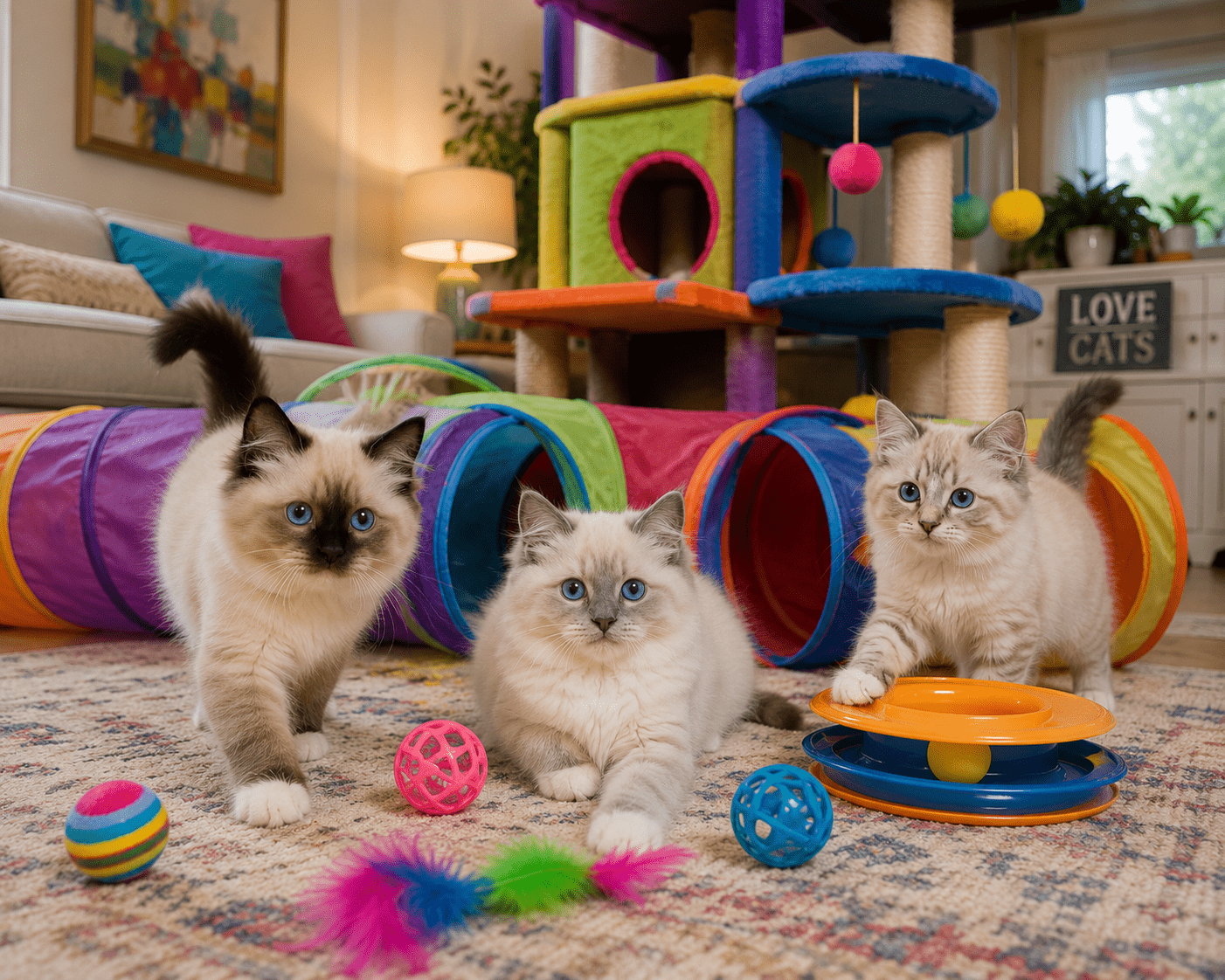

A Spring Home for a Ragdoll Kitten and Other Pets
Spring often brings small changes to a home: furniture shifts to make room for brighter days, doors open more frequently, and household routines become a little busier. If you are considering a Ragdoll kitten for a home that already includes another cat or a dog, this is a useful moment to think beyond the arrival day.
The overlooked question is not simply, “Where will the kitten stay?” It is, “How will the room communicate that every pet has somewhere to pause?” A Ragdoll kitten in a multi-pet home may be friendly, relaxed, and interested in following people, but those qualities do not mean the kitten wants constant access from another animal. Thoughtful layout gives sociable behavior room to develop naturally.
The shared room should offer choices, not one busy center
Many pet homes are designed around a central floor area. People sit there, the resident pet passes through it, and the new kitten is expected to join in. For a Ragdoll, this can create an awkward social situation: the kitten may be physically close to everyone but have no comfortable way to leave without crossing the busiest part of the room.
Instead, arrange the main living area so a kitten can move between participation and observation. A sturdy low platform beside a chair, an open-sided bed near the edge of the room, and a clear route toward a quieter area can be more useful than one large bed placed in the middle of the action.
This is especially relevant to Ragdolls because many grow into large, substantial cats. Furniture that is wide enough for an adult cat to turn around on, rather than a narrow decorative perch, will remain practical as the kitten grows. Low, stable surfaces also give a young kitten a comfortable place to rest without making every retreat a difficult climb.
What many owners miss about a calm-looking kitten
A kitten that does not hiss, swat, or run away is not necessarily fully comfortable. Some Ragdolls have a quiet way of handling uncertainty. They may freeze briefly, sit at the edge of a room, watch the resident pet closely, or repeatedly return to a person instead of approaching the other animal.
These small choices are useful information. A kitten that sits beside the sofa but never crosses the open floor may be telling you that the floor feels too exposed. A kitten that rests near your feet but leaves whenever the resident dog stands up may need a lower-traffic resting place. A kitten that follows you from room to room may be seeking reassurance, not asking to be introduced to every household member at once.
Look for patterns rather than judging the entire relationship by one peaceful afternoon. Comfort often appears as ordinary behavior: grooming, stretching, exploring with a loose body, settling down after the other pet moves, or choosing to approach and then leave again.
Spring changes can disrupt an established pet’s routes
In spring, owners may move a chair toward a sunny window, bring out lighter furniture, or clear a hallway that felt too crowded during winter. These changes seem minor to people, but they can alter how a resident pet travels through the home. A cat may lose its familiar way around the sofa, while a dog may suddenly spend more time near a doorway.
Before bringing home a Ragdoll kitten, watch where the resident pet naturally rests and passes through. The most important locations are not always the obvious beds. A quiet corner behind a chair, the end of a hallway, or the space beside a particular table may function as a private pause point.
Try to preserve at least one familiar resting option for the resident pet while adding new choices for the kitten. This reduces the chance that the arrival will feel like a complete redesign of the household. It also helps you distinguish a genuine preference from a reaction to furniture being moved around.
Arrange the room around escape routes
In a multi-pet home, a resting spot is more useful when the kitten can leave it without squeezing past another animal. This does not require separate rooms forever. It means paying attention to what happens around the resting place.
- Place a kitten bed beside, rather than directly inside, the busiest walking route.
- Give low resting areas two possible directions of exit whenever the furniture allows.
- Use a stable elevated surface for watching the room, but keep a comfortable floor-level option nearby.
- Avoid positioning a bed in a narrow corner where another pet can unintentionally block the only way out.
- Keep the resident pet’s favorite route recognizable while introducing new furniture gradually.
These details are easy to overlook because humans tend to evaluate a room by how attractive or spacious it feels. Cats evaluate it through movement. A large room with one blocked doorway may offer less freedom than a smaller room with several clear choices.
Let the Ragdoll kitten decide how social the room feels
Ragdolls are often described as people-oriented, and many kittens enjoy being near household activity. That does not make every kitten equally interested in another cat or dog. Individual temperament, age, previous experiences, and the resident pet’s behavior all matter.
For a prospective owner, this is an important lifestyle consideration. A Ragdoll may fit beautifully into an active household, but the home should still contain a quiet layer beneath the activity. Think of a room where the kitten can watch visitors, children, or another pet without being in the middle of every interaction.
When the kitten chooses to approach the resident animal, allow the moment to remain brief and ordinary. If the kitten retreats, do not turn the retreat into a problem that must immediately be solved. A successful shared home is not one in which the pets stay together constantly. It is one in which they can choose proximity and separation without either choice causing disruption.
Persian versus Ragdoll kittens in a multi-pet home
For this particular household question, Persian and Ragdoll kittens may call for slightly different layout priorities. Persians are often more comfortable with a settled, calm arrangement and may appreciate quiet resting places that are easy to reach without much traffic around them. Their compact, low-key presence can make floor-level retreats especially useful.
Ragdoll kittens are often more inclined to follow people or observe activity from nearby, so a Ragdoll-friendly room may benefit from both a social perch and a private retreat. Their eventual size also makes broad, sturdy resting surfaces worth planning for early. Neither breed should be treated as predictable: some Persians are playful and outgoing, while some Ragdolls prefer considerable independence. The best design responds to the individual kitten and the resident pet rather than relying on breed reputation alone.
A practical check before bringing your kitten home
Walk through the rooms at the time of day when the household is most active. Notice where another pet blocks a doorway, where people tend to gather, and whether a kitten could move from a resting place without crossing the room’s center.
Then make only a few purposeful adjustments:
- Preserve one familiar private place for the resident pet.
- Add a broad, stable observation spot for the kitten.
- Create a quiet alternative to the busiest shared room.
- Keep pathways open between resting areas and the room’s exits.
- Introduce spring furniture changes before the kitten arrives, when possible, so the arrival is not paired with a completely unfamiliar layout.
During the first days, observe more than you rearrange. If the kitten repeatedly chooses a particular edge, chair, or doorway, that preference may reveal something about light, noise, visibility, or social distance that you had not noticed. Use the kitten’s behavior to refine the room rather than expecting the original arrangement to be perfect.
A home that makes calm interaction possible
The most useful preparation for a Ragdoll kitten and other pets is not an elaborate setup. It is a home with enough visual and physical options for every animal to control its distance. In spring, when household patterns are already changing, a few careful adjustments can prevent the new kitten from becoming the reason an established pet loses its sense of familiarity.
If you are imagining life with a Ragdoll, explore more breed insights and practical kitten guidance at CTkittens.com.

Rachel Cohen is a journalist and producer with a passion for audio storytelling, health and science reporting, and feline companions.
A graduate of Middlebury College, Rachel spends her weekends exploring the mountains and when she isn’t outdoors or chasing a story, she can usually be found hanging out with her cats.