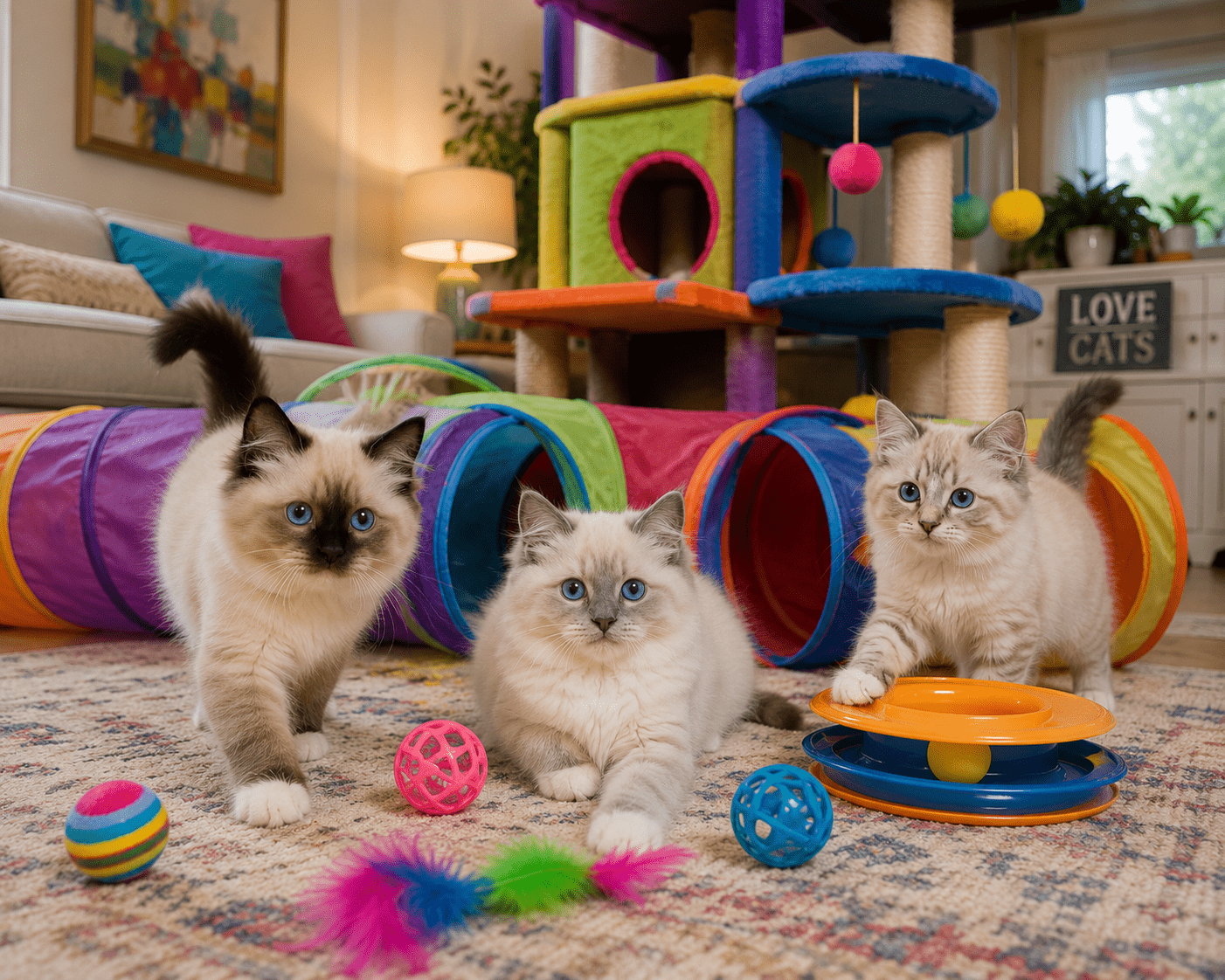

How a Day in a Multi-Cat Home Reveals Ragdoll Kitten Personality
In a home with more than one cat, it is easy to describe a Ragdoll kitten as simply friendly, shy, playful, or independent. Yet those labels rarely explain what you actually see. A kitten may follow the resident cat in the morning, sit beside you in the afternoon, and choose a quiet place across the room at night.
That changing pattern is not necessarily inconsistency. It can be a glimpse of individual Ragdoll kitten personality developing within a social household. Many Ragdolls are people-oriented and socially flexible, but each kitten still decides when to approach, whom to follow, and how much contact feels comfortable. Watching those decisions across a normal day can be more informative than judging the kitten by one dramatic interaction.
Morning: Notice who receives the first visit
The first social choice of the day is one owners often overlook. When the household begins moving, does the kitten seek a person, check on the resident cat, or watch from the edge of the room before joining in?
A Ragdoll kitten that follows the established cat first may be using that cat as a source of information. The older cat’s relaxed behavior can signal that the room is safe and worth exploring. Another kitten may head directly toward a person, showing that human contact is its strongest social anchor. A third may pause near a doorway and observe both before choosing.
The useful detail is not simply who arrives first. Look at how the kitten travels. A direct, loose-bodied approach suggests confidence in that moment. Moving along furniture edges, stopping to watch, or approaching in short stages may reflect a more observant temperament. Neither style is automatically better. They are different ways of entering the household’s rhythm.
Late morning: Quiet companionship can be easy to misread
Once the resident cat has settled, the kitten’s preferred social distance becomes clearer. Some Ragdoll kittens curl up close enough to touch. Others choose the same room but leave a small gap between themselves and the other cat.
That gap is not always a sign of tension. Some kittens enjoy low-pressure companionship: they want to know where the other cat is without being involved in every movement. A kitten that rests a few feet away, keeps its body relaxed, and occasionally glances toward its companion may be socially content while still valuing personal space.
Another overlooked clue is what happens when the adult cat gets up. Does the kitten follow immediately, remain settled, or move away? A follower may be highly interested in shared activity. A stay-behind kitten may be more self-directed. If the kitten moves away only when the other cat approaches, it may prefer to control the timing of contact rather than avoid the relationship altogether.
Midday: The most revealing moment may be boring
When the home becomes quiet, personality often appears in small choices rather than obvious action. One Ragdoll kitten may keep track of where both the human and the resident cat are, shifting locations whenever either one moves. Another may settle into an independent observation spot and remain there for a long time.
This is where two kittens of the same breed can look surprisingly different. A highly social kitten may use the resident cat as a reason to explore more rooms. A cautious but curious kitten may prefer to watch first and participate later. A confident kitten may ignore both cats and people until something genuinely interests it.
Pay attention to how the kitten handles a minor interruption, such as a person standing up or the other cat leaving the room. Does it resume resting quickly? Does it investigate? Does it seek a familiar companion? The speed and style of that response can tell you more about temperament than whether the kitten happens to sit on a lap.
Afternoon: Passing interactions reveal social style
In a multi-cat home, many important interactions last only a few seconds. The kitten and resident cat may meet in a hallway, exchange a brief nose touch, pause at a doorway, or pass without acknowledging each other.
A Ragdoll kitten that regularly approaches and then disengages may be socially confident without wanting prolonged contact. Another may wait for the resident cat to pass before continuing. Some kittens initiate with a small bounce or paw gesture, while others communicate interest by quietly following at a distance.
These brief encounters help distinguish friendliness from a need for constant closeness. A kitten can enjoy another cat’s presence while preferring short, self-directed conversations. It can also be people-oriented without wanting to be carried from room to room. The pattern matters more than any single greeting.
Evening: Affection may change when the household becomes active
Evening activity often brings out another side of a Ragdoll kitten’s personality. When several people are moving around, one kitten may place itself in the middle of the household, while another chooses a nearby chair or the edge of the room.
Many Ragdolls enjoy being close to people, but closeness does not always mean sitting on a lap. A kitten may show affection by following you between rooms, settling beside your chair, or returning repeatedly after brief explorations. If it leaves when the resident cat joins you and comes back once the space is quieter, it may be managing social competition rather than rejecting human attention.
Give that preference room to develop. Avoid pulling a hesitant kitten into a shared cuddle or placing it directly beside the other cat. When kittens can choose whether to approach, their natural social style becomes easier to understand and trust.
Night: Where the kitten rests completes the picture
At bedtime, look at proximity rather than contact. A Ragdoll kitten may sleep beside the resident cat, near a person, or in a separate place where both companions remain visible. Each choice can reflect a different balance of independence and connection.
The kitten that chooses a nearby but separate resting place may be socially secure and simply comfortable with distance. The kitten that sleeps pressed against another cat may be more contact-oriented. A kitten that changes locations during the night may be responding to household movement or looking for the setting that feels most peaceful.
These observations are especially useful because they show personality without requiring you to intervene. In a shared home, comfort often looks quiet.
Small clues worth remembering
- Social anchor: Notice whether the kitten checks the resident cat or a person first.
- Preferred distance: Sitting nearby can be a form of companionship even without touching.
- Recovery style: A kitten’s response after a companion leaves can reveal confidence and independence.
- Initiation style: Following, waiting, brief greetings, and returning later are all different social signals.
- Daily variation: A kitten may be outgoing during quiet hours and more reserved when the home is busy.
Persian versus Ragdoll kittens in a shared home
In relation to a multi-cat daily routine, Persian and Ragdoll kittens may make their personalities visible in different ways. A Persian kitten is often more likely to communicate through selective engagement, quiet observation, and a strong preference for familiar resting areas, although individual Persians can be highly active and social. Many Ragdoll kittens, by contrast, show interest by following people or another cat from room to room and joining household activity at their own pace. A Ragdoll may appear socially flexible without wanting constant physical contact. The useful comparison is not which breed is friendlier. It is whether the kitten tends to participate through movement and proximity or through stillness and carefully chosen interactions. Both breeds can be affectionate, reserved, playful, or independent.
Let the pattern guide your expectations
Once you notice these small differences, avoid measuring affection by a single behavior. A kitten that does not seek a lap may still be deeply interested in its people. A kitten that follows the resident cat everywhere may still need quiet time alone. Personality is often expressed through timing, distance, and repeated choices.
In a home with another cat, practical support can be simple: provide more than one comfortable place to rest, allow each kitten an easy way to move away, and let interactions end naturally. You do not need to manufacture constant togetherness. By watching the ordinary sequence of morning greetings, quiet pauses, passing encounters, and evening settling, you can learn what kind of companion your Ragdoll kitten is becoming.
For more thoughtful guidance on life with Persian and Ragdoll kittens, explore the kitten care and breed articles at CTkittens.com.

Rachel Cohen is a journalist and producer with a passion for audio storytelling, health and science reporting, and feline companions.
A graduate of Middlebury College, Rachel spends her weekends exploring the mountains and when she isn’t outdoors or chasing a story, she can usually be found hanging out with her cats.