
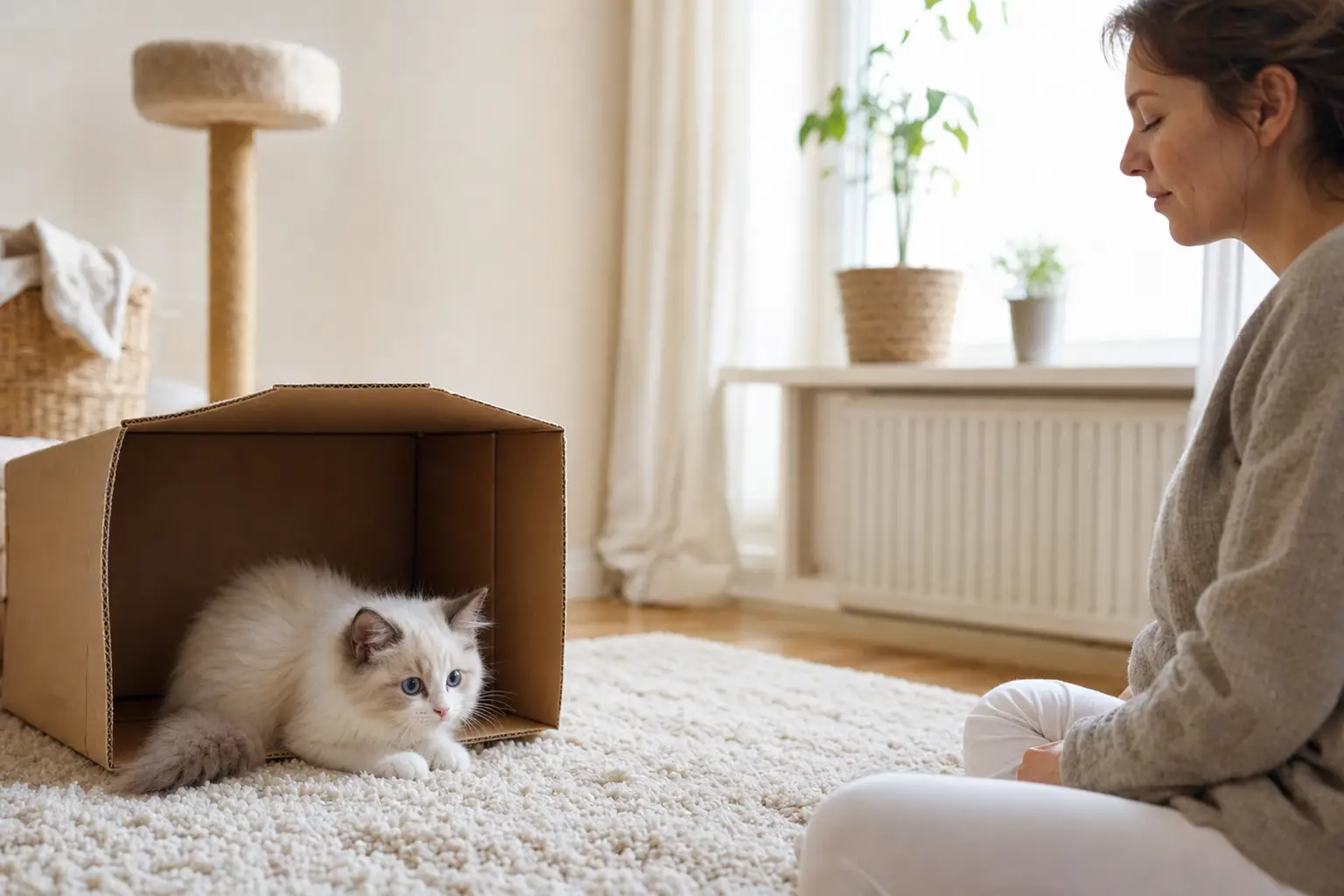
Slow Blinking at a Shy Ragdoll Kitten: A Gentle Guide
Slow blinking at a shy kitten can be a low-pressure way to say, I am calm, and you do not have to come closer yet. The goal is not to make your Ragdoll kitten blink on command. It is to offer a friendly signal while giving the kitten complete control over distance and timing.
For a nervous kitten, success may look surprisingly small: staying in the room, relaxing one ear, eating while you are nearby, or looking back without retreating. A returned slow blink is lovely, but it is not the only sign that trust is developing.
Why a slow blink can help
Cats often communicate through posture, movement, facial expression, and eye contact. A fixed stare can feel intense, especially to a kitten that is still deciding whether a person is safe. Softening your gaze, narrowing your eyes briefly, and then looking away reduces that pressure.
A 2020 study published in Scientific Reports examined cat eye-narrowing movements in interactions with people. In controlled experiments, cats were more likely to approach people who narrowed their eyes in a slow-blink-like expression than people who kept a neutral expression. The researchers also found that people appeared more approachable to cats after using the expression.
That does not mean every cat will return a blink, or that a blink proves your kitten feels completely secure. Context matters. A kitten may blink because it is relaxed, responding socially, or simply closing its eyes for a moment. Think of the gesture as an invitation, not a test.
Set up the interaction before you try it
A slow blink works best when the rest of the environment already feels predictable. If the kitten is hiding from loud visitors, chasing noises, rough handling, or an unfamiliar dog, eye contact alone will not solve the problem.
- Choose a quiet time when nobody needs to catch, move, or pick up the kitten.
- Sit on the floor or on a low chair rather than standing over the kitten.
- Turn your body slightly sideways instead of facing the kitten head-on.
- Keep your hands still and avoid reaching toward the hiding place.
- Make sure the kitten has an easy route to a safe hiding spot.
- Keep food, water, litter, sleeping areas, and play resources easy to access.
A cardboard box, covered bed, or open carrier can give a shy kitten a retreat. Do not remove the hiding place to encourage socialization. A refuge helps the kitten observe you without feeling trapped.
How to slow blink with a shy kitten
1. Start at the kitten’s chosen distance
Do not move closer just because you have begun the exercise. If your kitten is under a chair, stay far enough away that it can watch you without pressing itself farther into the corner. Distance is part of the message: you are not going to invade its space.
2. Let your gaze rest nearby
Look in the kitten’s direction for a moment, but avoid locking eyes. You can look at the floor near the kitten, glance briefly at its face, and then shift your gaze away. Your expression should be soft rather than animated.
3. Narrow your eyes slowly
Relax your forehead and cheeks. Lower your eyelids gradually, hold the gentle squint for about a second, and then open your eyes again. You can follow it by turning your gaze slightly to the side. The movement should look natural, not like an exaggerated wink.
4. Pause instead of repeating constantly
Give the kitten time to respond. One or two slow blinks are enough for a first attempt. Repeating the gesture continuously can become another form of staring, especially if the kitten is already uncertain.
5. End while the interaction is still comfortable
After a brief pause, return to reading, sitting quietly, or doing another calm activity. If the kitten stays in place, that is a positive outcome. You do not need to turn every peaceful moment into a training session.
How to read your kitten’s reply
A shy kitten may answer with a slow blink, but it may also communicate more quietly. Watch the whole body rather than focusing only on the eyes.
| What you notice | What it may mean | What to do |
|---|---|---|
| Slow blink, soft face, relaxed whiskers | The kitten may be comfortable enough to engage | Stay still and give it time |
| Looking away but remaining nearby | A polite request for less direct attention | Stop looking directly and continue quietly |
| Body lowers, ears turn sideways, tail tucks or flicks sharply | The kitten is becoming uncomfortable | End the interaction and increase distance |
| Hiding, hissing, swatting, or trying to escape | The interaction is too intense or the setting feels unsafe | Do not pursue; let the kitten decompress |
Pupil size should be interpreted with the lighting and the rest of the body in mind. Large pupils can occur in dim light, during play, or during fear, so they are not a complete emotional reading by themselves.
Make it part of a calm home routine
Trust usually grows through repeated, predictable experiences rather than one perfect interaction. Try a short slow-blink exchange when the kitten is already settled, such as after a meal or while you are sitting quietly nearby.
You can pair your calm presence with something the kitten enjoys. Place a treat on the floor at a comfortable distance, toss a toy away from your body, or begin a gentle wand-toy game if the kitten likes play. Do not use food to pull a frightened kitten out of hiding or lure it toward your hands. The kitten should be able to accept the reward without feeling trapped.
Keep sessions brief. A useful routine might be one or two quiet attempts, followed by ordinary household activity. Over time, the kitten may begin to remain visible for longer, approach on its own, or choose to rest in the same room.
Ragdoll-specific reminders
Ragdolls are commonly described as gentle, social cats, but breed tendencies do not determine an individual kitten’s confidence. A Ragdoll can be cautious, easily overwhelmed, highly playful, or very independent. Treat the kitten in front of you rather than expecting a particular personality because of its breed.
Do not assume that a relaxed Ragdoll wants to be picked up. Some cats tolerate being carried; others prefer all four paws on the floor. Allow the kitten to choose contact, and support its body properly if handling is necessary. A cat that goes still is not always enjoying the experience.
Ragdolls are known for blue eyes, which can make a small squint especially noticeable. Still, a persistent squint is not the same as a social slow blink. Redness, discharge, cloudiness, rubbing, swelling, or keeping one eye closed can indicate a health problem and should be discussed with a veterinarian.
What if your kitten never slow blinks back?
Nothing is wrong with your approach simply because there is no visible reply. Some kittens need more time. Others show trust through practical behaviors, such as eating near you, grooming in your presence, sleeping with their back turned, or walking past without rushing away.
Reduce the intensity if your kitten consistently retreats. Try sitting farther away, looking less directly, lowering household noise, or offering play instead of eye contact. If fear is severe, continues to worsen, or appears suddenly in a kitten that was previously comfortable, arrange a veterinary check. Pain and illness can change behavior, and a veterinarian can help rule out medical causes before you treat the issue as shyness.
Frequently asked questions
Should I stare at my kitten until it blinks?
No. A friendly slow blink is brief and relaxed, not a staring contest. Look softly, narrow your eyes, then look away or return your attention to something else.
How often should I slow blink at a shy Ragdoll kitten?
There is no required schedule. A few brief attempts during calm moments are enough. If the kitten turns away, hides, or becomes tense, stop and try again another time.
Is a slow blink always a sign of trust?
Not necessarily. It can be a friendly or relaxed signal, but one facial movement should be read alongside posture, ears, tail, movement, and the situation. Persistent squinting or other eye symptoms need veterinary attention.
Sources and further reading
The research discussed above is The role of cat eye narrowing movements in cat-human communication, published in Scientific Reports. For broader guidance on feline behavior and welfare, consult the resources provided by International Cat Care and your veterinarian.
Small, respectful signals can make a new kitten’s world feel less demanding. For more practical guidance on choosing and caring for companion cats, explore CTkittens.com.

Rachel Cohen is a journalist and producer with a passion for audio storytelling, health and science reporting, and feline companions.
A graduate of Middlebury College, Rachel spends her weekends exploring the mountains and when she isn’t outdoors or chasing a story, she can usually be found hanging out with her cats.


That reminder that a kitten staying in the room already counts as progress hit different, cuz we humans really do expect trust to happen way too fast lol.
Kinda wild how slow blinking is basically kitty consent culture, like trust grows way better when nobody’s forcing the convo lol.
Kinda wild how slow blinking is basically the cat version of respecting boundaries, like trust grows way faster when nobody’s forcing the convo lol.
Lowkey the slow blink gets all the hype, but letting the kitten keep its hiding spot and not forcing cuddles is probly what builds the real trust.
Only thing I’d add is some shy kittens seem to trust you faster when you basically ignore em, so the “blink twice then go back to reading” bit is lowkey the smartest advice here.
Honestly the “one or two blinks then go back to reading” bit is super useful, cause I was basically staring my poor kitten down like a tiny furry hostage lol.
The reminder that staying in the room counts as progress hit me, cuz we expect shy kittens to perform trust when sometimes just not bolting is a pretty huge win tbh.