
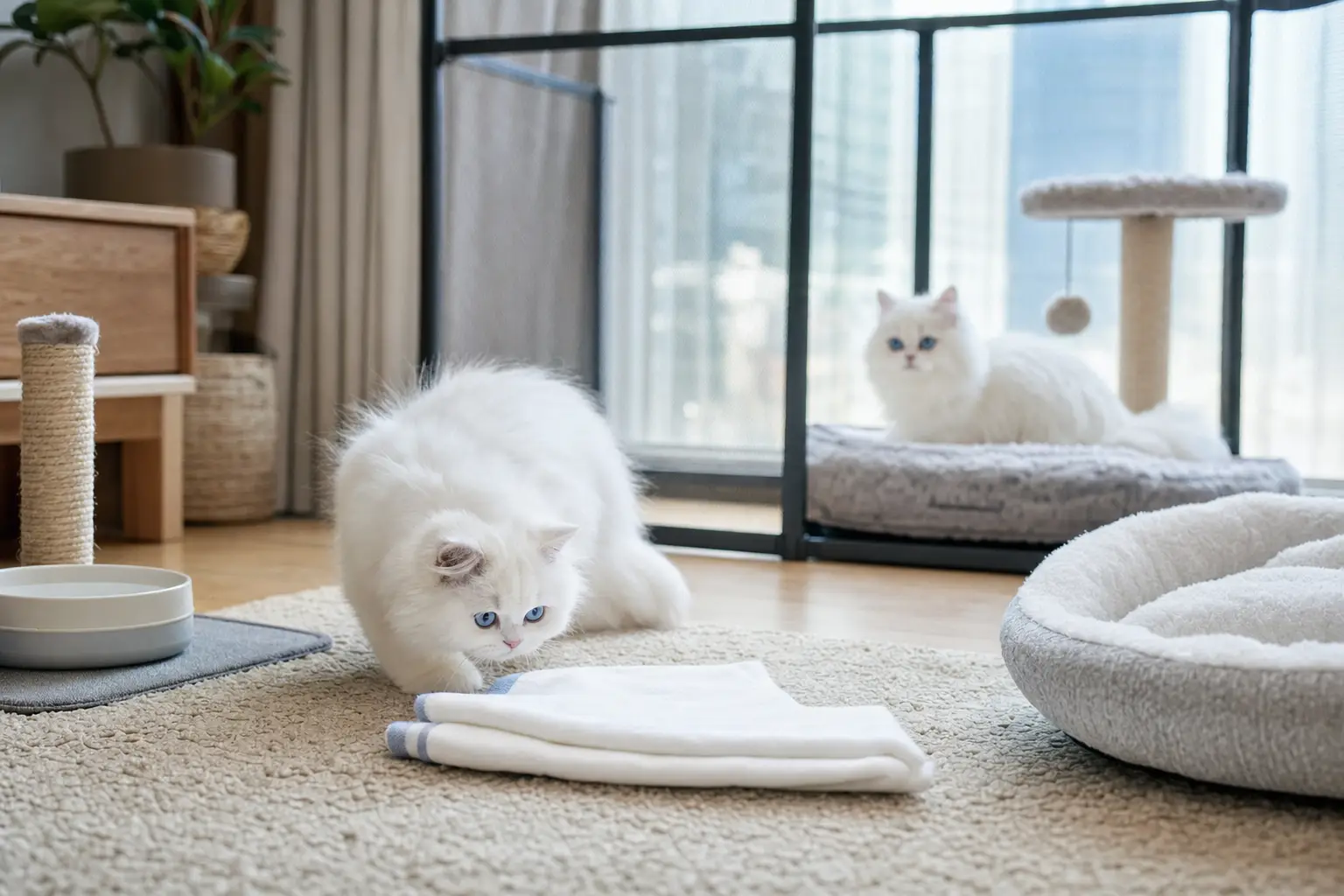
Bringing a Persian kitten home can feel complicated when you live in a studio, apartment, or other compact space. Where will the cats stay separate? Is there enough room for a slow introduction? Can scent swapping work without a spare bedroom?
Short answer: scent swapping cats in a small home can work well. The size of the home matters less than your ability to create two secure zones, prevent forced contact, and give both cats time to process unfamiliar smells. A smaller home may require more planning, but it does not automatically rule out a calm introduction.
This routine is designed for introducing a Persian kitten to a resident cat, although the same principles can help when introducing two kittens. Breed does not determine how quickly a cat will accept a companion. Individual personality, previous experience, age, health, and the way the introduction is managed all matter.
Why scent swapping helps
Cats gather important information through smell. Before two cats share a room, exchanging bedding or a clean cloth can let each one investigate the other’s scent without the pressure of a face-to-face meeting. When that scent is presented alongside food, play, or another pleasant experience, the unfamiliar smell may become less alarming over time.
Scent swapping is not a magic trick and it is not a substitute for separation. It is one stage in a gradual introduction that may also include visual contact through a secure barrier and, eventually, short supervised time together. The goal is not to make the cats become friends immediately. The goal is to keep their level of concern low enough that they can learn safely.
Five assumptions about scent swapping in a small home
1. You need a spare bedroom
Reconsider it: you need a secure base camp, not necessarily a full bedroom.
A quiet office, part of a bedroom, or a carefully prepared bathroom may work temporarily for a kitten. The space should contain a litter box, food and water placed away from the litter, a comfortable bed, hiding options, a scratching surface, and something safe to climb or perch on. Remove cleaning products, dangling cords, toxic plants, and escape routes.
A laundry room is often a poor choice because machines, chemicals, and sudden noise can make the space stressful. A bathroom can also be unsuitable if it is cold, echoing, or frequently used. Choose the calmest safe area available rather than the room that is simply easiest to close.
If you have no separate room, use a secure, escape-proof division such as a properly fitted mesh screen or another barrier designed for cats. A standard baby gate may not contain a small kitten, and a barrier with wide gaps can allow paws or heads through. Another option is careful room rotation: one cat explores while the other is securely settled in its own zone. This must be managed without surprise encounters.
2. One blanket swap is enough
Reconsider it: scent swapping is a repeated, low-pressure process.
Start with a small, clean, unscented cloth or a piece of bedding. You can gently rub it against the kitten’s cheeks and the side of the face, where familiar facial scent is deposited. Do not chase the cat with the cloth or restrain the cat to collect a scent. If the kitten walks away, wait and try again later.
Place the cloth several feet from the resident cat’s food, bed, or favorite resting place at first. Let the cat choose whether to approach. If the response is calm, gradually place the item closer on later exchanges. You can also offer a treat or begin a short play session when the cat notices the scent, provided the cat is relaxed enough to participate.
Repeat the process with the other cat’s scent. One or two brief exchanges a day may be enough, but there is no prize for doing more. If either cat avoids the area, stops eating, or becomes visibly tense, make the scent less intense by using a smaller or more distant item.
3. Faster is better, especially with a young kitten
Reconsider it: a kitten’s age does not set the schedule.
Persian kittens are often small enough to move quickly through a home, but that does not mean the resident cat is ready for immediate access. A playful kitten may repeatedly approach, pounce, or chase when an adult cat needs distance. The adult cat should always have a way to retreat without being followed into a corner or blocked from food, water, or the litter box.
Proceed according to behavior rather than a calendar. Signs that a cat may be ready for the next stage include eating normally, investigating the other cat’s scent, playing, grooming, resting in the open, and being able to disengage calmly. A single curious sniff is encouraging, but it is not automatically permission for a direct meeting.
Some introductions take days; others take weeks or longer. Moving back to an earlier stage is not failure. It is useful information that the previous step was too difficult or lasted too long.
4. Any unfamiliar scent exposure is helpful
Reconsider it: the intensity and context of the scent matter.
A clean cloth or familiar bedding is usually a gentler starting point than a heavily soiled litter item. Do not deliberately use urine, feces, or strongly contaminated bedding to force recognition. Those smells may be particularly threatening or confusing, and they can create hygiene problems.
Avoid trying to mask the cats’ smells with perfume, air freshener, or essential oils. Strong fragrance can make the environment harder for cats to interpret, and some scented products may be unsafe around pets. Wash bedding in an unscented detergent and keep the introduction area as predictable as possible.
Do not mix every resource at once. At the beginning, keep each cat’s food, water, litter, sleeping places, and favorite toys in its own zone. Cats should not have to compete for access while they are still learning about each other.
5. Hissing means the introduction has failed
Reconsider it: hissing is information, not a final verdict.
A hiss can mean that a cat feels worried and wants more distance. If the cat hisses once, retreats, and then returns to normal behavior, you can simply increase the distance or end that session. Do not punish hissing. Punishment can make the other cat’s presence feel even more threatening.
More concerning signs include repeated lunging, charging at a barrier, prolonged growling, hard staring, flattened ears combined with a stiff posture, swatting that escalates, blocking access to resources, or one cat remaining hidden and unwilling to eat. These signs mean the process should slow down. A lack of hissing does not prove that cats are ready either; a quiet, frozen cat may be frightened rather than comfortable.
A practical scent-swap routine for a compact home
Before beginning, arrange a veterinary check for the new kitten and follow your veterinarian’s advice about vaccinations, parasites, infectious-disease testing, and separation. Scent swapping is a behavior and introduction tool; it does not replace health precautions. This is especially important when the kitten’s medical history is incomplete.
- Prepare two zones. Give each cat a predictable area with its own essentials. In a small home, use height as well as floor space: a stable cat tree, shelf, or perch can provide useful distance. Make sure elevated areas cannot tip and that the kitten cannot fall behind appliances or furniture.
- Let both cats settle. Keep the new kitten in its base camp while the resident cat follows its usual routine. Avoid beginning the first scent exchange during a noisy, busy, or unusually stressful part of the day.
- Exchange one low-intensity item. Offer a clean cloth or small bedding item from one cat to the other. Leave it nearby rather than putting it directly in a bed or food bowl. Observe, but do not force investigation.
- Pair the scent with something positive. Use a favorite treat, a meal, gentle play, or quiet attention if the cat enjoys it. Keep the reward appropriate to the cat; a nervous cat may prefer food placed at a distance rather than a person leaning over it.
- Repeat and gradually increase access. When both cats remain relaxed, exchange bedding more regularly and allow each cat to investigate the other’s area separately. Keep the cats physically separated during these explorations.
- Add visual contact. Use a secure mesh screen or another barrier that prevents reaching through. Keep the first looks brief. Offer food or play at a distance where both cats can still eat or engage normally.
- Try short, supervised time together. Choose a room with escape routes and avoid holding one cat up to the other. End the session while things are still calm. Gradually increase the time only when both cats can move, pause, and disengage without chasing or cornering.
In a compact home, resource placement deserves special attention. A commonly recommended guideline is one litter box per cat plus one extra, but a small apartment may not make that possible. Treat the guideline as a goal rather than a reason to abandon the introduction. Provide as many boxes as you safely can, keep them in separate, quiet locations, and watch for signs that one cat is guarding access. Food bowls, water, beds, and scratching areas should also be distributed instead of clustered together.
When to pause or ask for help
Pause the introduction and return to the last comfortable stage if either cat stops eating, develops litter-box changes, hides constantly, overgrooms, or shows escalating aggression. These behaviors can be caused by stress, but medical problems can look similar. Contact a veterinarian if a behavior change is sudden, persistent, or accompanied by other symptoms.
If the cats repeatedly fight, one cat cannot access essential resources, or you cannot create safe separation, ask your veterinarian about referral to a qualified feline behavior professional. Do not allow cats to fight it out. Intervening with your hands can result in serious bites; use a barrier and separate the cats safely.
FAQ
How long should scent swapping take?
There is no universal timeline. Continue each stage until both cats can encounter the other’s scent or presence without persistent fear, agitation, or resource disruption. Some pairs progress quickly, while others need a much slower plan.
Can scent swapping work if I live in a studio?
Yes, provided you can create secure separation and manage room rotation or a reliable barrier. The main challenge is preventing accidental contact, not the number of square feet. Plan where each cat will eat, sleep, use the litter box, hide, and retreat before bringing the kitten home.
Do Persian kittens need a different introduction method?
The basic method is the same. A Persian kitten’s breed and appearance do not guarantee a particular temperament or timetable. Handle the kitten gently, avoid overwhelming it with attention, and account for its individual energy level and confidence.
Further reading
For additional guidance, see the ASPCA’s advice on introducing a new cat and the AAFP and ISFM feline environmental-needs guidelines. Both support gradual introductions, safe resources, and attention to each cat’s behavioral signals.
With thoughtful setup, scent swapping can be practical even in a smaller home. If you are preparing for a Persian kitten, explore CTkittens.com for more guidance on creating a comfortable start.

Rachel Cohen is a journalist and producer with a passion for audio storytelling, health and science reporting, and feline companions.
A graduate of Middlebury College, Rachel spends her weekends exploring the mountains and when she isn’t outdoors or chasing a story, she can usually be found hanging out with her cats.
The bit about hissing being info instead of instant failure is honestly huge, cuz folks panic at one lil hiss and rush the whole intro backwards lol.
The bit about hissing being info not failure legit changed my mindset, cuz I probably would’ve rushed in thinking the cats were beefing for good.
Ngl, I always thought one hiss meant the whole intro was cooked, so learning it’s basically just a cat saying “yo back up” makes me way less nervous about trying this in my tiny apartment.
Honestly the bit about hissing being info instead of failure made me feel way less panicky, cuz my resident cat is dramatic af and I would’ve rushed things backwards lol.