
Ragdoll Kittens: Teaching a Child the Slow-Blink Hello
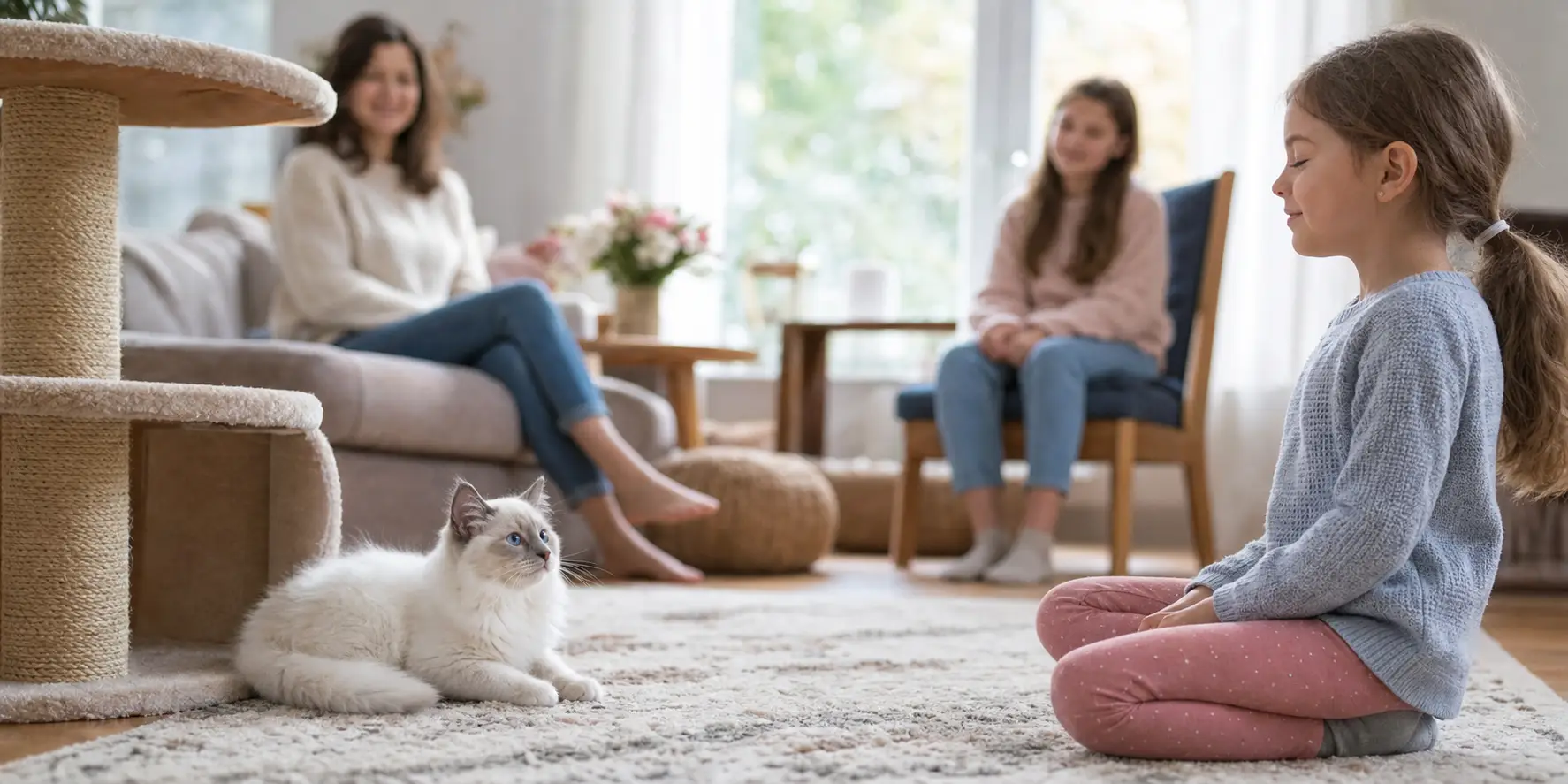
Yes, you can teach a child to slow-blink at a cat, but the goal is not to make a Ragdoll kitten perform a trick or hold eye contact. The kindest version is simple: the child looks softly toward the kitten, gently closes their eyes for a moment, opens them, and then looks slightly away. The kitten gets to respond—or not respond—and can leave whenever it wants.
Practice first without the kitten, then try the greeting from a comfortable distance during a quiet visit. These nine options make the lesson easier for children and less overwhelming for a young cat.
The short version: Soft gaze, slow blink, look away, and give the kitten space. Never corner, chase, pick up, or stare at a kitten to get a response.
Why teach a child a slow-blink hello?
Eye contact can be complicated in cat communication. A hard, prolonged stare may feel threatening, while relaxed eyelid movements can occur during calm social interaction. A 2020 study published in Scientific Reports found that cats were more likely to approach people after people used slow eye-narrowing movements. The study supports slow blinking as a useful friendly signal, although it does not mean every cat will answer every time.
A Ragdoll’s reputation for being sociable does not remove the need for consent. Many Ragdolls enjoy people, but each kitten has its own temperament, energy level, and history. A kitten that is tired, hiding, startled by noise, or still settling into a home may prefer no greeting at all.
Before friends arrive: set the child up for success
Explain that the slow blink is an invitation, not a command. A child can offer the signal, but the kitten chooses whether to come closer. Keep the lesson short and praise the child for being calm, not for making the kitten react.
- Have an adult supervise every interaction between a child, visitors, and the kitten.
- Give the kitten a retreat such as a quiet room, covered bed, cat tree, or high perch.
- Ask visitors to sit down and use quiet voices when they first arrive.
- Do not wake a sleeping kitten or pull one out of a hiding place.
- Stop the interaction if the kitten crouches, retreats, flattens its ears, lashes its tail, hisses, growls, or swats.
Children should also wash their hands after handling a cat, food bowls, toys, or litter. The Centers for Disease Control and Prevention provides general guidance on staying healthy around cats and other pets.
9 slow-blink hello options worth trying
1. Practice the motion in a mirror
Start with the child and a mirror rather than a real kitten. Ask them to make a relaxed face, look at their reflection without staring hard, close both eyes gently, and open them again. Keep it playful: try one blink, wait, and stop.
This helps children notice the difference between a soft blink and an intense gaze. If the child squeezes their eyes shut, leans forward, or keeps repeating the motion quickly, make it slower and shorter. The purpose is calm communication, not perfect technique.
2. Let the child watch an adult model it
Children often learn this greeting more easily by copying a trusted adult. Sit near the kitten without reaching toward it. Use a relaxed gaze, slow blink once, and look away. Then let the child try from the same distance.
Avoid turning this into a competition about whether the kitten blinks back. The child can learn that a successful greeting is one that leaves the kitten relaxed—even if the kitten continues napping or walks away.
3. Add a simple phrase and hand signal
Pair the motion with a quiet phrase such as, Hello, kitty. A child can also place one open hand on their own chest as a reminder to keep their body still. The cue should help the child remember the routine, not pressure the kitten.
Use the phrase once, slow-blink once, and wait. Repeating a name or signal over and over can make an already cautious kitten feel surrounded. One calm hello is enough.
4. Try the greeting from across the room
Distance is useful, especially when a friend has just entered the house. Let the kitten remain on a perch, under a table, or beside a trusted adult. The child can sit sideways rather than facing the kitten directly, offer one slow blink, and then look at the adult or a book.
This option works because the kitten does not have to manage a child’s face close to its own. If the kitten chooses to approach, the child should remain still and let the kitten sniff before attempting any touch.
5. Use a stuffed animal for a rehearsal game
A stuffed animal or picture of a cat gives children a pressure-free way to rehearse. The child can practice the sequence: pause, soften the eyes, blink slowly, look away, and wait. You can also role-play the kitten choosing to stay away.
Say, The cat heard your hello and decided to rest. This teaches an important boundary: a friendly signal can be offered without expecting petting, cuddling, or an approach.
6. Reward calm behavior instead of a kitten response
If the kitten is comfortable with treats, an adult can place a small treat near the kitten after the child has completed a quiet greeting. Put the treat down rather than asking the kitten to take it from the child’s fingers. This keeps the reward separate from grabbing or coaxing.
The treat is optional. A calm voice and a short pause are often enough. Do not use food to lure a kitten toward a child who is nervous, hiding, or trying to leave.
7. Start with one quiet friend
Several excited visitors can create too much movement and noise for a young cat. Begin with one friend who understands the plan: sit down, avoid staring, wait for the kitten, and let the child demonstrate the slow blink once.
Give the child a job that does not involve touching, such as showing the friend the kitten’s favorite toy or pointing out the retreat area. This keeps the visit positive while reducing the temptation to follow the kitten around.
8. Build a distance-and-duration ladder
Some children need a clear progression. Begin with the kitten several feet away for one brief blink. On another visit, the child might sit a little closer. Later, if the kitten repeatedly chooses to approach with a loose body and relaxed ears, the child can offer a hand for sniffing.
Move back down the ladder if the kitten becomes tense or the child becomes overexcited. There is no required final stage. A child who can greet a cat calmly from across the room has already learned a valuable skill.
9. Keep a no-eye-contact hello as a backup
Sometimes the best greeting is not a slow blink. If the kitten looks uncomfortable, the child can turn sideways, speak softly, toss a toy away from the kitten, or simply give a small wave to the adult instead. This is especially helpful when the kitten is hiding or has already had enough attention.
Teaching this backup prevents the slow blink from becoming another demand. It also shows children that respecting an animal includes knowing when not to interact.
How to tell whether the kitten is comfortable
Look at the whole body rather than one feature. A comfortable kitten may have a loose posture, neutral or forward ears, a relaxed tail, and the freedom to move away. It may blink, sniff, groom, play, or settle nearby. These signs are encouraging, but they are not permission to pick the kitten up.
Stress can appear as hiding, crouching, freezing, turning the head away repeatedly, flattened or sideways ears, a rapidly moving tail, hissing, growling, or swatting. If you see these signs, calmly end the interaction and make the retreat area available. Do not punish the kitten or ask the child to try again immediately.
What children should remember
- A slow blink is a friendly offer, not a command.
- The kitten does not have to blink back.
- Looking away is part of the greeting.
- Hands stay still unless an adult says the kitten is ready to sniff or be touched.
- A kitten that walks away is communicating clearly and should be allowed to leave.
For very young children, the safest lesson may be watching quietly from an adult’s lap or from the other side of the room. As children grow, they can learn to recognize body language and wait for an animal to initiate contact.
FAQ
Does every Ragdoll kitten slow-blink back?
No. Some kittens blink back, some look away, and some show comfort in other ways. A lack of response does not mean the greeting failed.
Should a child keep blinking until the kitten responds?
No. One slow blink followed by a pause is enough. Repeated attempts can become stressful, particularly if the kitten is trying to rest or retreat.
What if the kitten hides whenever friends visit?
Let the kitten hide in peace and keep visitors away from the retreat. If fear around visitors is persistent, worsening, or accompanied by changes in eating, toileting, or general behavior, speak with a veterinarian or a qualified feline behavior professional.
A gentle hello is a lesson in consent
The most useful part of teaching a child the slow-blink hello is not getting a dramatic feline reply. It is helping the child practice patience, quiet movement, observation, and respect for another living creature’s choice.
For more guidance on welcoming and caring for Ragdoll kittens, explore CTkittens.com.
Further reading: The research on cat eye-narrowing communication is available in Scientific Reports. For general health and hygiene guidance around cats, see the CDC’s cat safety information.

Rachel Cohen is a journalist and producer with a passion for audio storytelling, health and science reporting, and feline companions.
A graduate of Middlebury College, Rachel spends her weekends exploring the mountains and when she isn’t outdoors or chasing a story, she can usually be found hanging out with her cats.


Gonna try the stuffed-animal rehearsal first, cuz my kid gets way too hype around cats and practicing the “look away” bit beforehand actually makes alot of sense.
Gonna try the stuffed-animal rehearsal with my niece first, cuz “one blink then leave kitty alone” is way easier for her to remember than a whole list of rules lol.
Kinda wondering if teaching the “no-eye-contact hello” first might actually be easier for younger kids, since they gets excited and one blink can turn into a whole staring contest lol.
Kinda wondering if teaching the “no-eye-contact hello” first might actually be easier for really excitable kids, since waiting for a blink back could turn into a whole mission lol?