
Ragdoll Kittens With Children: A Practical Paw-Handling Plan
For families raising Ragdoll kittens with children, gentle paw handling is a useful life skill—not a test of how much the kitten will tolerate. It can make future nail checks, grooming, injury inspections, and veterinary visits easier, provided the kitten stays in control of the pace.
The safest approach is simple: an adult helper manages the setting and watches the kitten’s body language, while the child takes part in tiny, reward-based steps. No one pins the kitten down, pulls toes, or continues after the kitten says “enough.” A Ragdoll may be known for a relaxed reputation, but every kitten is an individual, and breed does not guarantee that a cat will enjoy being handled.
Why paw handling is worth teaching
Kittens use their paws for climbing, playing, scratching, and communicating. Having someone touch a paw can feel strange, especially if the kitten is tired, overstimulated, or unsure of the person. Early, gentle practice helps the kitten learn that a brief touch predicts something pleasant and that the interaction will end safely.
The goal is not to make a child hold every paw or inspect the claws on demand. The goal is a cooperative response: the kitten remains reasonably relaxed, the child uses light hands, and the adult can stop immediately when the kitten needs a break.
Set up the child, kitten, and helper for success
For young children, the helper should be a calm adult. An older, responsible child may eventually assist, but children should not be expected to supervise one another during handling practice.
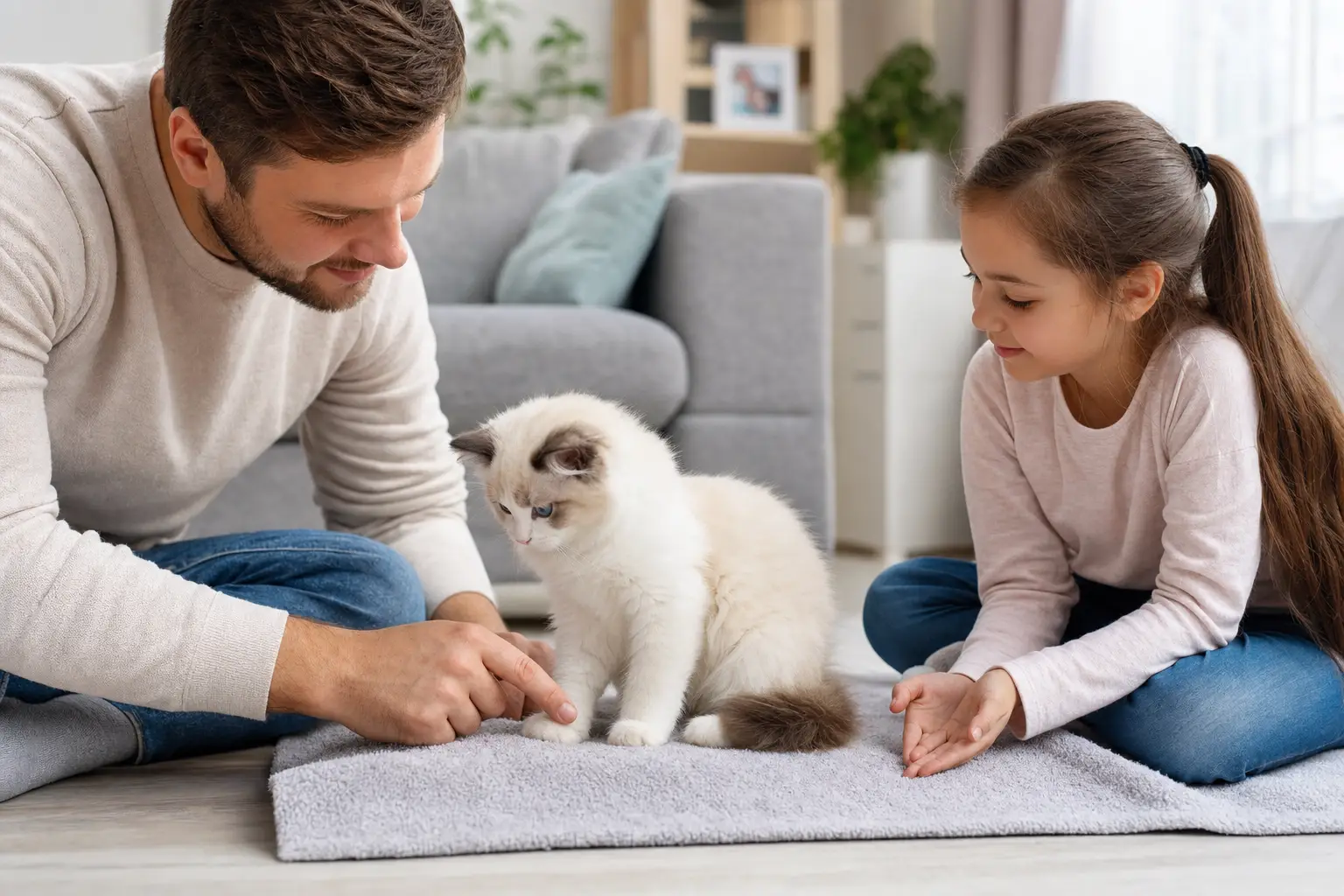
Choose a quiet room and a stable, non-slip surface such as a rug or towel on the floor. The floor is safer than a table or sofa edge if the kitten suddenly moves. Keep a few small, kitten-appropriate treats nearby. If treats are not suitable for your kitten, use a favorite toy, a small portion of the kitten’s normal food, or a pause to play.
Before beginning, agree on each person’s role:
- The adult helper controls the environment, offers rewards, watches body language, and ends the session if needed.
- The child sits still, keeps hands low, follows one instruction at a time, and never chases or grabs the kitten.
- The kitten is allowed to stand up, turn away, or leave. Leaving is information, not disobedience.
Start when the kitten is awake and calm—not immediately after rough play, during a meal, or when the kitten is hiding. Keep the first session under a minute. Several successful moments over time are more useful than one long session.
A step-by-step paw-handling plan
1. Build a calm starting point
Ask the child to sit sideways rather than facing the kitten head-on. The adult can reward the kitten for approaching, looking at the child, or resting nearby. At this stage, there is no need to touch the paws.
This first step is especially valuable for a kitten who becomes excited around children. Children move quickly and make unpredictable sounds, so calm proximity deserves its own practice. If the kitten walks away, let it go and try another time.
2. Touch a comfortable area first
Once the kitten is relaxed, the child can offer one gentle stroke on the shoulder or side, followed by a reward. Avoid reaching over the head or trapping the kitten between hands. The adult should demonstrate the motion first: one slow touch, then hands away.
Watch what happens after the touch. A loose body, neutral ears, normal movement, and willingness to take a reward suggest that the kitten can continue. A sudden pause, skin twitch, tail flick, head turn, or paw withdrawal means the adult should reduce the intensity or end the session.
3. Move gradually toward the foreleg
Over separate sessions, progress from the shoulder to the upper leg, lower leg, and finally the paw. Do not assume that a kitten who accepts a shoulder stroke is ready for toe handling. Each new area should be introduced as its own small step.
A useful pattern is: touch, remove the hand, reward. At first, the touch may last less than a second. Repeating a short, predictable action gives the kitten a clear way to understand what will happen next.
4. Touch the paw briefly
When the kitten accepts the lower leg, the adult can gently touch the top of one paw. If the kitten remains comfortable, the child can copy that touch with one finger. Do not begin by spreading the toes or pressing the pads.
Practice one paw at a time. There is no reason to handle all four paws in one sitting. Reward after each successful touch, then stop while the kitten is still willing to participate.
5. Add a very brief hold
Only after repeated relaxed touches should the adult try a light, one-second hold around the paw. The hold should be loose enough that the kitten can withdraw without struggling. Release before the kitten has to pull away.
It is better for the child to observe this step at first. Once the kitten consistently accepts the adult’s brief hold, an older child may try it under direct supervision. For toddlers, a fingertip touch or placing a reward on the floor is usually a safer role than holding the paw.
6. Keep nail care as a separate skill
Paw handling and nail clipping are not the same lesson. A kitten may accept a touch but object to a clipper, the pressure of a toe being extended, or the sound of cutting. Do not combine every new sensation in one session.
When nail care becomes necessary, have an experienced veterinary professional or groomer show the adult how to do it safely. The adult—not the child—should be responsible for clipping. If the kitten struggles, stop and ask for hands-on guidance rather than forcing the procedure.
How to read the kitten during practice
Children often interpret a purr as proof that a cat is happy, but purring alone does not tell the whole story. Look at the entire body and the kitten’s choices.
| What you see | What to do |
|---|---|
| Loose posture, soft movements, neutral ears, accepts a reward, stays nearby | Continue the same easy step or finish on a success |
| Tail twitching, ears turning sideways, frequent looking at the hand, paw withdrawal | Pause, reduce the touch, offer space, or end the session |
| Crouching, flattened ears, hissing, growling, swatting, biting, or trying to escape | Stop immediately and allow the kitten to leave without pursuit |
Do not punish a hiss, swat, or bite attempt. These are warnings that the interaction has gone too far. Punishment can make children more frightening and may cause the kitten to skip quieter warning signals in the future.
Common mistakes families can avoid
- Holding the kitten still “so it gets used to it.” Forced restraint can teach the kitten that hands predict being trapped.
- Practicing when the kitten is asleep. A startled kitten may scratch or bite, and children learn that waking a cat is acceptable.
- Letting several children take turns. One calm learner and one supervising adult are less overwhelming than a crowd of hands.
- Chasing a kitten that walks away. Respecting the exit is one of the clearest ways to build trust.
- Using food to lure the kitten into an unwanted hold. A reward should reinforce cooperation, not disguise restraint.
- Assuming a gentle breed needs fewer boundaries. Ragdolls can still become frightened, overstimulated, or uncomfortable.
When to pause and contact your veterinarian
If a kitten suddenly stops allowing paw contact, reacts strongly to one particular paw, limps, licks a paw repeatedly, or shows swelling or a damaged claw, pause training. A painful condition can make handling difficult, and behavior practice should not be used to push through possible injury.
Ask your veterinarian for advice if the kitten repeatedly panics despite very gentle sessions, if a child has been scratched or bitten, or if you are unsure how to introduce nail care. A kitten that cannot escape safely or is repeatedly restrained may need a different handling plan.
FAQ
What age should children start paw-handling practice?
There is no single correct age. The child’s ability to remain quiet, follow instructions, and keep gentle hands matters more than a birthday. Toddlers should participate only with an adult directly beside them, while the adult performs most of the handling.
How often should we practice?
Short sessions a few times a week—or brief opportunities during calm daily interactions—are enough. Stop after one or two successful repetitions if the kitten is still relaxed. Progress may take days or weeks, and moving backward a step is normal.
Should the child pick up the Ragdoll kitten?
Not as part of paw-handling practice. Young children should not carry kittens, and older children should do so only after an adult has taught them how to support the chest and hindquarters. The kitten should be placed down immediately if it struggles.
Where can families learn more about safe handling?
International Cat Care’s handling guidance explains why calm, respectful handling matters. Cats Protection’s advice on children and cats also covers supervision, boundaries, and helping children interact safely.
A small routine creates a useful habit
The best paw-handling routine is quiet, brief, and easy to stop. Let the adult helper protect the kitten’s boundaries, give the child one simple job, and reward cooperation without rushing toward nail clipping. With that approach, children learn both a practical cat-care skill and an equally important lesson: gentle interaction includes listening when an animal wants space.
Ready to learn more about choosing and raising a family-friendly Ragdoll? Explore CTkittens.com for more helpful guidance on Ragdoll kittens and life with your new companion.

Rachel Cohen is a journalist and producer with a passion for audio storytelling, health and science reporting, and feline companions.
A graduate of Middlebury College, Rachel spends her weekends exploring the mountains and when she isn’t outdoors or chasing a story, she can usually be found hanging out with her cats.
Calling the kitten walking away “information, not disobedience” is lowkey the smartest bit here, cause kids gotta learn consent applies to pets too.