
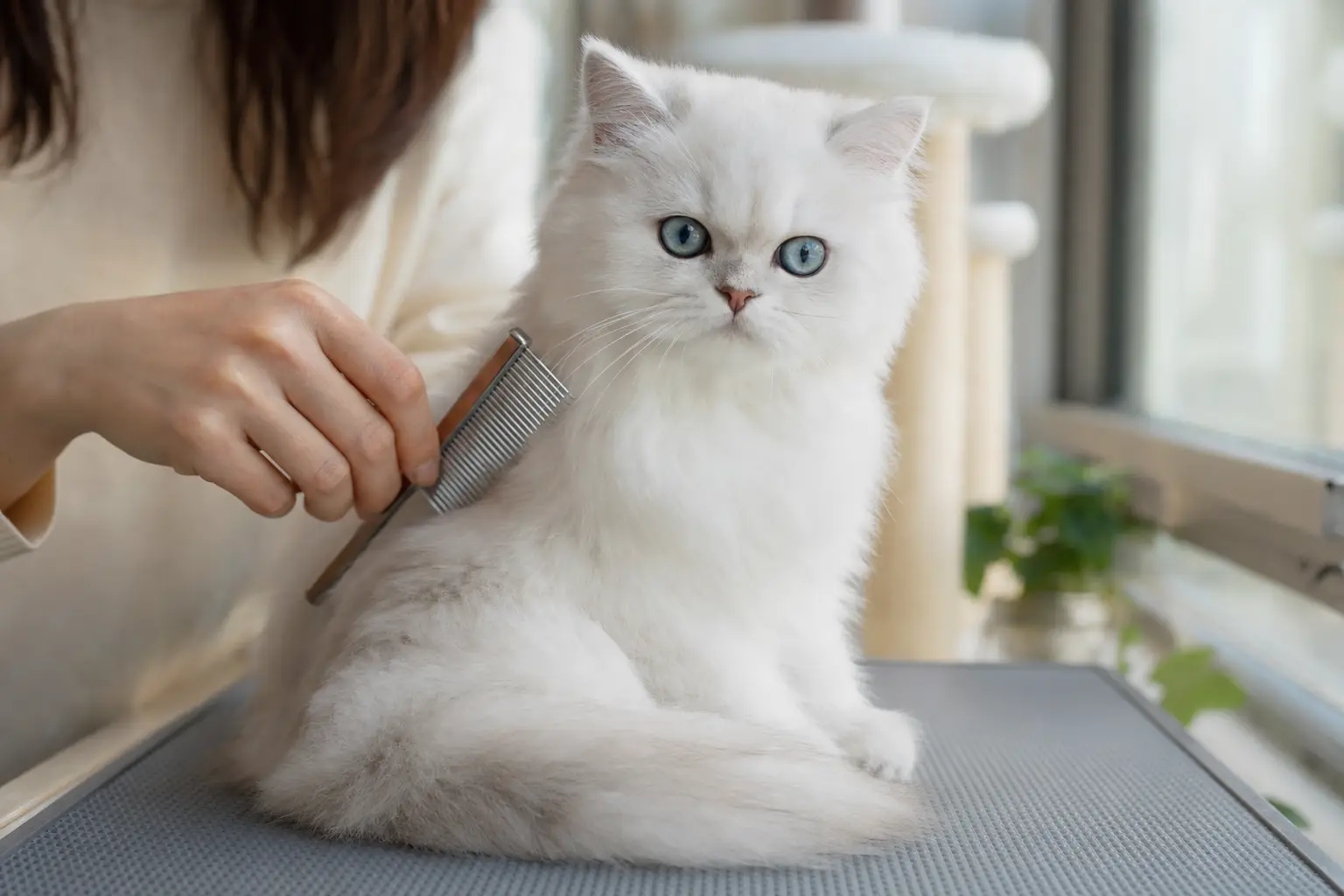
Persian Kittens: How to Read a Relaxed Tail During Grooming
When a Persian kitten accepts grooming with a loose body and a relaxed tail during grooming, that is a promising sign. It usually means the kitten is not feeling trapped or intensely threatened at that moment. But a tail is only one part of feline body language, so the best assessment comes from reading the whole kitten.
Successful grooming does not mean a kitten stays perfectly still while every knot is removed. It means the kitten can participate without escalating stress, receive gentle handling, take breaks, and recover quickly. That standard creates safer coat-care habits and helps prevent brushing from becoming a daily struggle.
What a relaxed tail during grooming looks like
Every kitten has an individual resting posture. Some Persians naturally carry the tail low, while others hold it in a gentle curve or let it rest beside the body. The key is not one exact position. Look for a tail that appears loose rather than rigid.
- Loose position: The tail rests naturally instead of being tightly tucked, stiffly extended, or clamped against the body.
- Gentle movement: A slow, occasional shift or soft wave can be compatible with relaxation, especially when the rest of the body remains soft.
- Flat fur: The tail coat is not suddenly puffed up. Raised fur can indicate strong arousal, fear, or surprise.
- No forceful thumping: Repeated whipping or hard thumping against the floor is a reason to pause and reassess.
- Consistent behavior: The tail remains reasonably loose as you make calm, light strokes rather than becoming increasingly tense.
A tail that is completely still is not automatically a relaxed tail. A frightened kitten may freeze. Conversely, a small tip twitch does not always mean the kitten is upset; it can reflect concentration, excitement, or mild stimulation. Context matters more than a single movement.
Read the tail with the rest of the body
The most useful question is not, What does this tail position mean? It is, Does the entire kitten look able to cope with this grooming step? Combine the tail with these signals:
| What you notice | What it may suggest | What to do |
|---|---|---|
| Soft posture, neutral ears, relaxed tail, normal breathing | The kitten may be comfortable or mildly interested | Continue briefly, then offer a pause |
| Tail tip twitching, focused eyes, body still but not rigid | Attention or rising stimulation; not enough information by itself | Reduce pressure and check again after a short pause |
| Tail lashing, ears turned sideways or back, tense shoulders | Stress, irritation, or discomfort may be building | Stop the stroke, remove the tool, and give space |
| Tucked tail, puffed fur, crouched body, wide pupils | Fear or intense arousal | End the session and let the kitten retreat |
| Repeated head turns, swatting, growling, hissing, or attempts to escape | The kitten is clearly asking for the interaction to stop | Do not hold the kitten down; end grooming safely |
Soft eyes, neutral whiskers, ears that are forward or gently to the side, and a body that is not braced against the surface all support the interpretation of a relaxed tail. Some kittens may purr, but purring is not a reliable guarantee of contentment. Cats can also purr when anxious or trying to settle themselves, so use it as one small clue rather than proof that grooming is going well.
Why Persian kitten grooming needs a low-pressure approach
Persian coats are long and can form tangles close to the skin. A knot may pull whenever the kitten moves, so a kitten that suddenly objects to brushing may be reacting to discomfort rather than being stubborn. The tail, legs, belly, armpits, and behind the ears can be especially challenging because they are sensitive areas and are easy to tug accidentally.
Frequent, gentle maintenance is generally easier for a kitten than occasional attempts to remove a large number of tangles. The aim is to teach that combs predict calm handling, short sessions, and relief—not restraint and escalating discomfort.
How to build a calmer grooming session
1. Prepare the setting
Choose a quiet area with good lighting and a stable, non-slip surface. Keep the tools within reach so you do not have to leave the kitten unattended or make sudden movements. A cat-safe comb or brush should suit the coat and be used with light pressure. If a tool scratches your own skin, it is too harsh for delicate kitten skin.
2. Start with a comfortable area
Begin with a few gentle strokes on an area the kitten already accepts, such as the shoulders or side of the body. Do not begin with a difficult mat, the belly, or the tail. Let the kitten sniff the tool, and reward calm behavior with a small treat, quiet praise, or a brief play break if those are motivating.
3. Pause before the kitten needs to escape
After a few strokes, stop and observe. Is the tail still loose? Have the ears changed? Is the kitten leaning away, holding the breath, or watching the brush tensely? Ending while the kitten is still comfortable teaches a more valuable lesson than extending the session until the kitten protests.
4. Approach the tail gently
When the rest of the body is calm, work toward the tail gradually. Never pull the tail, bend it sharply, or use it as a handle. Follow the direction of the hair with light strokes, and avoid repeatedly combing the same spot if the kitten begins to tense. If the tail becomes rigid or starts thumping, remove the tool and return to a neutral area—or finish for the day.
5. Treat mats as a safety issue
Do not yank a tight mat or cut close to the skin with household scissors. Cat skin can be pulled into a mat and is easy to injure. A small loose tangle may sometimes be eased apart with appropriate professional guidance, but dense, tight, or widespread mats are best assessed by a veterinary team or an experienced cat groomer.
What success really looks like
A relaxed tail is encouraging, but grooming success is better measured by the kitten’s ability to remain comfortable and recover. Look for a pattern such as:
- The kitten approaches or remains near the grooming area without immediate avoidance.
- The body stays loose while you handle easy areas.
- The tail remains natural instead of becoming tucked, rigid, or forcefully active.
- The kitten can pause, accept a reward, and resume later without escalating.
- After grooming, the kitten returns to normal behavior rather than hiding for a prolonged period.
Cooperation does not require forcing a kitten to endure every step. Giving a choice to move away, when safe, can provide useful information. A kitten that repeatedly leaves is communicating that the session is too difficult, too long, painful, or poorly timed. Adjust the process rather than simply increasing restraint.
When a tail change may need veterinary attention
Grooming behavior can reveal pain. If a kitten that usually accepts touch suddenly guards the tail, cries, bites when the area is approached, walks differently, or keeps the tail in an unusual position, stop grooming and contact a veterinarian. A sudden change should not be dismissed as a training problem.
Also stop immediately if the kitten shows open-mouth breathing, persistent panting, weakness, collapse, or visibly labored breathing. Persian cats can have shortened facial structures, and stress or heat may be particularly unhelpful for some individuals. Move the kitten to a quiet, cool area and seek urgent veterinary advice if breathing does not promptly return to normal or appears difficult.
For broader cat-care guidance, see International Cat Care and VCA’s overview of grooming and coat care for cats. These resources cannot replace an examination when a kitten seems painful or unwell.
FAQ
Is a still tail always a sign that my Persian kitten is relaxed?
No. A still tail can occur during calm observation, but it can also accompany fear or freezing. Check the ears, eyes, posture, breathing, and whether the kitten can move away or accept a pause.
What does tail lashing mean during brushing?
Repeated, forceful tail movement often means stimulation, irritation, stress, or discomfort is increasing. Stop brushing for a moment and check for a snag, mat, sensitive area, or overly long session.
How long should a Persian kitten grooming session last?
There is no useful universal time limit. For a young or inexperienced kitten, a few calm strokes may be enough. Increase gradually only when the kitten remains comfortable, and finish before body language turns tense.
Final takeaway
Reading a relaxed tail during grooming is about looking for a loose, natural tail alongside a soft body, neutral ears, normal breathing, and the ability to pause without panic. If the tail or the rest of the kitten says the experience is becoming too much, stop. Short, predictable sessions build trust more effectively than trying to complete every grooming task at once.
Looking for more practical Persian kitten care guidance? Explore CTkittens.com for additional tips on coat care, kitten comfort, and life with a Persian companion.

Rachel Cohen is a journalist and producer with a passion for audio storytelling, health and science reporting, and feline companions.
A graduate of Middlebury College, Rachel spends her weekends exploring the mountains and when she isn’t outdoors or chasing a story, she can usually be found hanging out with her cats.


The bit about a still tail possibly meaning freeze mode caught me off guard, cause I’ve def mistaken “not moving” for “totally chill” before lol.
That bit about a still tail maybe meaning “frozen scared” instead of relaxed is lowkey important, cause cats be subtle as hell when they’ve had enough.
Honestly I used to think a still tail meant my kitten was chill, so the bit about freezing kinda made me rethink how I been brushing her.
Ngl, the bit about purring not always meaning they’re chill made me rethink how many times I probably kept brushing when my kitten was lowkey asking me to stop.
Kinda wild how reading a kittens tail during brushing is basically the same broader lesson as consent anywhere else—notice the small “nope” signals before they gotta start yelling, lol.
Kinda wild how grooming a kitten is basically a lesson in consent, like if the tail starts thumping they’re saying “nah fam” way before the claws come out.