
Ragdoll Kittens: Reading a Relaxed Tail During a Pet Introduction
Short answer: When a Ragdoll kitten holds its tail upright with a soft curve, keeps its body loose, and shows neutral or forward-facing ears, it is often communicating comfortable interest. That does not mean the kitten is ready for a face-to-face meeting. A relaxed tail is a green light to continue calmly, not permission to rush.
Understanding Ragdoll kitten body language is especially useful during introductions because kittens can move from curious to overwhelmed in a few seconds. The safest approach is to watch the entire kitten, give both animals room to retreat, and make each meeting brief enough to end on a positive note.
A small moment that changed the pace
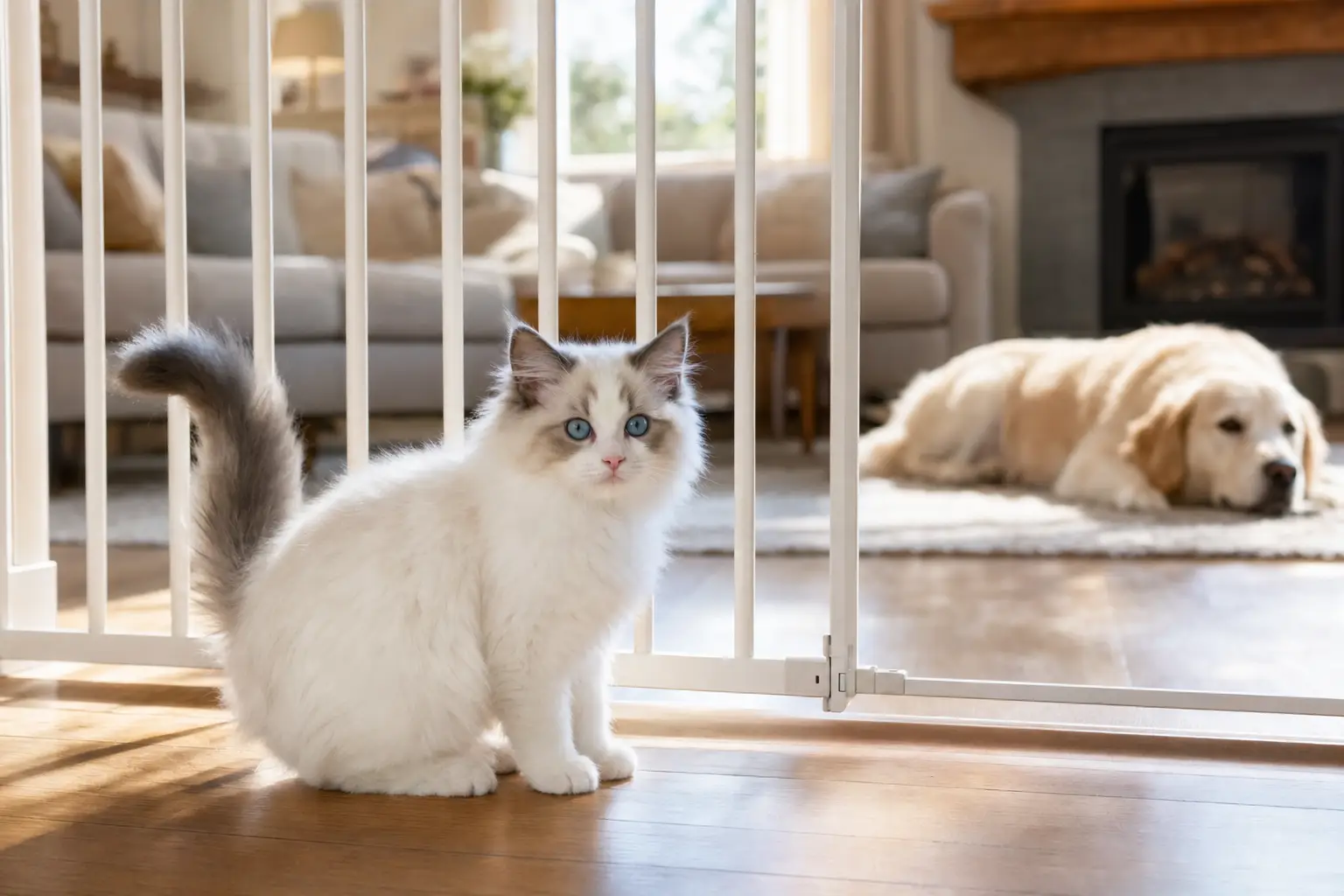
The following is an illustrative example, not a report of a particular household. Imagine a young Ragdoll kitten called Willow meeting a calm adult dog called Jasper. Willow is behind a tall baby gate, with a quiet room behind her and no pressure to approach.
Jasper notices the kitten and looks away instead of staring. Willow steps forward. Her tail rises, the tip makes a gentle curve, and her back remains level. Her ears point mostly forward, her whiskers sit naturally, and she pauses to sniff the air.
Those details suggest that Willow is interested without showing obvious fear. The people in the room do not open the gate or carry her closer. They allow a few quiet seconds, offer a treat on her side of the barrier, and then end the session while both animals are still settled.
The next meeting is not automatically longer just because the first one went well. They repeat the same setup, watching for changes. If Willow’s tail begins to lash, her ears flatten, or she retreats and does not return, the distance increases. Her relaxed tail helped them read the moment, but her whole body determined what happened next.
What a relaxed tail may be telling you
A cat’s tail is expressive, but it is not a stand-alone mood meter. Position, movement, muscle tension, facial expression, and the surrounding situation all matter.
| Tail and body pattern | Possible meaning | Helpful response |
|---|---|---|
| Tail upright, with a loose curve or softly hooked tip | Friendly interest, confidence, or a comfortable greeting | Maintain the current distance and let the kitten choose whether to investigate |
| Tail low or tucked close to the body | Uncertainty, fear, or a desire to avoid interaction | Increase space and provide a hiding place or escape route |
| Tail puffed, with an arched or stiff body | Alarm, defensive arousal, or intense excitement | Stop the interaction without punishment and separate the animals calmly |
| Tail moving slowly from side to side | Focused attention; the meaning depends on the rest of the posture | Watch closely rather than assuming the kitten is relaxed |
| Sharp tip twitching or fast lashing | Rising stimulation, frustration, irritation, or conflict | Pause, create distance, and allow the kitten to settle |
A tail held high is generally more reassuring than a tucked or puffed tail, but context can change the meaning. A kitten may raise its tail while approaching something unfamiliar because it is curious, not because it has already accepted that animal. Similarly, a kitten that appears still may be frightened rather than calm.
Read the whole kitten, not just the tail
Good observation looks for a pattern of signals. During a supervised meeting, encouraging signs may include:
- A loose body rather than a crouched, rigid, or flattened posture.
- Ears that remain neutral or gently forward instead of pinned sideways or backward.
- Normal breathing and ordinary movement, including sniffing or calmly looking away.
- Willingness to eat a treat, play briefly, or return to the area after stepping away.
- Soft eyes and relaxed whiskers, without a fixed stare or tightly pulled-back facial expression.
Signals to pause include repeated hiding, crouching, freezing, frantic escape attempts, growling, hissing, swatting, or a sudden change from loose movement to stiffness. One hiss is not a failure. It is information that the kitten needs more distance or a slower pace.
Do not punish hissing, growling, or retreating. These behaviors can warn you that the kitten is uncomfortable. Quietly block the view, guide the other animal away, or end the session. Physical restraint can remove the kitten’s ability to make a safe choice and may make future meetings more stressful.
A calmer way to introduce a Ragdoll kitten to another pet
Introductions work best as a series of small, predictable steps rather than one dramatic meeting. The timeline should follow the animals’ behavior, not a calendar.
1. Start with separate spaces
Give the kitten a secure room containing food, water, a litter box, bedding, toys, scratching material, and places to hide. The resident pet should keep its normal routine as much as possible. This first separation allows both animals to become familiar with new smells without the pressure of direct contact.
2. Exchange scents before faces
Use clean bedding or a soft cloth to carry each animal’s scent into the other’s area. You can also feed them on opposite sides of a closed door if both remain comfortable. Begin far enough from the door that each animal can eat normally, then gradually move the bowls closer over later sessions if there are no signs of stress.
3. Add a visual barrier
A tall gate, secure screen, or partly opened door can provide a controlled view. Keep the first visual sessions short. Reward calm behavior, but do not lure the kitten or resident pet toward the barrier if either one wants to move away.
4. Try brief, supervised time together
Only move to the same-room stage when both animals can see each other without persistent fear or intense fixation. Keep the kitten’s escape routes open. A high perch, cat tree, or nearby kitten-safe room is more useful than placing the kitten in the center of the floor.
End while the interaction is still calm. Several short sessions are usually easier to manage than one long session in which one animal becomes overwhelmed.
If the other pet is a dog
Keep the dog on a loose leash at first, and reward looking away, sitting, or responding to the handler. Do not allow chasing, cornering, pawing, or nose-to-face pressure. A wagging dog tail does not automatically mean friendliness; a stiff body, fixed stare, closed mouth, or intense forward focus may signal that the dog needs more distance.
Never leave a kitten alone with a dog until you are confident the dog can remain calm and the kitten has safe ways to escape. A dog with strong chase behavior, poor impulse control, or a history of aggression needs extra caution and professional guidance before direct contact.
If the other pet is a cat
Give each cat separate resources at first. That includes food and water stations, litter boxes, resting areas, scratching posts, and hiding spaces. Cats may need more time to accept shared territory than their owners expect, so avoid forcing them to sit together or carrying one cat toward the other.
Watch for resource blocking, prolonged staring, ambushing, or one cat becoming afraid to access food, water, or the litter box. These are reasons to return to an earlier introduction stage. For broader information about feline conflict and aggression, see the Cornell Feline Health Center’s overview of aggression in cats.
Why a Ragdoll’s reputation is not a guarantee
Ragdolls are often described as gentle or easygoing, but breed descriptions cannot predict every individual kitten. Early socialization, genetics, previous experiences, health, the resident pet’s behavior, and the home environment all influence an introduction.
A confident kitten may still need time. A shy kitten may become comfortable with patient management. Even a friendly kitten can become frightened if another animal rushes forward. Treat the kitten in front of you as an individual rather than assuming that a Ragdoll will automatically welcome a dog or another cat.
The same principle applies to the resident pet. A calm animal in one setting may react differently when a new kitten enters its territory. Look for repeatable calm behavior across several sessions before increasing freedom.
When a relaxed tail is not enough
Body language can guide everyday decisions, but it cannot diagnose pain, illness, or serious behavioral problems. Contact a veterinarian if a kitten shows a sudden and lasting change in behavior, appears painful, stops eating or drinking, has repeated vomiting or diarrhea, or becomes unusually withdrawn. A veterinary behaviorist or another appropriately qualified behavior professional may be helpful when introductions involve repeated attacks, severe fear, or a dog that cannot disengage from the kitten.
If a fight starts, do not put your hands between the animals or grab at their faces. Use a barrier, a door, or another safe method to separate them, then allow everyone to settle before reassessing the plan. Seek veterinary care for significant bites, scratches, or other injuries.
FAQ
Does an upright tail mean my Ragdoll kitten is ready to meet the other pet?
No. It usually suggests that the kitten is not showing obvious fear at that moment, but readiness also depends on loose posture, calm movement, and the other animal’s behavior. Continue with distance and supervision rather than moving straight to contact.
What should I do if the kitten’s tail drops during the meeting?
Increase distance and reduce the pressure. Let the kitten retreat to a safe area, and end the session if the tail stays low or other stress signals appear. Try again later at an easier stage, such as scent exchange or a visual meeting through a barrier.
How long should introductions take?
There is no reliable universal schedule. Some animals progress quickly, while others need repeated short sessions over a longer period. Move forward only when both pets remain relaxed at the current stage, and step back whenever stress returns.
The calmest reading is the most useful one
A relaxed, gently curved tail is encouraging because it may show that a Ragdoll kitten feels safe enough to observe and explore. The real skill is resisting the urge to overinterpret it. Pair the tail with the ears, eyes, whiskers, posture, movement, and the other pet’s behavior.
When the kitten can approach, pause, retreat, and return by choice, introductions become a conversation instead of a confrontation. For more guidance on welcoming a Ragdoll kitten and preparing your home, explore the resources at CTkittens.com.

Rachel Cohen is a journalist and producer with a passion for audio storytelling, health and science reporting, and feline companions.
A graduate of Middlebury College, Rachel spends her weekends exploring the mountains and when she isn’t outdoors or chasing a story, she can usually be found hanging out with her cats.

