Short answer: choose DIY unless your child learns better with a picture book, visual cards, or a plush cat. No special product is needed to teach a child the slow-blink hello to a Persian kitten. The most useful tools are a calm adult, short sessions, and a clear lesson: invite the kitten to communicate, but never demand a response.
A slow blink is not a trick that a kitten must perform on cue. It is a relaxed narrowing and closing of the eyes that people can use as a friendly, non-threatening signal. A kitten may blink back, look away, walk closer, or do nothing at all. Each response can be normal. During the first month, the goal is not to produce a perfect kitten greeting; it is to help a child notice body language and respect the cat’s choice.
Persian Kittens: How to Teach a Child the Slow-Blink Hello
What the slow blink means
When a cat is comfortable, its face and body usually look loose rather than tense. The eyes may soften, the ears may rest in a neutral position, and the cat may close its eyes briefly before looking away. A human can copy that relaxed expression by looking toward the kitten without staring, slowly closing the eyes, opening them again, and then turning the head slightly aside.
Research published in Scientific Reports found that cats were more likely to approach people after slow-blink interactions, and people were more likely to receive a positive response when they used the expression. That does not mean every cat will answer every time, or that a blink overrides other body-language signals. Think of it as a polite invitation rather than a command. Read the study on cat eye-narrowing communication.
DIY or store-bought: which option is better?
For most families, a DIY approach is the better starting point. It costs nothing, keeps the lesson focused, and can be adjusted to the child’s age. A store-bought item can support the lesson, but it cannot make a shy kitten trust a child faster.
| Option | What it can do | Limit |
|---|---|---|
| DIY picture card | Shows three steps: sit quietly, slow blink, wait. | An adult still needs to explain the pictures and supervise. |
| DIY routine chart | Reminds the child to have one brief, calm practice each day. | It should not turn the kitten’s response into a score or competition. |
| Children’s cat body-language book | Provides illustrations and gives the child something to study away from the kitten. | Books vary in quality; the child still needs to observe the individual cat. |
| Plush cat | Lets a child rehearse a soft gaze and slow blink without approaching the real kitten. | It teaches the movement, not the kitten’s consent signals. |
| Interactive cat toy | Can help build a positive relationship through adult-led play. | It is not a slow-blink tool, and string or wand toys should be put away after use. |
A useful DIY kit can be as simple as a sheet of paper with three drawings: a seated child, gently closed eyes, and a pause symbol. Add one rule in large letters: Let the kitten choose. A child can practice the blink with a stuffed animal first, then try it with the kitten only when the kitten is awake, visible, and relaxed.
If you buy something, choose a calm visual aid rather than a gadget that flashes, makes noise, or encourages the child to get close to the kitten’s face. A picture book or plush animal is usually more relevant than a clicker, laser pointer, or electronic toy.
A four-week plan for teaching a child the slow-blink hello
There is no fixed timetable for trust. Some kittens are outgoing on the first day; others need much longer. Use the schedule as a gentle framework, not a test.
Days 1–3: observe before practicing
Give the kitten a quiet base area with food, water, a litter tray, resting places, and hiding options. The child can sit nearby with an adult and watch without reaching in. The adult can model one slow blink from a comfortable distance.
Do not ask the child to approach a hiding kitten, pick it up, or stare at it. A kitten that is eating, sleeping, using the litter tray, or retreating needs privacy. In these first days, learning that the child will not chase or grab is more valuable than learning a greeting.
Days 4–7: introduce one quiet blink
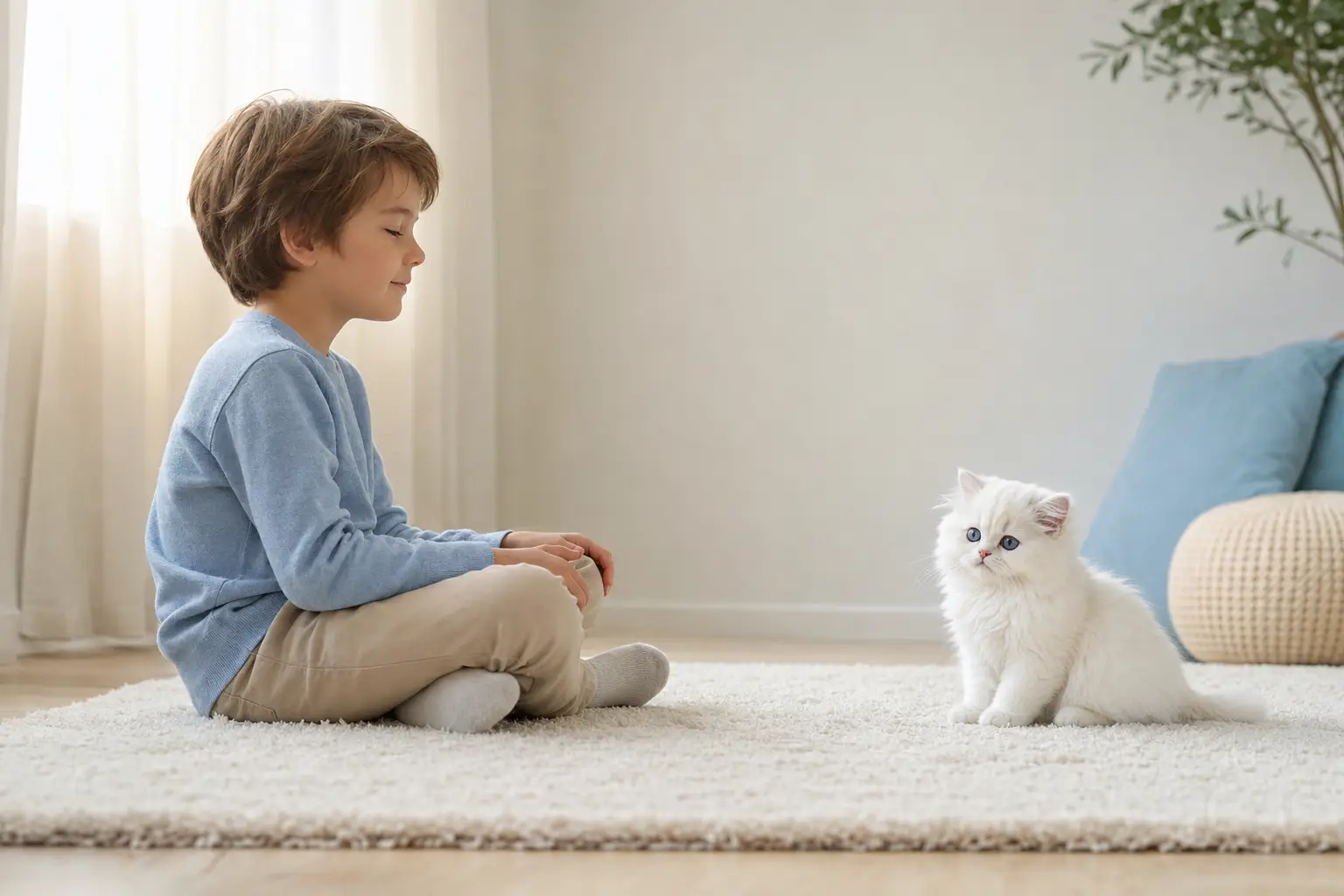
When the kitten is out and settled, have the child sit sideways rather than face-to-face. Ask for one soft look, one slow blink, and then a pause. The child can quietly look at a book or move their gaze away afterward. A response is welcome but not required.
Keep the practice brief. One good attempt is better than repeated blinking that turns into staring. If the kitten walks away, the lesson is finished. The child can say, “Thank you for telling me,” so leaving becomes part of the communication lesson.
Week 2: pair the blink with a calm hello
Once the kitten is comfortable seeing the child, add a quiet word such as “hello.” The child should speak softly, blink once, and wait. Avoid leaning over the kitten or putting a face close to its face.
Teach the child to look for the whole body, not just the eyes. A loose posture, neutral ears, and a relaxed tail are more reassuring than a single blink. Flattened ears, a crouched body, a rapidly lashing tail, hiding, hissing, swatting, or repeated head-turning mean the child should stop and give space. A practical overview of these signals is available from Cats Protection’s cat body-language guide.
Week 3: let the kitten choose proximity
If the kitten approaches after the blink, the child can remain still and let the kitten sniff. Petting should happen only if the kitten clearly invites it by staying close, leaning into a hand, or presenting the side of the face. Start with one or two gentle strokes on the cheek or under the chin if the kitten enjoys them.
The child should not touch the eyes, whiskers, tail, paws, or belly during this exercise. An adult can offer a toy or treat if appropriate, but the child should not use food to lure the kitten toward a face or hold it in place. The kitten’s ability to walk away is part of feeling safe.
Week 4: practice in ordinary moments
By the fourth week, the child can use the slow blink when entering the room, before calm play, or after the kitten settles nearby. There is no need for a daily drill. A natural greeting that lasts a few seconds is more useful than a formal session.
Celebrate good choices rather than results. “You blinked and waited” is better feedback than “The kitten did not blink back.” This teaches the child that respectful communication is successful even when the other individual chooses not to respond.
Persian kitten considerations
Persian kittens may need extra care around the face and coat. Their long coats can mat, and their facial structure can contribute to watery eyes or tear staining. Grooming and eye-area care should be demonstrated by a veterinarian or experienced professional, especially during the first month. A young child should not be responsible for brushing out mats, wiping near the eyes, or applying any product.
Do not interpret persistent squinting as a friendly slow blink. Contact a veterinarian if one or both eyes stay partly closed, look red or cloudy, produce unusual discharge, or seem painful. Also seek advice if the kitten is lethargic, stops eating, hides unusually, or shows a sudden change in behavior. Eye discomfort can make a kitten avoid interaction, and it needs medical attention rather than more practice.
Keep every child-kitten interaction supervised. Children should wash their hands after handling pets, avoid kissing the kitten, and leave the kitten alone around food and the litter tray. The Centers for Disease Control and Prevention’s healthy-pets guidance offers general advice about handwashing and safer interactions between children and animals.
Common mistakes to avoid
- Holding the kitten still so the child can blink at it.
- Repeating the blink until the kitten reacts.
- Teaching the child that a look, hiss, or retreat is misbehavior.
- Putting a phone, mirror, toy, or treat directly in front of the kitten’s face.
- Allowing unsupervised handling, chasing, rough play, or access to loose strings.
- Assuming a blue-eyed or long-haired Persian kitten has the same comfort level as another cat.
FAQ
What if my Persian kitten never blinks back?
That is not a failure. The kitten may be relaxed without copying the gesture, or may prefer to communicate through posture, scent, play, or proximity. If the kitten remains comfortable and can leave freely, the child is learning the right lesson.
Can a child practice the slow blink in a mirror?
Yes. A mirror or plush cat can help a child learn to close and open the eyes slowly. Keep the practice separate from the kitten so the child does not become focused on making the cat perform.
Should we buy a special slow-blink toy?
No. There is no need for a specialized product. A DIY picture card is enough. Consider a children’s book or plush cat only if it helps your child understand the steps or practice calmly away from the kitten.
The best first-month choice
Start with DIY: a simple visual card, an adult demonstration, and one respectful attempt when the kitten is relaxed. Add a store-bought book or plush cat if your child benefits from extra visual practice, but keep the real interaction slow and optional.
The most meaningful hello is not the one that gets a guaranteed blink back. It is the one that tells a Persian kitten, through patience and space, that this child will listen.
Ready for more thoughtful Persian kitten care? Explore the guides and kitten resources at CTkittens.com.
Sources and further reading

Rachel Cohen is a journalist and producer with a passion for audio storytelling, health and science reporting, and feline companions.
A graduate of Middlebury College, Rachel spends her weekends exploring the mountains and when she isn’t outdoors or chasing a story, she can usually be found hanging out with her cats.