
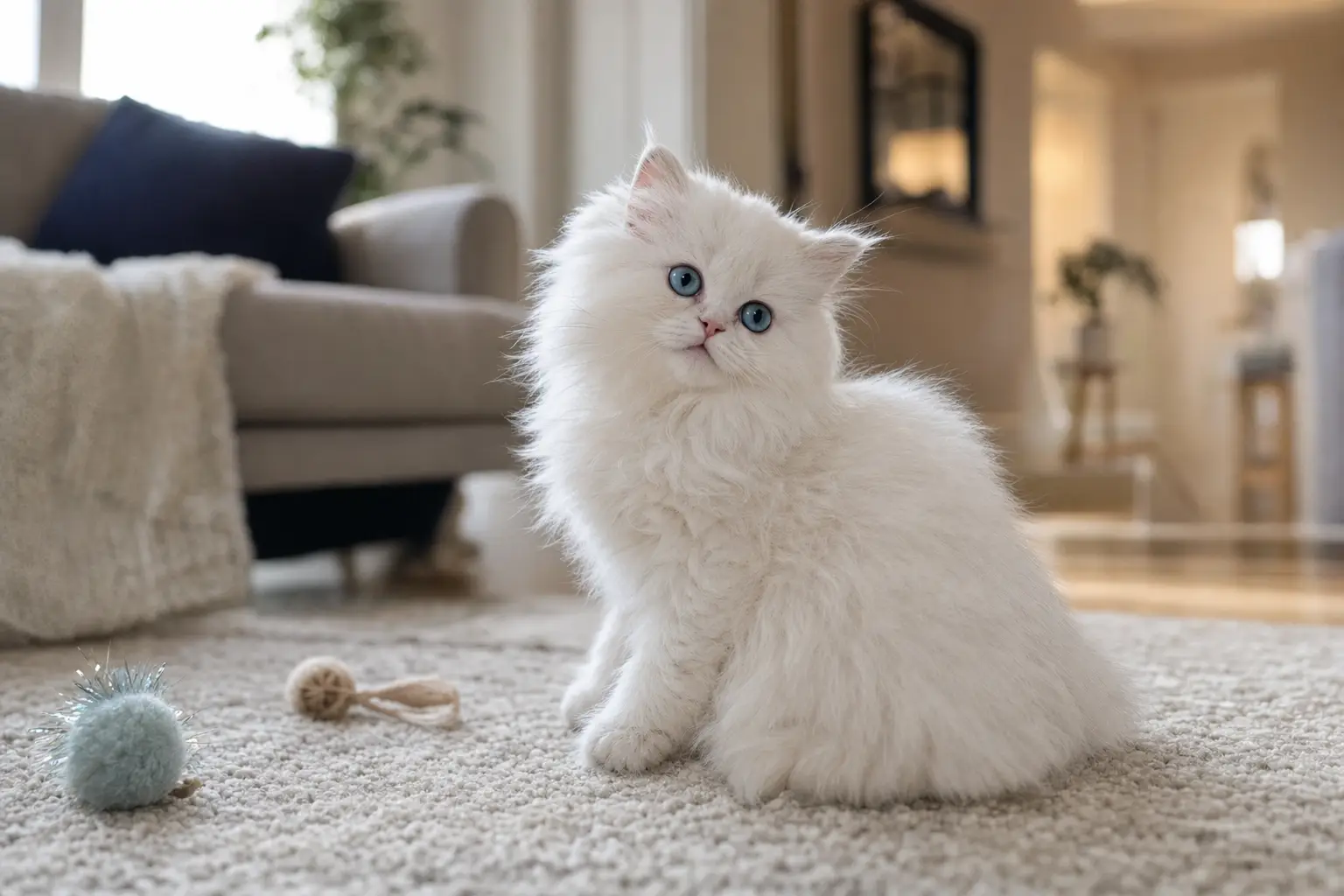
Yes, you can teach a Persian kitten its name, even when the home is full of footsteps, appliances, visitors, toys, and other pets. The most reliable approach is simple: say the name once in a pleasant voice, reward the kitten for orienting toward you, and slowly practice in more distracting rooms.
At first, a name response does not mean running across the house. It may be no more than an ear flick, head turn, eye contact, or a pause in play. Those small responses are the foundation. Once your kitten consistently looks toward you, you can separately build a stronger come-when-called behavior.
The short version: Begin in a quiet base room with five-to-eight repetitions per session. Say the name once, mark the instant your kitten notices you with a calm yes, and offer a tiny treat, play, or gentle attention. Move to another room only when the response is easy in the current one.
What a name response really means
A kitten does not automatically understand that a sound is a personal label. Your kitten learns that the sound predicts something worthwhile. In practical terms, the pattern is:
- Say the name once.
- Your kitten turns an ear, looks, or shifts attention toward you.
- Immediately reward that response.
Use the name as a friendly attention cue, not as a command for every behavior. If you say it before meals, play, a favorite treat, or calm affection, it can become a useful invitation to check in with you. If it is mostly followed by medicine, nail trimming, being placed in a carrier, or being scolded, your kitten may begin to avoid it.
Persian kittens are individuals. Their breed does not guarantee a particular level of responsiveness, and a quiet or observant kitten is not necessarily being stubborn. Keep the sessions short and adjust the environment instead of increasing your volume.
Prepare the home before training
Choose one name and one pronunciation. Ask everyone in the household to use it consistently, especially during the first few weeks. A nickname can be introduced later, but several different sounds at the beginning can make the association less clear.
Choose rewards your kitten genuinely values. Tiny soft treats are convenient, but a short chase with a wand toy, a favorite toy tossed along the floor, or gentle attention may work just as well. If your kitten has a medical condition or a restricted diet, ask your veterinarian which treats are appropriate.
- Train when your kitten is awake, comfortable, and not already overwhelmed.
- Keep treats small and account for them as part of the daily food plan.
- Use a calm, bright tone rather than a loud or urgent voice.
- Keep doors, balconies, windows, hot surfaces, cords, and toxic plants secured.
- Stop while your kitten is still engaged, rather than waiting for frustration.
A useful first goal is five successful responses in a quiet room. That may take one session or several days. Progress is measured by relaxed, dependable responses—not by how quickly you can move from room to room.
How to teach a Persian kitten its name
Start about one or two feet away when your kitten is calmly looking around. Say the name once in a light, cheerful voice. Do not immediately repeat it. The moment your kitten shows any sign of noticing you, use a brief marker such as yes and deliver the reward.
Wait a few seconds and reset. Repeat only a handful of times. If your kitten does not respond, make the exercise easier: move closer, reduce background noise, choose a better reward, or wait until your kitten is not focused on a toy or meal. Repeating the name several times in a row can teach your kitten that the first few repetitions do not matter.
Once your kitten reliably looks at you, add distance in small steps. Then practice while you are sitting, standing, or briefly moving away. Reward the look first. Later, give a larger reward when your kitten chooses to walk toward you.
A room-by-room training plan
Each room adds a different kind of distraction. Change one factor at a time—distance, sound, movement, people, or another animal—so you can tell what your kitten is ready for.
| Room | Training goal | How to practice |
|---|---|---|
| Base room | Notice the name | Practice at close range with little noise. Reward an ear turn, glance, or head turn. |
| Kitchen | Respond around ordinary household sounds | Practice away from hot surfaces and food preparation. Use a treat or toy, not the kitten’s bowl every time. |
| Living room | Respond while people move | Have one person walk slowly or sit nearby. Reduce the distance if your kitten keeps watching the movement instead of you. |
| Hallway or stairs | Turn attention across space | Call from a short, safe distance. Reward any turn toward you before expecting the kitten to travel farther. |
| Grooming area | Keep the name emotionally neutral | Pair the name with treats and calm interaction, not only brushing, bathing, medication, or nail care. |
| Window or entry area | Manage high-value distractions | Work well away from an open door, visitor, or exciting view. Security comes before testing a response. |
The base room: build clarity first
Use a quiet room where your kitten already feels secure. Sit on the floor and let the kitten settle. Say the name once when the kitten is not deeply absorbed in something else. Reward orientation, then release your attention.
Do not stare intensely or lean over the kitten. A relaxed posture makes it easier for a cautious kitten to choose interaction. If your kitten walks away, let the session end and try again later.
The kitchen: add sound without adding danger
The kitchen is useful because it contains low-level distractions, but it is not a place to train near a hot stove, sharp tools, open appliances, or food that could be harmful to cats. Begin when the room is quiet. Later, practice while a cupboard closes or someone walks past at a distance.
Avoid making the name a synonym for dinner. Food can be a powerful reward, but use play and attention too. That helps your kitten respond in rooms where no bowl is present.
The living room: work around movement
Movement is often more difficult than sound. Ask another person to cross the room slowly while you practice. Reward a glance toward you, then pause. If your kitten can respond three or four times, increase the person’s movement gradually.
When toys are involved, do not interrupt an intense chase repeatedly. Wait for a natural pause, say the name, and reward the check-in. The lesson is that responding does not always mean the fun stops.
The hallway and stairs: build distance carefully
Start with only a few feet between you and your kitten. Say the name, and reward the turn. If the kitten takes a step toward you, offer an additional reward. You can then toss a toy or treat slightly behind the kitten to reset without physically moving the kitten into position.
Stairs require extra care. Do not call a young kitten from a dangerous height or encourage rushing. A hallway on one level is enough until your kitten has good footing and the area is securely managed.
The grooming area: protect the meaning of the name
Long-coated kittens need regular coat care, but the name should not predict only an unpleasant task. Several times when no grooming is needed, enter the area, say the name, reward a look, and leave. During grooming, use separate cues and frequent calm breaks where possible.
If your kitten becomes distressed during brushing, stop and seek guidance on handling and coat care rather than trying to solve the problem by calling more insistently.
Windows and entryways: save these for last
Outdoor movement, visitors, and an opening door can be more compelling than any treat. Practice far from those distractions first. Never test a name response by allowing a kitten near an unsecured door, balcony, or window.
A name response is not a safety barrier. Use secure screens, closed doors, identification, and supervision. Training should support good management, not replace it.
How to increase distractions without losing progress
Think of distractions as a ladder. Move from a quiet room to a person sitting nearby, then a person walking, a household sound, a toy at a distance, and finally a more exciting view or visitor. Stay at each level until your kitten can respond comfortably several times.
If the response disappears, the distraction is too large for the current skill level. Move farther away, reduce the sound, put the toy down, or return to the previous room. This is not failure; it is useful information about the next training step.
Once the response is established, do not stop rewarding altogether. You can gradually vary the reward so the kitten does not receive food every single time, but continue to offer play, praise, attention, or occasional treats. Fade a food lure, not the good consequences of responding.
Common problems and practical fixes
My kitten ignores the name
Check the setting first. Your kitten may be tired, overstimulated, focused on prey-like movement, or too far away. Lower the distraction and reward a smaller response. If the kitten rarely reacts to voices or ordinary sounds, mention it to a veterinarian because hearing or health concerns can affect responsiveness.
My kitten comes only when treats are visible
Keep the reward hidden until after the response. You can also alternate food with a toy or affection. If you have been luring the kitten physically, begin showing the reward only after the kitten looks or approaches.
My kitten runs away after hearing the name
The name may have become associated with being picked up, stopped, or handled. Rebuild it in the quietest room: say the name softly, reward immediately, and do not follow with an unpleasant event. Keep sessions easy for several days.
There is more than one cat
Practice individually at first. In a group, say one cat’s name and reward that cat for orienting while the others receive no correction. Keep the distance generous and prevent competition over treats. Later, practice brief name checks with everyone present.
Name response versus recall
These are related but different skills. The name tells your kitten, pay attention. Recall means come to this location. Teach the first skill before expecting the second.
When your kitten looks toward you reliably, take one small step backward after saying the name. Reward movement toward you. Gradually increase the distance, but keep high-risk situations out of the exercise. For outdoor access, secure containment and supervision remain essential regardless of training.
Frequently asked questions
How long does it take to teach a Persian kitten its name?
Some kittens begin orienting within a few sessions, while others need more time. Age, temperament, previous experiences, reward value, and household noise all matter. Short daily practice is generally more useful than one long session.
Should I repeat the name if there is no response?
No. Pause and make the exercise easier instead. Repeating the name can make it background noise. Try again when your kitten is closer, calmer, or less engaged with another activity.
Can I change my kitten’s name?
Usually, yes. Use the new name consistently and pair it with pleasant outcomes. If the old name has a negative history, avoid using both names interchangeably during the rebuilding period.
A cheerful habit, not a demand
The best name response is relaxed and willing. Your kitten should learn that noticing you leads to something good, even when the home is busy. Keep the cue positive, change rooms gradually, and respect the moments when your kitten needs rest or space.
For broader feline welfare and behavior information, consult resources from International Cat Care and the ASPCA. If your kitten shows sudden changes in responsiveness, fear, pain, or unusual behavior, contact your veterinarian.
Ready for more thoughtful Persian kitten guidance? Explore CTkittens.com for practical resources to help your kitten settle, bond, and thrive at home.

Rachel Cohen is a journalist and producer with a passion for audio storytelling, health and science reporting, and feline companions.
A graduate of Middlebury College, Rachel spends her weekends exploring the mountains and when she isn’t outdoors or chasing a story, she can usually be found hanging out with her cats.


Honestly the bit about an ear flick counting as progress made me realize my kitten probably wasnt ignoring me, I was just expecting a whole Disney-style sprint lol.
The bit about rewarding even a tiny ear flick is such a useful detail, cuz most folks would miss that and assume the lil fluffball aint listening.
The bit about rewarding an ear flick instead of expecting a full-on sprint is lowkey the smartest detail, cause kittens be communicating way subtler than we notice.
Ngl, counting an ear flick as progress is kinda genius, my cat been “ignoring” me for years and maybe I just wasnt speaking fluent cat lol.
Never thought an ear flick counted as progress, but honestly that makes kitten training feel way less like theyre ignoring us and more like we gotta notice the tiny wins lol.