
Ragdoll Kittens: 10 Gentle Petting Games for Preschoolers
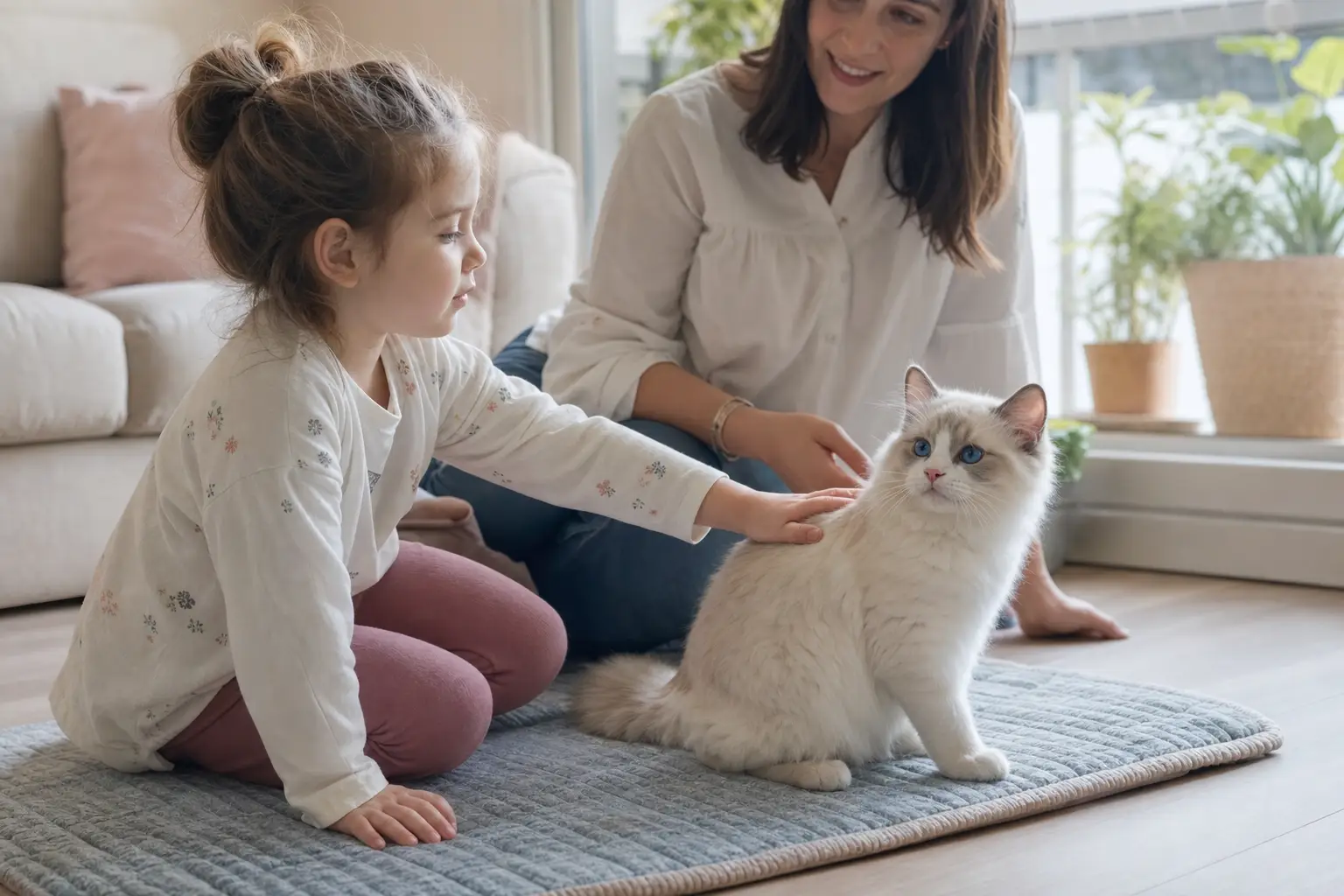
The best gentle petting games for preschoolers are short, predictable, and easy for a kitten to leave. Invite the Ragdoll kitten to approach, guide the child to use a flat hand for one-way strokes along the shoulders and back, pause after a few seconds, and stop whenever the kitten turns away or shows tension.
Ragdolls are often described as relaxed, people-oriented cats, but a breed name cannot predict an individual kitten’s comfort level. Some kittens enjoy a quiet stroke; others would rather watch from beside the sofa. The goal is not to make a kitten tolerate handling. It is to help a child notice that friendly touch is a two-way interaction.
Before the first stroke: set up a choice-based game
Choose a quiet room with a clear escape route. Ask the preschooler to sit on the floor or on a low cushion rather than chase the kitten around the house. Keep the child’s hands low and still, and let the kitten decide whether to come closer. An adult should remain within arm’s reach for the entire interaction.
Pet the kitten only on areas that are usually easy to read: the shoulders, upper back, or cheeks if the kitten leans into a hand. Avoid the belly, paws, tail, ears, and whiskers unless an adult knows that this particular cat enjoys gentle contact there. Never wake a sleeping kitten, disturb one that is eating or using the litter box, or block a route to safety.
Use these simple responses when reading the kitten’s body language:
| What you may see | What the child should do |
|---|---|
| Loose body, relaxed ears, normal tail, leaning into the hand | Continue one or two slow strokes, then pause |
| Head turn, skin twitch, tail flick, ears rotating sideways, body becoming still | Remove the hand and give the kitten space |
| Walking away, hiding, hissing, growling, swatting, or biting | End the game calmly; do not follow or punish the kitten |
A purr by itself is not permission to continue. Look at the whole body, and treat walking away as a successful choice rather than a rejection.
Ten gentle upgrades for a Ragdoll kitten petting game
1. Create a no-corner petting station
Place a washable mat near, but not inside, the kitten’s favorite resting area. The mat gives the child a clear place to sit and gives the kitten a familiar option for approaching. Leave an open path behind or beside it. A kitten should never be held in place on the mat or trapped between a child and furniture.
2. Replace grabbing with a flat-hand path
Preschoolers often reach from above, which can feel startling to a small animal. Demonstrate a low, open hand first. Let the kitten sniff if it chooses, then show the child how to make one slow stroke from the shoulders toward the middle of the back. Lift the hand instead of rubbing back and forth rapidly.
3. Use the three-stroke pause
Count three gentle strokes out loud, then freeze the hand near the child’s lap. Wait a few seconds. If the kitten stays loose or leans closer, the child may repeat the sequence. If the kitten turns away, the child says all done and lets it leave. This simple rhythm is easier for a young child to remember than a vague instruction to be gentle.
4. Teach a kitten traffic light
Make three colored cards together. Green can mean a loose body and a kitten choosing to stay. Yellow can mean a tail flick, a head turn, or ears moving back, so hands pause. Red can mean the kitten leaves, hisses, growls, swats, or bites, so the game ends. Keep the cards as reminders, not as toys for waving near the kitten.
5. Add a quiet starting cue
Use the same gentle phrase, such as gentle time, before every session. The adult says it, places an open hand near the mat, and waits. Calling the kitten repeatedly, carrying it over, or using a treat to keep it in place turns an invitation into pressure. A starting cue works only when the kitten remains free to decline.
6. Rehearse on a stuffed animal first
Before involving a live kitten, let the child practice on a plush toy. Show the difference between a slow stroke and a pull, poke, squeeze, or pat. Practice keeping fingers away from eyes, ears, and the tail. This rehearsal also gives an energetic child a safe outlet when the kitten is sleeping or has already finished the game.
7. Reward calm choices, not stillness
If the kitten remains relaxed, an adult can place a small, appropriate treat on the floor after the child’s hand returns to their lap. Do not reward the child by holding the kitten still for a longer session. The useful behavior is calm interaction and stopping promptly, not making the kitten stay.
8. Separate petting from play
Kitten energy can switch quickly from cuddling to pouncing. Keep fingers, toes, and clothing out of the play routine. If the kitten grabs at a hand, end petting and have an adult redirect it to a suitable toy, such as a wand toy used under supervision. Store string, ribbon, and small toy parts safely afterward.
9. Make the exit part of the game
Use a consistent ending: the child says all done, places both hands in their lap, and watches the kitten leave. The adult can then offer a toy or treat away from the child. This teaches that a cat walking off is normal and that following, cornering, or picking it up is not part of petting.
10. Finish with a grown-up reset
After the session, the adult checks that the kitten has access to water, food, a resting place, and a quiet retreat. Wash the child’s hands with soap and water, especially before eating. Put away toys and note what the kitten seemed to enjoy or avoid. The next session can then be shorter, gentler, or held in a different location.
Safety rules adults should enforce every time
- Stay close and actively supervise; never leave a preschooler alone with a kitten, even if they usually get along.
- Do not let a child carry, restrain, chase, corner, dress, or wake the kitten.
- Keep the child’s face away from the kitten’s face, and do not allow kissing or hugging.
- Stop immediately if either the child or kitten becomes excited, frightened, frustrated, or rough.
- Do not punish hissing, scratching, growling, or hiding. These are warnings that the interaction needs to end.
- If a scratch or bite breaks the skin, wash the area promptly with soap and running water. Seek medical advice for a deep wound, an injury to the face or eye, or signs of infection.
Young children can carry germs from animals to their mouths or food without realizing it. The Centers for Disease Control and Prevention’s cat-safety guidance recommends handwashing after contact with cats and taking scratches and bites seriously. For handling ideas and feline body-language context, International Cat Care’s handling guidance is a useful companion resource.
How long should a session last?
There is no universal ideal length. Start with a few calm strokes and end while both participants are still comfortable. Several brief sessions are usually easier for a preschooler and a kitten than one long attempt. If the kitten repeatedly leaves after the first stroke, that is information: switch to observing, playing with an adult-controlled toy, or practicing with the stuffed animal instead.
As the child grows more consistent, the adult can quietly reduce prompts, but supervision remains necessary. A kitten may be tolerant one day and overstimulated the next because of tiredness, noise, pain, or ordinary changes in mood. If a normally comfortable kitten suddenly avoids touch or reacts painfully, stop handling and contact a veterinarian for advice.
Frequently asked questions
Are Ragdoll kittens good pets for preschoolers?
Some are a good match, especially in a calm home with adults who supervise and teach respectful handling. Ragdoll is not a guarantee of patience, and every kitten has a different history and personality. The individual animal’s behavior matters more than the breed label.
Should a preschooler hold a Ragdoll kitten?
Usually, no. Young children may squeeze, drop, or accidentally restrain a moving kitten. An adult can handle necessary lifting safely and can teach the child to pet while the kitten keeps all four paws on a stable surface.
What should a child do if the kitten scratches?
The child should freeze and call an adult rather than yell, pull away violently, or chase the kitten. The adult should separate them calmly, wash any broken skin, and review what warning sign was missed. Never punish the kitten for communicating discomfort.
A kinder definition of a successful game
A successful petting game does not end with a kitten being held in place or a child getting as many strokes as possible. It ends with the child using a gentle hand, noticing a signal, and allowing the kitten to choose what happens next. That foundation can support a trusting relationship far better than forced cuddling.
For more guidance on welcoming and caring for Ragdoll kittens, explore CTkittens.com.
Sources and further reading

Rachel Cohen is a journalist and producer with a passion for audio storytelling, health and science reporting, and feline companions.
A graduate of Middlebury College, Rachel spends her weekends exploring the mountains and when she isn’t outdoors or chasing a story, she can usually be found hanging out with her cats.


Only thing I’d tweak is the three-stroke rule, since some kittens get twitchy after just one and preschoolers might treat “three” like a quota lol.