
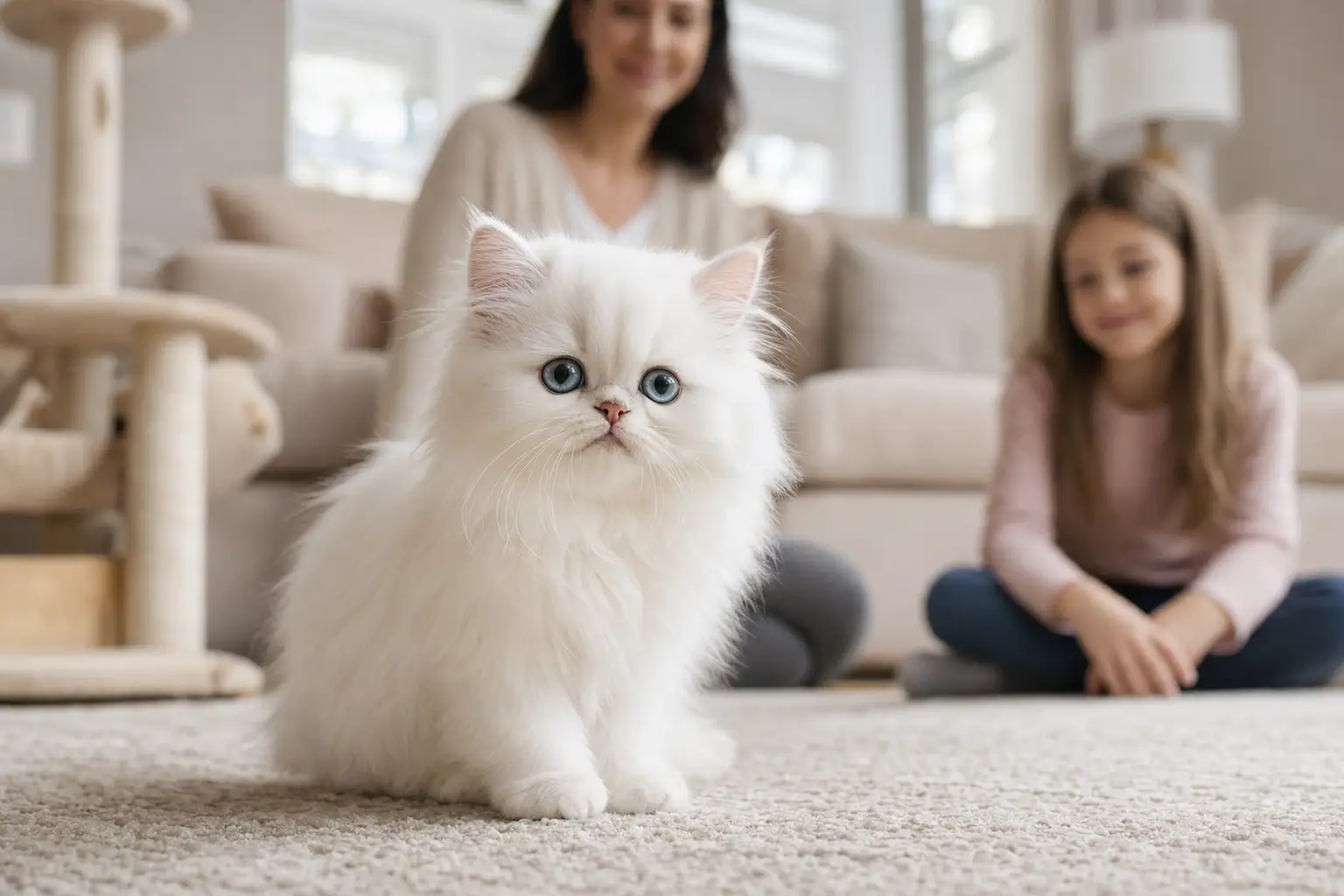
Persian Kitten Ear Positions: What Happy Family Time Looks Like
When family time is going well, a Persian kitten often shows relaxed, upright ears that gently angle toward interesting sounds or people. Forward ears can suggest curiosity and engagement, while a loose body, soft eyes, normal appetite, and the freedom to walk away provide stronger evidence that your kitten feels comfortable.
Ear position is useful, but it is not a happiness meter. A kitten may turn one ear toward a noise, flatten both ears because a vacuum cleaner starts, or rotate their ears while deciding whether to join a game. The most accurate reading comes from the entire cat: ears, eyes, whiskers, posture, tail, movement, and willingness to choose contact.
Here is how to recognize a successful family interaction without expecting your kitten to sit still or accept attention from everyone.
What comfortable Persian kitten ear positions look like
A content kitten usually has ears that are upright or gently forward, rather than rigidly pulled back. The ears may move independently as your kitten follows conversations, footsteps, toys, or outdoor sounds. That small amount of movement is normal and often shows that the kitten is relaxed enough to pay attention to their surroundings.
Look for several signals at the same time:
- Soft, open posture: The body is loose rather than crouched, tense, or pressed close to the floor.
- Gentle facial expression: The eyes look relaxed, the pupils fit the lighting, and the whiskers are not sharply pushed forward or pulled tightly back.
- Voluntary interaction: Your kitten approaches, sniffs, plays, settles nearby, or returns after taking a break.
- Normal behavior: The kitten continues eating, grooming, exploring, and using the litter box normally.
- Easy recovery: After a small household noise, the kitten settles again instead of remaining tense or hiding.
Some cats also slow-blink or stretch near people they trust. These signs are more meaningful when they appear with relaxed ears and a loose body. Purring alone is not proof of happiness; cats may also purr when anxious, uncomfortable, or trying to soothe themselves.
Persian kitten ear positions and what they may mean
The following guide can help you interpret common ear positions. These are clues, not fixed translations. Your kitten’s normal baseline and the surrounding situation matter.
| Ear position | Possible meaning | Helpful response |
|---|---|---|
| Upright and gently forward | Comfort, interest, or curiosity | Continue quietly and let the kitten decide whether to come closer. |
| Moving or swiveling | Listening to different sounds or monitoring the room | Reduce sudden noise and observe the rest of the body. |
| Angled sideways | Uncertainty, heightened attention, or early overstimulation | Pause intense play and offer an easy route to a quiet space. |
| Rotated backward | Listening behind the kitten, concern, or rising tension | Check for a noise or interaction that may be bothering them. |
| Flattened or pinned close to the head | Fear, distress, defensive behavior, or possible pain | Stop reaching toward the kitten and give them space. |
| One ear repeatedly held differently | A sound may be drawing attention, but discomfort is also possible | Watch for scratching, head shaking, discharge, or sensitivity and contact a veterinarian if it persists. |
The same sideways ears can have different meanings in different moments. A kitten chasing a toy may briefly angle their ears during intense concentration. A kitten being held tightly may show the same position while feeling trapped. Context changes the interpretation.
What success looks like during family time
Family time is successful when your Persian kitten feels safe enough to make choices. The goal is not to keep the kitten in the center of the room while everyone pets them. A confident interaction may look quieter: your kitten sits on a nearby cat tree, watches the family, approaches one person, accepts a few gentle strokes, and then leaves for a nap.
Positive signs include:
- Your kitten chooses to enter the room instead of being carried into it.
- The ears remain neutral or gently forward while the body stays loose.
- Your kitten can move away without being followed, grabbed, or blocked.
- The kitten returns to the family after a short break.
- Play remains loose and responsive rather than frantic or defensive.
- Children can observe the kitten without chasing, cornering, or waking them.
That last point is especially important. A kitten who walks away is communicating clearly, not being rude. Respecting the retreat teaches the kitten that people listen to their signals. Over time, this can make family interactions more predictable and enjoyable.
How to create calmer interactions with a Persian kitten
Give your kitten a safe choice
Set up a quiet retreat, such as a covered bed, open carrier, cat tree, or room behind a baby gate. The space should not become a place where people reach in after the kitten has withdrawn. A kitten who knows how to leave may feel less pressure to defend themselves.
Let the kitten start contact
Invite interaction by sitting sideways, speaking softly, and offering a relaxed hand for your kitten to investigate. If the kitten leans forward, sniffs, or rubs against you, try a few gentle strokes around the cheeks, chin, or shoulders. Avoid following a retreating kitten or insisting on a lap session.
Keep handling brief and predictable
Young kittens can become overstimulated quickly. Instead of passing the kitten from person to person, let one calm family member interact at a time. End the session while the ears and body still look relaxed. A small treat, a quiet toy, or access to a favorite resting spot can help create a positive ending.
Teach children to watch before touching
Children can learn a simple routine: stop, look, and wait. If the kitten’s ears turn sideways, the tail begins to lash, the body lowers, or the kitten stops responding to play, the child should pause. Never allow children to pick up a kitten that is trying to leave, and always supervise young children around cats.
Notice the setting, not just the kitten
Visitors, loud television, vacuum cleaners, barking dogs, and fast movement can change ear position even when nobody is touching the kitten. If the ears suddenly rotate or flatten, lower the noise and make space before assuming the kitten is reacting to a person.
Why Persian kittens may need a closer look
Persians commonly have small, rounded ears and abundant facial fur, and individual kittens can have noticeably different head shapes. Some have a very short muzzle, while others have a more moderate face. These features can make subtle ear and facial signals harder to see than they are in a short-haired cat.
Do not judge a Persian kitten by ear shape alone. Compare the kitten with their own usual expression. A relaxed Persian may not display a dramatic change in ear angle, so body looseness, movement, appetite, play, and the choice to approach are particularly helpful clues.
Regular, gentle grooming also gives you a chance to notice changes around the ears. Handle the area only as much as your kitten tolerates. Do not push cotton swabs into the ear canal or apply human ear products unless a veterinarian specifically instructs you to do so.
When unusual ear positions may signal a health problem
Ear language and ear health can overlap. A kitten who keeps one ear down, resists touch, or suddenly holds both ears back may be frightened, overstimulated, or uncomfortable. Ear mites, infection, injury, skin irritation, and other problems cannot be diagnosed from posture alone.
Contact your veterinarian if you notice persistent or repeated changes along with:
- Frequent head shaking or ear scratching
- Redness, swelling, odor, or discharge
- Crusting or dark material in the ear
- Pain when the ear or head is touched
- A head tilt, loss of balance, or unusual weakness
- Reduced appetite, hiding, lethargy, or a sudden behavior change
A head tilt, balance problem, severe pain, or rapidly worsening signs deserve prompt veterinary advice. The Merck Veterinary Manual’s overview of feline ear disorders explains why ear symptoms should be assessed rather than treated by guesswork.
A simple ear-and-body check for family members
Before touching your kitten, take a few seconds to ask:
- Are the ears neutral? Upright or gently forward is generally more reassuring than pinned or tightly sideways.
- Is the body loose? Look for a relaxed back, normal movement, and no attempt to freeze or crouch.
- Can the kitten leave? An open route is essential. If the kitten cannot choose distance, do not continue.
- What happened just before the change? A noise, fast hand, unfamiliar visitor, or prolonged petting may explain a sudden shift.
This approach is more reliable than labeling a single pose as happy or unhappy. International Cat Care offers additional guidance on understanding feline body language, including the importance of reading several signals together.
FAQ
What do forward ears mean in a Persian kitten?
Gently forward ears often indicate interest or calm attention, especially when the kitten’s body is loose and they choose to stay nearby. Forward ears can also occur during focused play, so check the rest of the posture.
Are flattened ears always a sign that my kitten is unhappy?
Flattened ears usually mean the kitten is experiencing fear, distress, defensiveness, or discomfort. Stop the interaction and provide space. If the position continues when the environment is calm, or appears with signs of illness, ask a veterinarian for advice.
Why does my kitten hold one ear back?
Your kitten may be listening to a sound behind them or reacting to something in the room. If one ear stays back repeatedly, or there is scratching, discharge, odor, head shaking, or pain, arrange a veterinary examination.
How can I tell whether family time is working?
Look for choice and recovery. Your kitten approaches voluntarily, keeps a relaxed posture, can take breaks, and returns to normal behavior after the interaction. A kitten who is merely still, frozen, or unable to escape is not necessarily comfortable.
The real measure of a happy interaction
Persian kitten ear positions are valuable signals, but the best measure of family-time success is trust. A comfortable kitten does not have to perform affection on demand. When family members notice relaxed ears, respect retreat, reduce pressure, and allow the kitten to return by choice, they create the conditions for a confident relationship.
For more guidance on choosing and caring for Persian kittens, explore CTkittens.com.

Rachel Cohen is a journalist and producer with a passion for audio storytelling, health and science reporting, and feline companions.
A graduate of Middlebury College, Rachel spends her weekends exploring the mountains and when she isn’t outdoors or chasing a story, she can usually be found hanging out with her cats.

