
Cat introduction advice
Introducing a Persian Kitten to a Resident Cat: A Calm Doorway Plan
A doorway should be a controlled checkpoint, not the place for an abrupt nose-to-nose meeting.
The safest approach is to begin with complete separation, then move from scent sharing to closed-door meals, visual contact, and short supervised time together. Only advance when both cats can remain reasonably calm at the current stage. Some introductions take several days; others take weeks or longer. The aim is not instant friendship, but a home where both cats can eat, rest, play, and retreat without feeling threatened.
This gradual sequence is consistent with guidance from International Cat Care and the ASPCA. A Persian kitten may be especially small, young, and easily overwhelmed, while the resident cat may regard the new arrival as an intrusion. Planning for both cats’ needs gives the introduction a much better foundation.
Before the Persian kitten comes home
Arrange a veterinary check for the kitten and discuss vaccinations, parasite control, and any testing that is appropriate for the kitten’s history and your household. Keep the cats separate until you have received suitable veterinary advice, particularly if the kitten’s health background is incomplete. A resident cat should also be current on routine care where possible.
Choose a quiet safe room for the kitten. It should have a solid door and contain:
- Food and water placed away from the litter tray
- A clean litter tray that the kitten can enter easily
- A hiding place, comfortable bedding, and a scratching surface
- Age-appropriate toys and a secure place to climb or perch
- Several days of supplies so you do not need to open the door constantly
For two cats, provide resources in more than one location. A useful starting point is one litter tray per cat plus one extra, along with separate feeding areas, water stations, scratching posts, resting places, and hiding spots. Distribution matters: placing everything together can allow one cat to block access to the whole set.
Set up the doorway as a safety barrier
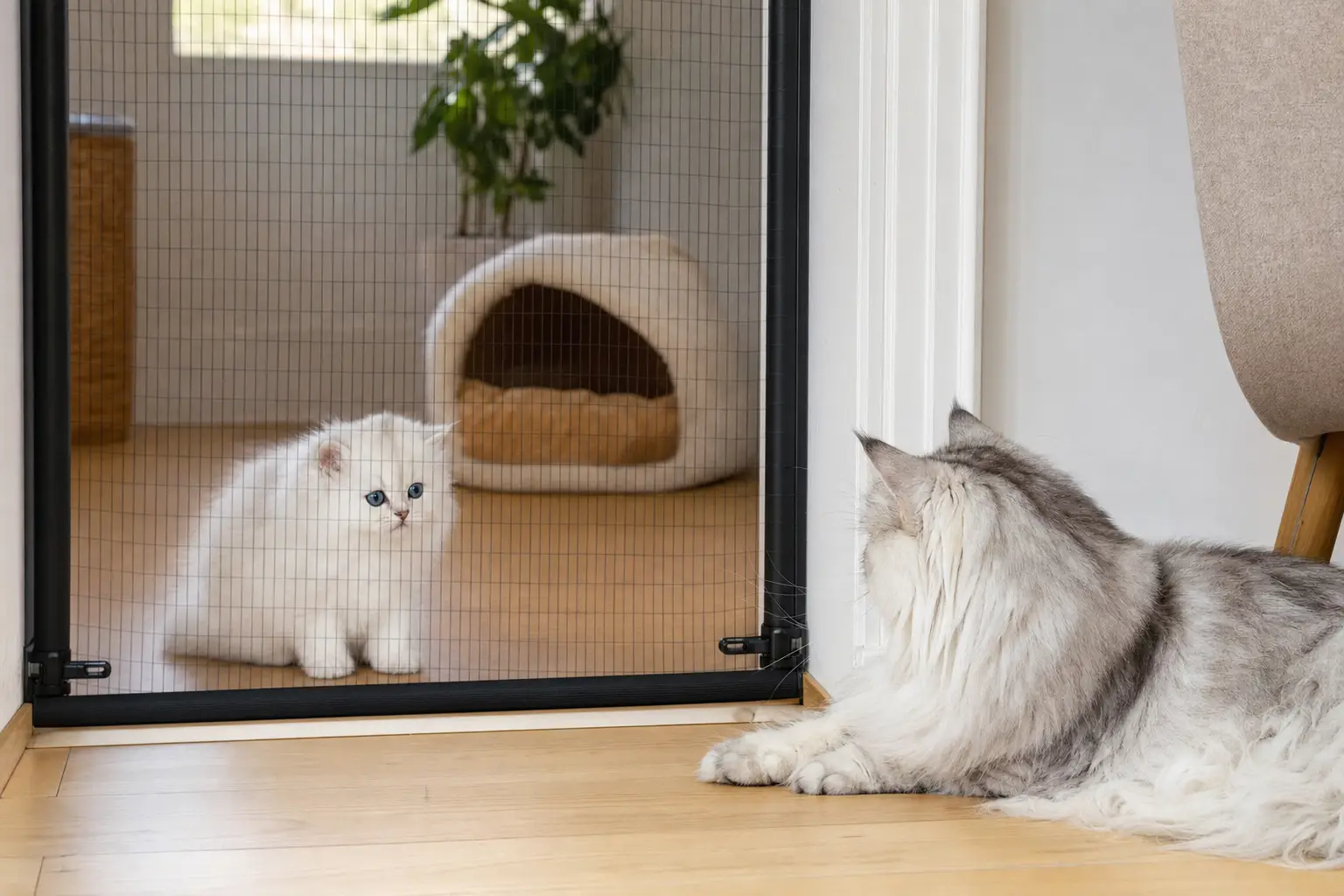
At first, the closed door protects both cats from an interaction that is too intense. Later, you can use a properly secured mesh screen, tall gate, or another barrier that allows sight without allowing a kitten to squeeze through or either cat to reach the other.
Do not rely on a standard baby gate without checking it carefully. Small kittens can climb, squeeze between bars, or dart through before you can respond. If you use a gate, supervise every visual session and add a secure screen or second barrier when necessary. Keep a way to close the solid door quickly.
Have high-value treats, a wand toy, and a calm routine ready. Food should reward relaxed behavior, not lure a frightened cat closer than it wants to go. Never hold one cat in place for the other to inspect.
A step-by-step doorway introduction
1. Let the kitten settle behind a closed door
For the first stage, the cats should not see each other. Give the kitten time to eat, use the litter tray, sleep, and explore the safe room. Let the resident cat investigate the closed door from a distance, but do not carry the kitten out for a tour.
The resident cat may sniff, hiss, or walk away. These reactions do not automatically mean the introduction will fail. They are information about the cat’s comfort level. If either cat is persistently agitated, increase distance from the door and give both a quiet break.
2. Begin scent exchange
Once the kitten is settling, exchange bedding or small blankets between the cats. You can also use a clean cloth to gently collect scent from one cat’s cheek area and place it near the other cat’s food or resting area. Do not force either cat to smell the cloth.
Offer treats or meals when a cat investigates the other’s scent calmly. The goal is to make the unfamiliar smell ordinary and safe, not to create a test the cat must pass.
3. Feed on opposite sides of the closed door
Place each cat’s food bowl far enough from the door that both will eat comfortably. Over several meals, move the bowls closer only if both cats continue eating normally and show relaxed behavior. If one cat stops eating, stares at the door, growls continuously, or refuses to leave the area, move the bowl back.
Short play sessions on each side of the door can also build a positive routine. End while the cats are still calm. Repetition is more useful than a long, dramatic session.
4. Allow controlled exploration
When the kitten is comfortable in the safe room and both cats are calm around the closed door, let the resident cat explore the kitten’s room while the kitten is safely elsewhere. Then reverse the arrangement. This gives each cat information about the other’s scent without the pressure of direct contact.
Keep the resident cat’s favorite resources available. Exploration should not feel like the new kitten has taken over the resident cat’s territory.
5. Add brief visual contact
Open the door a fraction, use a secure screen, or install a suitable barrier. Start with sessions lasting only a few seconds if needed. Reward looking away, sniffing, blinking, eating, or calmly moving away. These choices show that the cats can notice one another without becoming fixated.
Close the barrier before either cat becomes highly aroused. If a kitten repeatedly rushes the opening, increase the distance, play with the kitten first, or return to scent work for a while. Do not allow the kitten to repeatedly ambush the resident cat at the threshold.
6. Try short, supervised room time
When visual sessions are consistently calm, allow both cats into a larger room with several escape routes. Keep doors open to safe areas, remove opportunities for cornering, and supervise closely. A wand toy can redirect the kitten, but do not wave it between cats if that increases competition.
Keep the first meetings short and separate the cats while things are still going well. Gradually increase the time together. Unsupervised access should wait until neither cat is routinely chasing, blocking, stalking, or frightening the other.
| Stage | Signs you can consider moving forward |
|---|---|
| Closed door | Both cats eat, rest, and use the litter tray normally near the room. |
| Scent exchange | Each cat investigates the other’s scent without prolonged distress. |
| Visual barrier | They can look, disengage, and accept treats or play. |
| Supervised room time | They can share space without repeated chasing, cornering, or panic. |
Learn the difference between communication and escalation
A brief hiss, growl, or warning swat can be a cat’s way of requesting distance. Do not punish it. Punishment can make the other cat’s presence more frightening and may suppress warning signals without resolving the discomfort.
More concerning signs include a fixed stare, flattened ears, tense crouching, hard tail lashing, stalking, blocking access to food or litter, repeated chasing, screaming, biting, or a cat hiding for long periods. If you see these signs, calmly create separation with a door or solid barrier and return to an earlier stage. Never put your hands between fighting cats. Use a barrier to interrupt safely, then check both cats for injuries.
Persian kitten details worth considering
Breed does not determine personality, and Persian kittens vary as individuals. However, a Persian kitten may have a long coat and a flatter facial shape, so keep the introduction room cool, quiet, and easy to clean. Ask your veterinarian about grooming, eye care, breathing, and dental considerations specific to your kitten.
Kittens also have bursts of play followed by substantial sleep. A resident adult cat may not appreciate being pounced on every time it walks past. Schedule interactive play for the kitten, provide toys that can be used independently, and give the adult cat elevated or enclosed places where it can rest undisturbed. Do not expect the resident cat to teach the kitten boundaries through repeated stressful encounters.
Contact a veterinarian promptly if either cat stops eating, develops repeated vomiting or diarrhea, becomes unusually lethargic, or shows labored or open-mouth breathing. Breathing difficulty is not something to watch through an introduction session.
What to do if progress stalls
- The resident cat hisses at the kitten: Increase distance and shorten the session. Reward calm behavior, but do not force closer contact.
- The kitten keeps rushing the doorway: Add play and rest before sessions, use a more secure barrier, and return to very brief visual contact.
- One cat hides: Preserve its safe room and resources. Do not pull it out or place food directly beside the other cat.
- There is a fight: Separate safely, check for wounds, and stop direct sessions. A veterinarian or qualified feline behavior professional can help design the next step.
A slower introduction is usually more efficient than repeatedly allowing frightening encounters. If the cats have had a difficult start, several calm days at an earlier stage may be needed before trying again.
FAQ
How long does it take to introduce a Persian kitten to a resident cat?
There is no reliable deadline. Some cats progress in days, while others need weeks or longer. Move forward based on behavior rather than a calendar. Eating normally, disengaging from the other cat, and choosing to rest are more useful measures than simply completing a certain number of days.
Should the cats meet directly in the doorway?
No. The doorway is best used for controlled scent, sound, and visual contact. Start with a closed door and add a secure barrier before allowing any shared-room time.
Is hissing always a bad sign?
No. A brief hiss can communicate discomfort and a wish for more space. Treat it as a reason to slow down, especially if it is followed by stalking, chasing, cornering, or a physical fight.
When can the cats be left alone together?
Only after repeated supervised sessions have been calm and neither cat guards resources or pursues the other. Continue providing separate escape routes and resources even after the cats appear comfortable.
A calm introduction is a lasting investment
The doorway method works because it gives cats control over distance and lets familiarity build in manageable steps. Protect the resident cat’s routine, protect the Persian kitten from overwhelming contact, and treat every calm choice as progress.
For more guidance on Persian kitten care and choosing the right companion for your home, explore CTkittens.com.

Rachel Cohen is a journalist and producer with a passion for audio storytelling, health and science reporting, and feline companions.
A graduate of Middlebury College, Rachel spends her weekends exploring the mountains and when she isn’t outdoors or chasing a story, she can usually be found hanging out with her cats.


The bit about rewarding them for looking away instead of forcing eye contact is lowkey genius, cause folks forget disengaging is actually a win with cats.