
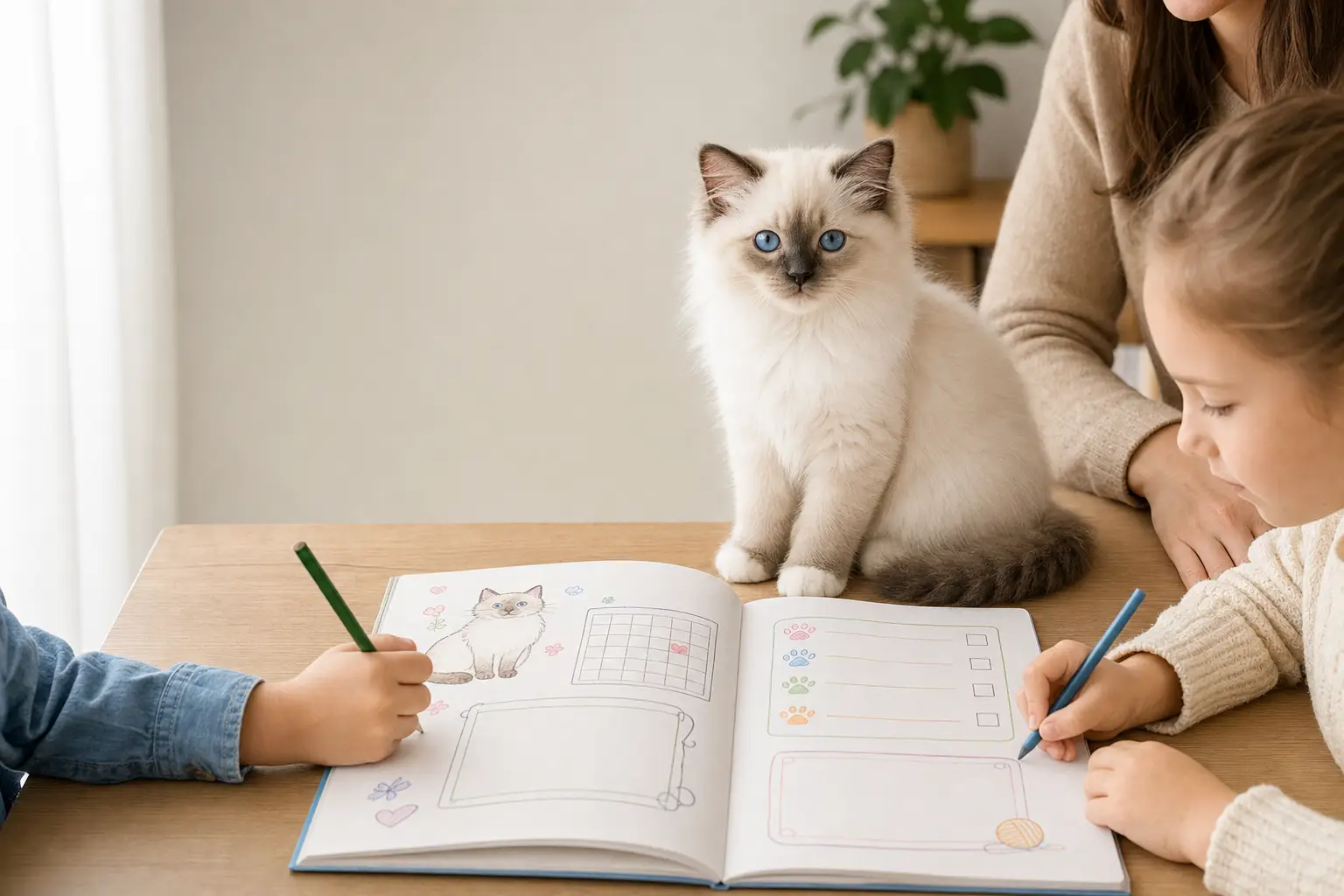
Ragdoll Kittens: 11 Creative Kitten Health Notebook Ideas
A kitten health notebook gives your family one reliable place to track veterinary records, daily observations, grooming, questions, and important contact details. When children help, it can also turn kitten care into a practical lesson in observation and responsibility—without asking them to diagnose problems or make medical decisions.
The best notebook is simple enough to use regularly. A three-ring binder, divided journal, or shared digital document can work. Keep the original veterinary paperwork in a safe place, then use the notebook as an easy-to-read family reference. For a Ragdoll kitten, give extra attention to long-coat care, gentle handling, growth, and any health information supplied by the breeder or rescue organization.
Set up the notebook before your kitten arrives
Start with five sections: identity and emergency contacts, veterinary records, growth and observations, daily care, and questions for the veterinarian. Add a plastic sleeve for adoption papers, vaccine records, microchip details, insurance information, and any documented health testing from the kitten’s parents.
| Section | What to keep there | Child-friendly contribution |
|---|---|---|
| Identity | Name, birth date if known, microchip number, clinic, emergency contacts | Decorate the cover and copy phone numbers with adult help |
| Health history | Vaccines, parasite care, examination notes, test results, medication instructions | Add dates or place approved stickers beside completed visits |
| Daily care | Food, water, litter, grooming, behavior, and questions | Record observations using words or drawings |
Use a clear rule throughout the notebook: children observe and report; adults verify and act.
11 creative ideas for a Ragdoll kitten health notebook
1. Make a kitten passport page
Give the first page a friendly identity-card format. Include your kitten’s name, arrival date, approximate age, sex, color pattern, microchip number, veterinarian, clinic phone number, and nearest emergency clinic. Add a current photograph so the family can identify the kitten quickly if paperwork and photos become separated.
Child’s job: draw a border, write the name, or choose a safe photo. Adult checkpoint: verify every number and keep the microchip registration updated with the registering company if your contact information changes.
2. Build a vaccine and wellness timeline
Use a long strip of paper or a monthly calendar for veterinary visits. Record the date, the name of each vaccine or treatment exactly as written by the clinic, the kitten’s weight if provided, and the recommended follow-up date. Leave space for questions about boosters, parasite prevention, spaying or neutering, and future wellness exams.
Vaccination and parasite schedules depend on age, previous records, health, location, and lifestyle. Do not fill in a schedule from a generic internet chart. Ask your veterinarian to complete it.
3. Create a growth graph without turning it into a competition
A simple graph can show how your kitten changes over time. Use one color for dates and another for weights recorded by the veterinarian or taken at home with veterinary guidance. Add height or length only if your vet finds it useful; weight trends are generally more practical than trying to predict adult size.
Children can place a dot on the graph and write a sentence such as, Today I noticed more confidence on the stairs. The purpose is to notice trends, not to compare your Ragdoll with another cat or worry about a single measurement.
4. Design a body-observation map
Draw a simple cat outline and create a page for neutral observations: eyes, ears, nose, mouth, coat, paws, appetite, water intake, litter habits, and energy. Children can use prompts such as same as usual, different today, or tell an adult.
This page should not become a home diagnosis chart. Its value is helping a child describe a change clearly—for example, the kitten is avoiding the comb on the left side—instead of saying only that the kitten looks unwell.
5. Add a stoplight symptom page
Make three columns: green for normal routines, yellow for something to discuss with an adult, and red for an urgent call to a veterinarian. Keep the examples adult-approved and specific.
- Green: normal eating, playing, grooming, sleeping, and litter-box habits.
- Yellow: a repeated change in appetite, energy, stool, urination, grooming tolerance, or behavior.
- Red: trouble breathing, collapse, severe bleeding, suspected poisoning, a serious injury, or inability to urinate.
Children should never decide that a red sign can wait. The page is a reminder to get an adult immediately. In an emergency, contact your veterinarian or an emergency clinic rather than trying to solve the problem with the notebook.
6. Make a medication and treatment control panel
Reserve a page for each prescribed medicine or treatment. Include the product name, why it was prescribed, the instructions copied from the label, start and stop dates, and a space for an adult to initial each dose. Keep medicines out of the child’s reach.
Children may help place an adult’s approved checkmark on the chart, but they should not measure, choose, hide, or give medication unless a responsible adult is directly supervising and the veterinarian has said it is appropriate. Never add human medicine or an over-the-counter flea product without veterinary advice.
7. Turn mealtimes into a food and water log
Record the food brand and formula, feeding instructions, treats, and any gradual diet changes. A child can draw a water bowl and mark whether it was refreshed, but an adult should handle portion decisions and interpret changes in appetite.
Include a note to ask before introducing new foods. Sudden diet changes can upset a kitten’s digestion, and a kitten that repeatedly refuses food deserves prompt veterinary guidance. The log can also help your veterinarian identify whether a change began after a particular food or treat.
8. Create a Ragdoll grooming passport
Ragdolls have a semi-long coat that benefits from regular inspection and gentle combing. Make a grooming checklist for coat checks, combing, nail inspection, and looking briefly at ears and paws. Record the tool used and whether the kitten remained relaxed.
Let children decorate the page with small drawings of a comb and paw prints. An adult should do the actual nail trimming unless the child is older, trained, and closely supervised. Stop if the kitten struggles. A calm, short session is more useful than forcing a complete grooming routine.
9. Add a body-language and consent diary
A Ragdoll’s calm reputation does not mean every kitten wants to be picked up at every moment. Create two columns: inviting interaction and needs space. Examples might include approaching with a relaxed body, turning away, hiding, tail flicking, flattened ears, or trying to leave.
Children can draw the signals they notice and write what happened next. This teaches an important health habit: respecting stress signals. Adults should demonstrate how to support the kitten’s chest and hindquarters, keep handling low to the ground, and release the kitten before it becomes distressed.
10. Start a question jar for veterinary visits
Keep a pocket or envelope labeled Ask the vet. Whenever a child notices something interesting, they can add a note: Why does the coat look darker on the ears?, When should we trim the claws?, or Is this treat suitable for a kitten?
At the appointment, an adult can group the questions into nutrition, behavior, prevention, and grooming. This prevents small concerns from being forgotten and helps children participate without interrupting the examination.
11. Make a monthly photo and routine review
Choose one day each month to add a relaxed photograph and three short observations: something that went well, something that changed, and one question. Include routine notes such as litter-box location, favorite resting places, grooming tolerance, and new play skills.
This creates a useful timeline if a behavior or physical change later needs explanation. Keep the review brief and positive; the notebook should support care, not make the family monitor every movement.
Health information worth recording for a Ragdoll kitten
Ask the breeder, rescue organization, or veterinarian for copies of available records rather than relying on memory. Depending on the kitten’s history, useful documents may include prior examinations, vaccine records, parasite treatments, microchip information, and parent health-testing documentation.
Ragdolls are among the breeds for which families may hear about hypertrophic cardiomyopathy, a disease involving abnormal thickening of the heart muscle. If a breeder provides genetic testing information, file the actual report and ask your veterinarian what it does—and does not—show. A genetic result is not a complete substitute for veterinary assessment, and no paperwork guarantees that a kitten will never develop a health problem. Cornell University’s Feline Health Center provides background on feline hypertrophic cardiomyopathy.
Make the notebook safe and useful for children
- Use washable crayons or pencils, not loose objects that a kitten could swallow.
- Wash hands after handling litter, stool, vomit, medication, or a sick animal.
- Keep the notebook, medicines, cleaners, and grooming tools away from unsupervised children and pets.
- Never wake, chase, restrain, or carry the kitten as part of a notebook activity.
- Ask an adult to check every health entry before it is treated as a fact.
Children can be excellent observers, but they should not be responsible for deciding whether a kitten needs treatment. A sudden change in breathing, consciousness, mobility, urination, appetite, or behavior should be reported to an adult at once. For suspected poisoning, contact a veterinarian or an appropriate animal poison service; do not wait to see whether the kitten improves.
Frequently asked questions
What is the most important page in a kitten health notebook?
The emergency and identity page is the best place to begin. Include the regular veterinarian, emergency clinic, microchip details, adoption contact, and any important medication or allergy information. It should be usable even when everyone is stressed.
Can children weigh a Ragdoll kitten?
They can help record a weight when an adult manages the scale and the kitten is secure. Ask your veterinarian how often home weights are useful. A trend matters more than a single number, and weighing should stop if it causes fear or struggling.
Should the notebook include breeder health records?
Yes. Keep copies of contracts, vaccination records, examination notes, parent health-testing reports, and written feeding instructions. File the original documents separately and write down the date each record was received.
How often should we update it?
Update it after veterinary visits, treatments, food changes, or notable health changes. A short monthly family review is enough for routine observations. If the notebook becomes too detailed to maintain, simplify it rather than abandoning it.
Keep the goal simple
A thoughtful kitten health notebook does more than collect paperwork. It helps children practice careful observation, gives adults a clearer record for veterinary conversations, and teaches the kitten’s boundaries to the whole household. Start with one page today, then add sections as your Ragdoll grows.
Ready to learn more about bringing home and caring for a Ragdoll? Explore the kitten care resources at CTkittens.com for more practical guidance.
Trusted references

Rachel Cohen is a journalist and producer with a passion for audio storytelling, health and science reporting, and feline companions.
A graduate of Middlebury College, Rachel spends her weekends exploring the mountains and when she isn’t outdoors or chasing a story, she can usually be found hanging out with her cats.


Only thing I’d tweak is keeping the daily logs super short, cuz my family would 100% abandon a notebook that starts feeling like kitten homework lol.
The “kids observe, adults verify and act” rule is honestly the smartest bit, keeps em involved without accidentally turning a 9-year-old into Dr. Google lol.
The “children observe, adults verify” rule is honestly the smartest detail here, keeps the kiddos involved without turning them into tiny unlicensed vets lol.
The consent diary bit is lowkey the smartest page here, since “Ragdolls are chill” dont mean the lil dude wants grabbed 24/7.
That body-language diary is lowkey the smartest page here, cause “Ragdolls are chill” gets mistaken for “this cat wanna be held 24/7” way too often.
The body-language diary kinda hit me, cause my old cat was “chill” too and turns out we was just missing all her tiny leave-me-alone signals lol.
Ngl the “children observe, adults verify” rule is smart as heck, since kids get involved without accidentally becoming the household vet lol.