
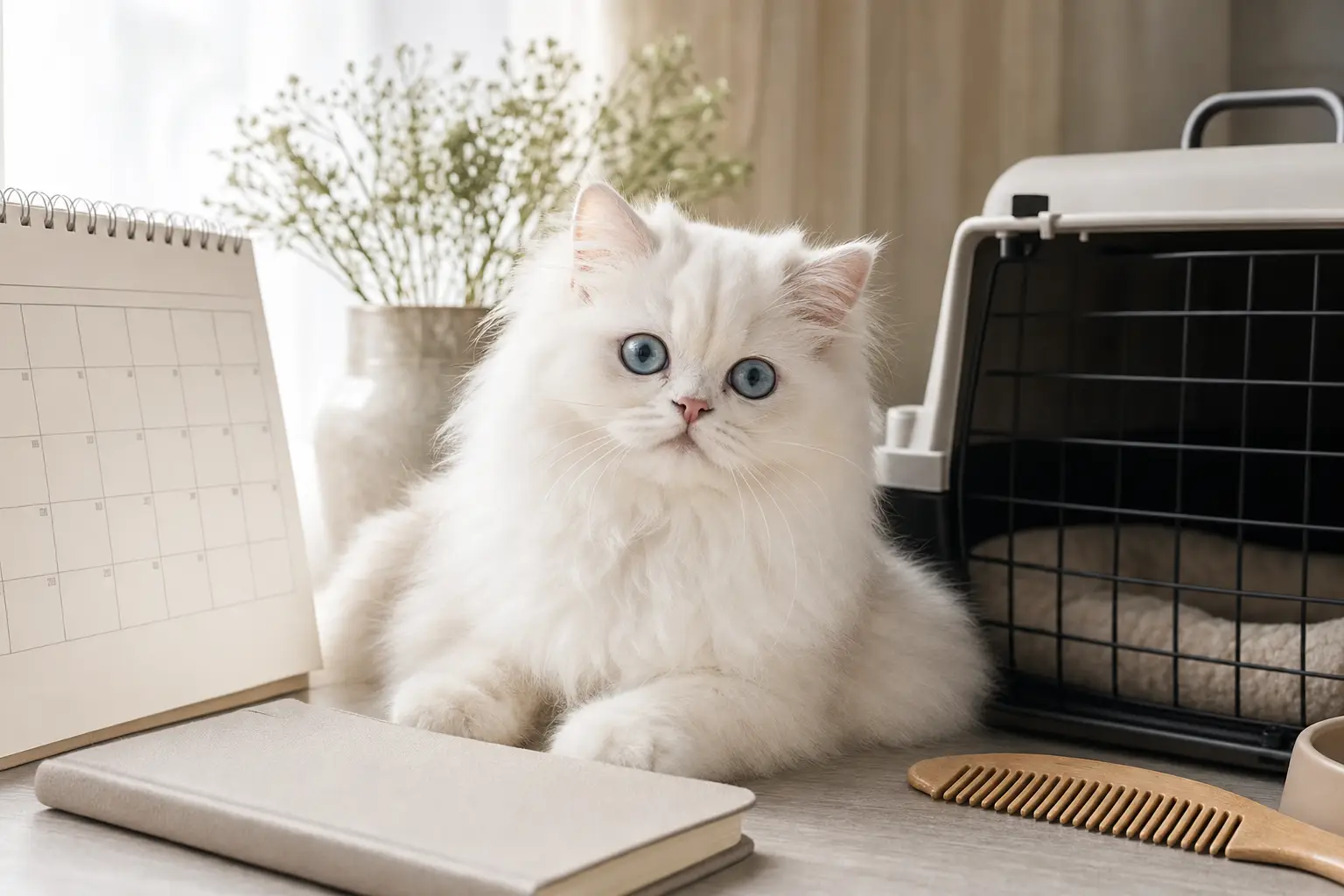
Persian Kittens: Build a Wellness Calendar With Your Veterinarian
A Persian kitten wellness calendar is more than a list of vaccine dates. It is a shared plan between your household and your veterinarian for tracking growth, preventive care, grooming, dental health, inherited risks, and small changes that may deserve attention.
The best calendar is personalized. Your veterinarian will adjust it for your kitten’s age, medical history, vaccination records, lifestyle, local parasite risks, and whether your cat will live entirely indoors or have outdoor access. Still, having a basic framework makes it easier to know what to ask, what to monitor at home, and when not to wait.
Why Persian kittens benefit from a planned routine
Kittens change quickly during their first year. They grow, receive a series of immunizations, transition through different foods, develop adult teeth, and may be spayed or neutered. A single appointment rarely covers every decision at once.
Persian cats also have features that make regular observation especially useful. Their long coats can hide skin changes or mats. Their short facial structure may affect tear drainage, eye comfort, breathing, and dental spacing. Some Persian lines also carry inherited risks that are worth discussing with a veterinarian and, when appropriate, a breeder or genetic-testing service.
A calendar helps turn those considerations into ordinary habits rather than reasons for worry. It also gives your veterinarian a clearer record of what is normal for your individual kitten.
Start the calendar at the first veterinary visit
Arrange an examination soon after bringing your kitten home, following any adoption or breeder agreement. Bring all available records, including the kitten’s date of birth, vaccine history, deworming or parasite-treatment history, diet, microchip information, and any health guarantee.
At this visit, expect a conversation as well as a physical examination. Your veterinarian may review:
- Weight, body condition, growth, heart and lung sounds, eyes, ears, skin, coat, mouth, and abdomen
- Core and risk-based vaccination needs, including the timing required by local law for rabies
- Fecal testing and a parasite-control plan suited to your kitten’s exposure risk
- Feeding portions, litter-box habits, exercise, socialization, and safe handling
- Microchipping and permanent identification
- Spay or neuter timing and what to expect from anesthesia and recovery
- Persian-specific questions about eyes, breathing, grooming, teeth, and inherited disease
Write down the next appointment before leaving. A reminder in your phone or a shared family calendar is usually more reliable than trying to remember a date from a paper handout.
A practical Persian kitten wellness calendar
The schedule below is a planning guide, not a substitute for an examination. Vaccine products, laws, parasite prevalence, and veterinary recommendations vary by location.
| Life stage | Useful veterinary discussion | Home habit |
|---|---|---|
| First visit after adoption | Baseline examination, record review, growth, parasite plan, vaccine planning, microchip, diet, and Persian-specific concerns. | Begin gentle brushing, nail handling, carrier practice, and a simple health log. |
| Kitten vaccine series | Many kittens need repeat visits every three to four weeks during the primary series, commonly through about 16 to 20 weeks of age. Your veterinarian will determine the appropriate products and dates. | Record each vaccine, any reaction, weight, appetite, stool changes, and questions for the next visit. |
| About four to six months | Discuss spay or neuter timing, permanent identification, dental development, nutrition, and behavior. Ask whether FeLV vaccination is appropriate based on age and exposure risk. | Check the mouth only if your kitten is comfortable. Do not force the jaws open or turn handling into a struggle. |
| Six to 12 months | Complete the kitten plan, review rabies requirements, reassess body condition, and establish the adult preventive-care schedule. | Continue coat care and note your cat’s normal breathing, eye appearance, appetite, litter-box use, and activity. |
| Adult and mature years | Schedule at least annual examinations, or more often if your veterinarian recommends it. Preventive testing is based on age, findings, and risk rather than a one-size-fits-all panel. | Keep weight and grooming records. A gradual change is often easier to spot when you know the baseline. |
Persian-specific checkpoints to put on the calendar
Eyes and tear staining
Persian facial anatomy can contribute to tear overflow and staining. Staining by itself does not tell you whether an eye is healthy, however. Add a quick visual check to your normal grooming routine: look for a sudden increase in discharge, redness, squinting, cloudiness, swelling, or signs that your kitten is rubbing an eye.
Ask your veterinarian how to clean the face safely. Avoid human eye drops, peroxide, essential oils, and harsh whitening products unless a veterinary professional specifically directs you to use a product. A new or worsening eye change deserves a call rather than being dismissed as typical Persian staining.
Breathing and heat tolerance
Some flat-faced cats have narrower upper airways or may struggle more in heat and during stressful exertion. That does not mean every Persian has a breathing disorder. It does mean your veterinarian should know if your kitten snores heavily while awake, tires unusually quickly, breathes noisily, or has difficulty recovering after play.
Keep the kitten cool, avoid strenuous activity in hot weather, and mention any breathing pattern before anesthesia or sedation. Open-mouth breathing, blue or gray gums, severe effort, collapse, or rapidly worsening breathing is an emergency.
Coat, skin, and grooming
Long hair needs consistent care. Many Persian kittens do best with short, calm sessions every day or nearly every day, gradually introduced with treats and breaks. Check behind the ears, under the legs, around the collar area, and near the tail, where mats can develop unnoticed.
Do not cut tight mats with household scissors. A veterinarian or experienced professional groomer can recommend the safest approach, especially if the skin is sore. Put grooming appointments or coat checks on the calendar before the coat becomes difficult to manage.
Teeth and facial structure
Short facial structure can leave some cats with crowded or misaligned teeth. During routine examinations, your veterinarian can look for retained baby teeth, gum inflammation, painful lesions, or difficulty eating. A kitten that drops food, chews on one side, paws at the mouth, or develops bad breath should be examined.
Ask when to begin home dental care and which feline products are suitable. Never use human toothpaste, which may contain ingredients unsafe for cats.
Inherited kidney disease
Polycystic kidney disease, or PKD, has been identified in Persian cats and related lines. A conversation about family history and available genetic testing can be appropriate, particularly when acquiring a kitten from a breeder. The University of California, Davis Veterinary Genetics Laboratory describes testing for a known PKD1 variant.
A genetic result is not a complete health forecast, and a test does not replace routine examinations. Ask what a result means for your particular kitten, whether parent documentation is available, and whether your veterinarian recommends any monitoring based on the kitten’s history or examination.
Turn the plan into a low-effort household habit
Wellness routines work best when they are attached to something you already do. For example, weigh your kitten on the same day each week, check the coat during brushing, and review the calendar when ordering food or litter.
A simple record can include:
- Date and weight, using the same scale when possible
- Food brand, feeding amount, appetite, and notable stool changes
- Vaccine, parasite-prevention, medication, and grooming dates
- Short notes about eyes, breathing, coat, mouth, energy, and litter-box habits
- Photos of recurring tear staining, skin areas, or coat concerns to show the veterinarian
Do not turn home checks into a daily medical inspection. The goal is familiarity, not anxiety. If your kitten resists a procedure, stop and ask your veterinary team for a low-stress method. Calm carrier practice and reward-based handling can make future visits easier.
How to choose a trusted veterinarian
A strong veterinary relationship is built on communication, not on having every answer memorized. Look for a clinic that welcomes questions, explains the reason for recommendations, gives you time to decide when a choice is not urgent, and provides a clear plan for after-hours problems.
At the first appointment, ask:
- What should be on this kitten’s next three visits?
- Which vaccines and parasite preventives fit our lifestyle and location?
- What breathing, eye, dental, or coat changes should prompt a call?
- Would you like information about the kitten’s Persian family history or PKD testing?
- What is the clinic’s urgent-care or emergency referral process?
If your kitten becomes frightened easily, ask whether the practice uses cat-friendly handling and whether appointments can be scheduled during quieter times. The American Association of Feline Practitioners also offers information about Cat Friendly Practices.
When a calendar reminder is not enough
Contact a veterinarian promptly for persistent vomiting or diarrhea, refusal to eat, marked lethargy, sudden eye changes, painful urination, repeated trips to the litter box with little or no urine, or a rapidly enlarging swelling. Seek emergency care for collapse, severe breathing difficulty, blue or gray gums, major trauma, or suspected poisoning.
Persian features should never be used to explain away a sudden change. Your kitten’s normal pattern is the most useful comparison, and your veterinary team can help decide how urgent a change may be.
Frequently asked questions
How often should a Persian kitten see a veterinarian?
Most kittens need several visits during the first vaccine series, often spaced three to four weeks apart, followed by an appointment to complete the kitten plan. After that, examinations are generally at least annual, with timing adjusted for health, age, and risk.
Is tear staining normal in Persian kittens?
Tear staining and overflow can occur with Persian facial anatomy, but they are not automatically harmless. Redness, squinting, pain, cloudiness, swelling, or a sudden change should be assessed by a veterinarian.
Should every Persian kitten have a PKD test?
Ask your veterinarian and the breeder about family history and available testing. A test may provide useful information in some situations, but it does not replace physical examinations or general preventive care.
Reliable references
- American Association of Feline Practitioners: Feline Vaccination Guidelines
- American Veterinary Medical Association: Pet vaccinations
- UC Davis Veterinary Genetics Laboratory: PKD1 testing in Persian cats
- Cat Friendly Practice: Finding a cat-friendly veterinary practice
With a few recurring reminders and a veterinarian who knows your cat, preventive care becomes part of family life instead of a series of rushed decisions. Explore CTkittens.com for more guidance as you prepare for life with a Persian kitten.

Rachel Cohen is a journalist and producer with a passion for audio storytelling, health and science reporting, and feline companions.
A graduate of Middlebury College, Rachel spends her weekends exploring the mountains and when she isn’t outdoors or chasing a story, she can usually be found hanging out with her cats.
Ngl the bit about learning your kitten’s normal baseline instead of obsessively checking every symptom is key, cuz otherwise that wellness calendar could turn into an anxiety spreadsheet real quick lol.
Honestly the tip about snapping pics of recurring eye gunk is clutch, cuz my memory at the vet turns into straight-up mashed potatoes.
Kinda shows how pet care is really just noticing tiny patterns before they become big problems, which tbh applies to humans too lol.
Only bit I’d push back on is weekly weigh-ins might be a lil much for most folks, but tying eye and coat checks to brushing is honestly way easier to stick with imo.
The tip about snapping pics of recurring eye or coat issues is lowkey genius, since my brain ain’t remembering what “slightly worse than Tuesday” looked like at the vet.
Saving pics of tear stains and coat issues for the vet is lowkey genius, cause my memory at appointments ain’t worth a damn.
Honestly the bit about tracking their normal breathing and eye gunk is smart af, cuz subtle changes are way easier to catch when ya actually know their baseline.