
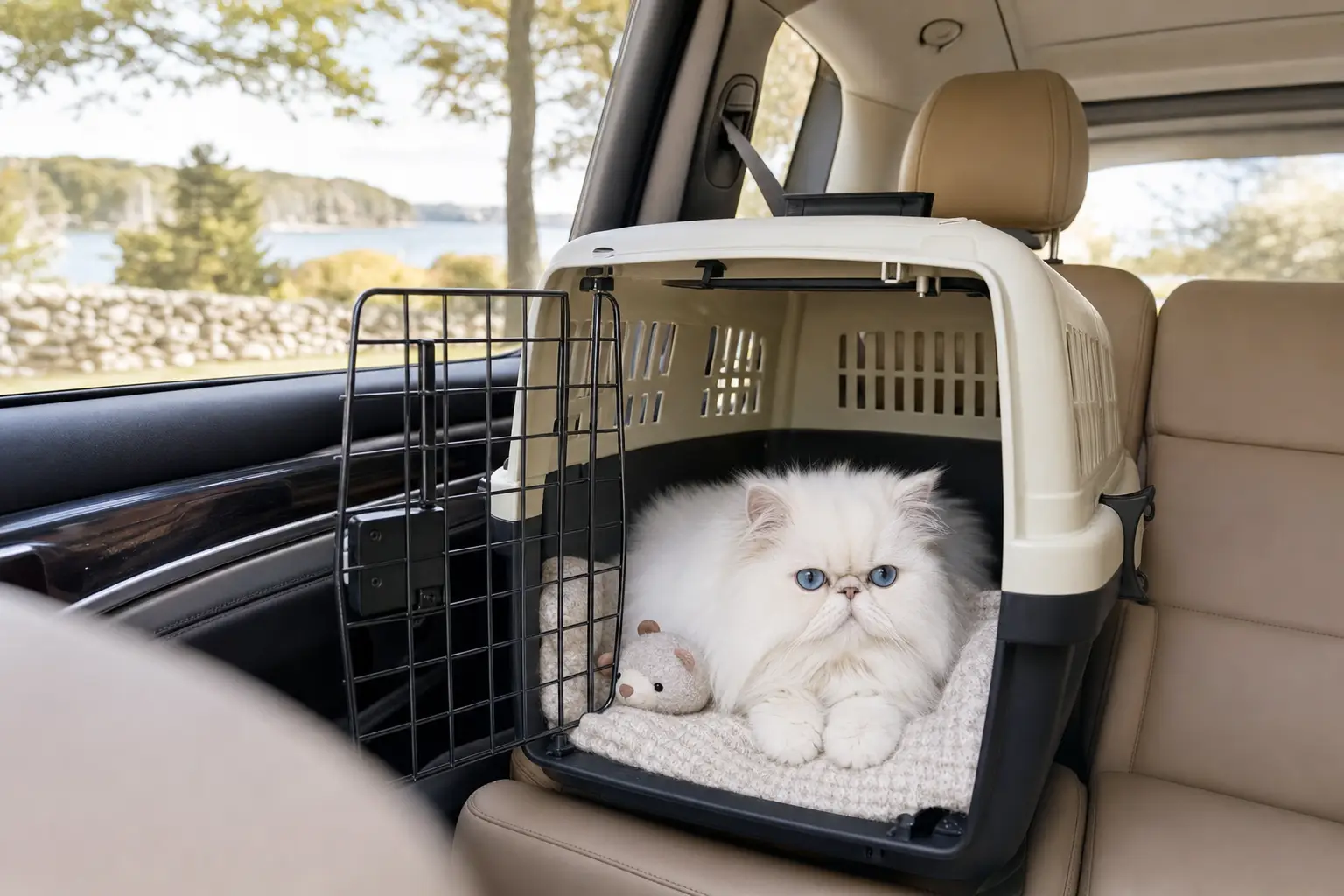
If you are planning a Persian kitten road trip, turning the carrier into a familiar den is one of the most sensible preparations you can make. The carrier should feel like a safe resting place long before the engine starts—not a box that appears only before a stressful veterinary visit.
That said, carrier training alone does not answer whether a New England road trip is right for your household. Your kitten’s breathing, age, temperament, health history, vaccination status, and the pace of your itinerary all matter. For some families, a carefully planned trip is reasonable. For others, a trusted in-home caregiver is the kinder choice.
The short answer: the den idea is useful, but travel is individual
Yes, making the carrier a favorite den can be valuable even if you never take your Persian kitten on a vacation. A familiar carrier can make routine veterinary visits, emergency evacuations, and necessary relocations less frightening.
It is not a guarantee that your kitten will enjoy several hours in a car. The right question is not simply, “Can a Persian travel?” It is: Can this particular kitten travel safely and cope with this particular itinerary?
Start with a veterinary check, especially if your kitten has noisy breathing, tires easily, has experienced motion sickness, or has a very short, flat facial structure. Then test the idea gradually with short drives before committing to a multi-state journey.
Why a carrier den can help
Cats generally cope better when they have a predictable, enclosed place that smells familiar. A carrier left open at home gives your kitten the opportunity to investigate it voluntarily. Over time, bedding, treats, meals, and quiet naps can change the carrier from a warning signal into an ordinary part of the environment.
This approach also gives you an important safety advantage: a cat should not ride loose in a vehicle. A frightened kitten can hide under a seat, interfere with the driver, escape when a door opens, or be injured in a sudden stop. Veterinary and feline-care organizations recommend transporting cats in a secure, well-ventilated carrier.
Do not force the carrier to become a favorite spot. Leave the door open, let your kitten walk out, and avoid using the carrier as punishment. The goal is confidence, not compliance through fear.
Persian-specific health questions to answer first
Persian cats vary considerably in facial shape. Some have relatively open faces, while others have pronounced brachycephalic features. A shortened muzzle can be associated with narrowed airways and greater difficulty coping with stress or heat. That does not mean every Persian is unable to travel, but it does mean a casual “the kitten seems fine” assessment is not enough for a long drive.
Ask your veterinarian to assess your kitten’s breathing and overall fitness for the proposed trip. Mention the approximate driving time, expected weather, overnight stops, and whether you will cross state lines. Your veterinarian can also advise about vaccination timing, parasite prevention, motion sickness, feeding, and any medication that may be appropriate.
Never give a human motion-sickness medicine, calming product, or sedative without veterinary direction. Sedation can affect coordination, temperature regulation, and breathing. It is also not a substitute for gradual carrier training.
During travel, open-mouth breathing, marked effort to breathe, collapse, blue or gray gums, extreme weakness, or rapidly worsening distress requires urgent veterinary attention. Cats may pant briefly after intense fear, but breathing difficulty should never be dismissed as ordinary travel anxiety.
Is your household a good fit for the trip?
Use this practical screening guide before booking a pet-friendly hotel or mapping a route.
| Question | Encouraging sign | Reason to pause |
|---|---|---|
| How does your kitten handle the carrier? | Walks in willingly and settles after the door closes. | Persistent panic, escape attempts, drooling, or distress despite slow training. |
| How is the kitten’s health? | Quiet breathing at rest and veterinary approval for the plan. | Noisy breathing, heat sensitivity, recent illness, or unexplained exercise intolerance. |
| What is the itinerary like? | Few accommodation changes, climate-controlled travel, and a calm indoor destination. | Long outdoor days, crowded events, extreme weather, or a different hotel every night. |
| Can you manage the practical details? | One adult can focus on the cat while another drives, with records and supplies ready. | Frequent unscheduled stops, no safe place for a litter box, or plans to leave the kitten alone in a car. |
If several answers fall in the “reason to pause” column, staying home with a reliable caregiver may be better. A vacation is optional; your kitten’s comfort and safety are not.
How to turn the carrier into a den
Begin at least several days before a short test drive, and give yourself longer if your kitten is cautious.
- Choose a stable, well-ventilated carrier. It should allow your kitten to stand, turn around, and lie naturally. For car travel, follow the carrier manufacturer’s instructions for restraint. A product specifically designed and tested for vehicle use is preferable to improvising a seat-belt attachment.
- Place it in a quiet part of the home. Keep the door open and add a washable pad or familiar-smelling blanket. Avoid placing it in direct sun or in a busy walkway where the door may swing shut unexpectedly.
- Create positive associations. Drop treats near the entrance, then farther inside. Offer a favorite toy or occasional meal in the carrier, but never push your kitten through the opening.
- Practice brief door closures. Close the door for a few seconds, reopen it calmly, and reward relaxed behavior. Increase the time in small steps. If your kitten becomes frantic, return to an easier stage.
- Add movement gradually. Lift the carrier, walk around the room, and set it down. Later, carry it to the car without driving. Keep the carrier level and avoid swinging it by the handle.
- Take short drives. Start with a few minutes in a parked, climate-controlled car, then try a quiet loop around the neighborhood. End the session before distress becomes intense.
A towel over part of the carrier can reduce visual stimulation, but never block ventilation. Some cats prefer a covered, darker space; others become more anxious when their view is restricted. Let your kitten’s response guide you.
New England road-trip planning
A route through Connecticut, Rhode Island, Massachusetts, Vermont, New Hampshire, or Maine can involve quick changes in traffic, temperature, elevation, and weather. Plan for the cat rather than assuming every stop will be suitable.
- Check travel requirements. Interstate rules can differ. Confirm current requirements with the destination state’s animal-health authority and review USDA APHIS pet-travel guidance. Carry vaccination and veterinary records, including rabies documentation if applicable.
- Plan indoor destinations. Confirm that every lodging property accepts cats and ask about carrier, room, and unattended-pet policies. A quiet room with a closed door is safer than bringing a kitten into a busy lobby or outdoor attraction.
- Respect temperature. Never leave a kitten alone in a parked vehicle, even for a quick errand. Use climate control while driving, keep the carrier out of direct sun, and be cautious with summer heat and winter cold.
- Prepare for toileting. Pack a small litter box, the usual litter, absorbent pads, waste bags, paper towels, and cleaning supplies. Offer the litter box in a secure indoor room or other fully enclosed setup; do not open the carrier in a parking lot.
- Keep the routine familiar. Bring the same food, blanket, and feeding schedule when practical. Avoid changing food during the journey unless your veterinarian tells you to do so.
What the travel day should look like
Feed according to your veterinarian’s advice and avoid experimenting with a large meal immediately before departure. Secure the carrier in the rear seating area as directed by the manufacturer, away from direct drafts and airbags. Do not allow the kitten to ride on a passenger’s lap or roam inside the vehicle.
Keep the car quiet and drive smoothly. A carrier liner, spare towel, water, familiar food, medications prescribed for this kitten, and a copy of veterinary records should be easy to reach. Save the phone numbers and addresses of emergency clinics along the route instead of assuming you can search calmly during a crisis.
When you stop, keep the carrier closed until you are inside a secure room. Opening it outdoors creates an avoidable escape risk. At the destination, set up food, water, litter, and a hiding place before giving your kitten time to explore. A kitten who spends the first evening quietly under a bed may simply be decompressing; do not force interaction.
When staying home is the kinder choice
Choose a trusted sitter or professional in-home caregiver if your Persian has significant breathing concerns, becomes distressed during short practice drives, or would spend the trip in heat, cold, crowds, and constant transitions. Staying in familiar surroundings is often less disruptive than a long optional journey.
If you do travel, think of the carrier den as one part of a broader plan: veterinary clearance, secure restraint, climate control, legal documentation, calm lodging, and a realistic willingness to turn back.
FAQ
Can a Persian kitten stay in the carrier for an entire road-trip day?
The carrier is for safe transport, not continuous confinement as a substitute for a living space. For a longer journey, plan secure indoor breaks where your kitten can access water, food, and a litter box. Ask your veterinarian how to structure breaks for your kitten’s age and health.
Should I open the carrier during a roadside stop?
No. Keep the carrier closed in the vehicle and in outdoor areas. If your kitten needs access to a litter box or more room, use a closed, escape-proof indoor space such as a hotel room prepared in advance.
Is carrier training useful if we decide not to travel?
Yes. A familiar carrier can make veterinary appointments, evacuations, and unexpected moves easier. Training also lets you transport your cat without chasing or forcing them into an unfamiliar box.
Reliable planning resources
For practical carrier and cat-transport guidance, review Cat Friendly Homes from the American Association of Feline Practitioners and the American Veterinary Medical Association’s pet-travel guidance. For information about flat-faced cats, see International Cat Care’s brachycephaly advice. Check USDA APHIS pet-travel information and the relevant state animal-health authority for current interstate requirements.
Still deciding whether a Persian kitten fits your household and travel plans? Explore CTkittens.com for more guidance as you prepare for life with a kitten.

Rachel Cohen is a journalist and producer with a passion for audio storytelling, health and science reporting, and feline companions.
A graduate of Middlebury College, Rachel spends her weekends exploring the mountains and when she isn’t outdoors or chasing a story, she can usually be found hanging out with her cats.


Funny enough, the emergency evacuation angle sold me on carrier training way more than the actual road trip did, cause disasters dont exactly wait for kitty to feel ready lol.
Only bit I’d push back on is the “secure indoor breaks” idea, cuz on a long New England route those spaces aint exactly easy to find unless you’ve mapped pet-friendly stops beforehand.
Only thing I’d push back on is calling roadside litter breaks practical, cuz finding a truly escape-proof indoor spot mid-route ain’t always gonna happen, so shorter driving days seems way smarter.
Welp, I’m leaving the carrier out as a nap spot from now on, cause wrestling a freaked-out fluffball into it before a vet trip ain’t it.
Big takeaway for me is do a few tiny test drives first, cuz finding out your kitten hates the car halfway to Maine would be a freakin nightmare.
Kinda wondering if a kitten who loves their carrier but freaks out in new hotel rooms is still a nope for the trip, cause those are two pretty different stress tests tbh?
Anyone else think mapping emergency vets before leaving is lowkey the smartest tip here, especially with how fast Persian breathing issues can go sideways?