
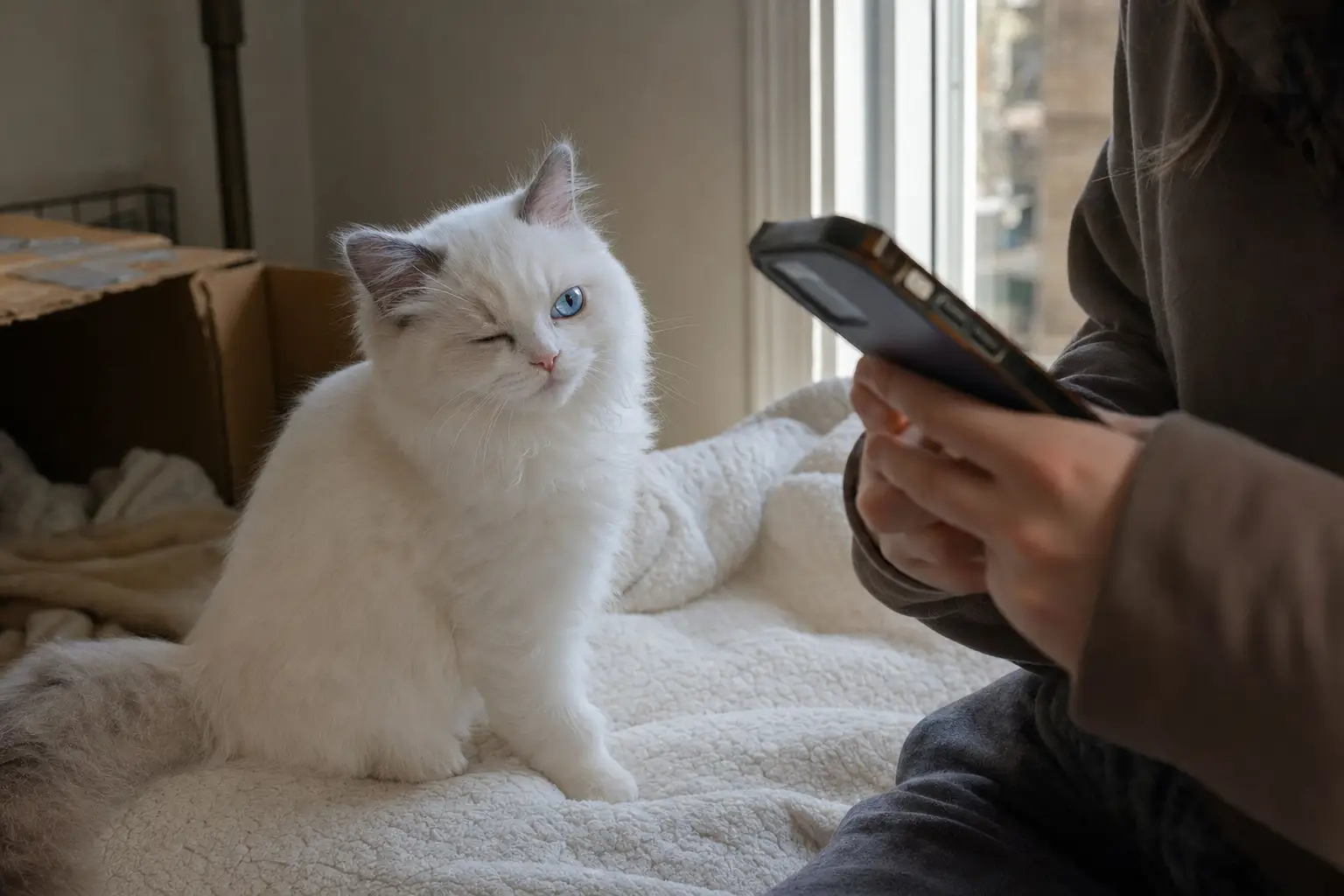
Ragdoll Kitten Slow Blink: Capturing the First One at Home
The first slow blink from a Ragdoll kitten is easy to miss. It may happen while you are sitting on the floor, holding a phone in one hand and wondering whether the kitten is looking at you or simply getting sleepy.
The simplest way to capture it is not to stage a perfect portrait. Let your kitten settle in a familiar spot, place yourself at eye level, offer one relaxed slow blink of your own, and wait. Keep the camera ready before you begin. A phone video, Live Photo, or Motion Photo usually gives you a better chance than trying to press the shutter at exactly the right moment.
A small home is not a disadvantage. You need a calm corner, soft natural light, a safe retreat, and enough patience to let the kitten choose the pace.
What a slow blink may be saying
Researchers have found that cats are more likely to narrow their eyes and approach or respond positively when people use slow-blink movements. That supports what many cat owners observe: relaxed eye narrowing can be part of friendly, non-threatening communication. It is not a universal translation for “I love you,” and one blink alone cannot prove that a kitten has completely settled in.
Look at the whole body rather than the eyes in isolation. A comfortable Ragdoll kitten may have a loose body, neutral or gently forward ears, relaxed whiskers, and a tail that is resting rather than lashing. The face may soften, the eyelids may close gradually, and the kitten may remain near you after reopening its eyes.
- Likely relaxed: soft eyelids, loose posture, quiet breathing, and an interest in staying nearby.
- Possibly tired: repeated yawning, head drooping, a sleepy posture, or blinking that occurs without any social engagement.
- Worth taking seriously: one-sided squinting, redness, discharge, cloudiness, frequent pawing at the eye, or avoiding light.
Ragdolls are often described as people-oriented, but breed tendencies do not determine every kitten’s personality. A confident kitten may respond quickly; a newly arrived or cautious kitten may need days or weeks before it offers a clear social blink. The Cat Fanciers’ Association Ragdoll profile and The International Cat Association breed information are useful references for the breed, but neither replaces watching the individual cat in front of you.
Make a small home work for the photograph
You do not need a dedicated studio or an empty room. In fact, a familiar everyday setting can make the image feel more honest. Instead of clearing the entire space, make one small area visually and physically safe.
Create three simple zones
- A settling spot: Use a washable blanket, low cat bed, sturdy chair, or rug near a window. Choose something the kitten already uses if possible.
- A camera position: Leave enough room for you to sit or kneel without leaning over the kitten. Eye-level photographs generally feel calmer than pictures taken from above.
- A retreat: Keep an open carrier, cardboard box, or covered bed nearby. The kitten should be able to leave the frame whenever it wants.
Do not place a kitten on a high shelf, narrow windowsill, unstable furniture, or close to a hot radiator just to improve the composition. Secure dangling cords, remove toxic plants, and check that the window cannot be pushed open. A quiet, safe scene matters more than a spotless background.
Vertical options can also help in a compact home. A stable cat tree, approved shelf, or window perch gives the kitten choice without taking up much floor space. The feline environmental needs guidelines from the American Association of Feline Practitioners and International Society of Feline Medicine explain why hiding areas, resting places, play opportunities, and separated resources support feline comfort.
A calm 10-minute approach
The following routine is designed for a real home, where the laundry may be visible and the kitten may decide that the blanket is less interesting than a cardboard box.
- Let the kitten arrive first. Sit nearby and do something quiet for a few minutes. Avoid immediately lifting the kitten into position or calling its name repeatedly.
- Prepare the camera before making eye contact. Clean the lens, silence unnecessary notifications, and select video, Live Photo, or Motion Photo mode. If you are using a camera, use continuous autofocus and have the lens ready before the kitten looks toward you.
- Lower your body. Sit on the floor or lower yourself until the lens is roughly level with the kitten’s face. Turn slightly sideways rather than facing the kitten head-on.
- Offer one slow blink. Look briefly toward the kitten with a soft expression, close your eyes slowly, pause for a moment, and reopen them. Then look slightly away. Do not hold a hard stare.
- Wait instead of repeating the signal. Give the kitten time to respond. Repeating the blink every few seconds can turn a gentle interaction into pressure.
- Stop while the mood is still good. If the kitten walks away, hides, becomes restless, or starts biting the phone strap, let the session end. Respecting that choice builds a better foundation for future photographs.
A small treat or a little play afterward can create a positive ending, but the reward should never require the kitten to remain still or maintain eye contact. The best image may show the kitten turning away after the blink. That is still useful information: the kitten communicated, then made its own choice.
Camera tips for blue eyes and pale fur
Ragdoll kittens are known for vivid blue eyes, while their coats may look white, cream, or lightly shaded depending on their color pattern and age. Pale fur and bright eyes can fool a phone’s automatic exposure, especially beside a sunny window.
- Use window light from the side or front. Avoid strong direct sunlight, which can create harsh shadows and make the eyes look washed out.
- Tap the eye or face to focus. If the fur appears too bright, lower the exposure slightly. Check the screen for detail in the white coat rather than aiming for the brightest possible image.
- Skip the flash. It can startle a kitten and rarely improves a close indoor portrait.
- Choose movement-friendly settings. Video, Live Photo, or a short burst helps when the blink lasts less than a second. If your camera allows manual settings, a shutter speed around 1/250 second can help freeze a small head movement.
- Move closer instead of relying on heavy digital zoom. Digital zoom can soften the eyes and whiskers. Leave some space around the kitten and crop later.
- Keep a catchlight in the eyes. A small reflection from the window can make blue eyes look lively without adding artificial lighting.
For an especially natural result, photograph the kitten during a calm part of its normal routine rather than interrupting sleep, feeding, or active play. The first slow blink is a relationship moment before it is a photography moment.
What to do if the blink does not happen
Do not assume the kitten dislikes you. A new environment can be stimulating, and the presence of a phone may be enough to change the interaction. The kitten may also be hungry, overstimulated, ready to play, or simply focused on something outside the frame.
Try again on another day in the same familiar corner. Keep the session brief and remove one variable at a time: put the phone down, move farther away, or wait until the kitten has finished exploring. Some kittens respond more readily when you sit quietly and look just past them rather than directly at them.
Never hold the kitten’s head still, pry open or close its eyelids, touch the face to create a pose, or keep following it with the camera. A forced blink is not a sign of trust, and a frightened kitten is unlikely to produce the relaxed expression you want.
If the kitten leaves, the respectful response is to let it leave. In a small home, giving an animal a clear escape route is one of the easiest ways to make future interactions calmer.
Slow blink or eye problem?
A relaxed slow blink is usually gradual and occurs alongside comfortable body language. Eye discomfort can look different: persistent squinting, repeated blinking, tearing, discharge, redness, swelling, cloudiness, unequal pupils, or sensitivity to light deserve attention.
A photograph cannot diagnose an eye problem. If those signs continue, or if the kitten seems painful or unwell, contact a veterinarian promptly. The Merck Veterinary Manual’s overview of eye disorders in cats explains why changes around the eye should not be dismissed as communication.
Frequently asked questions
Is a slow blink unique to Ragdoll kittens?
No. Cats of many breeds and mixed backgrounds may use eye narrowing as part of relaxed social communication. Ragdolls may be especially appealing subjects because many enjoy staying near people, but individual temperament matters more than the breed label.
How long should I wait for a response?
There is no reliable countdown. Wait quietly for several seconds, then allow the kitten to return to its own activity. Short, low-pressure sessions are more useful than a long attempt to produce one specific expression.
Can I teach my kitten to slow blink?
You can offer the signal and reward calm interaction, but you cannot make a genuine social response happen on command. Think of it as an invitation, not a trick. A relaxed gaze, a soft face, and a kitten that chooses to remain nearby are all worthwhile outcomes.
Keep the moment, not just the image
The most meaningful first slow blink may not be perfectly sharp. It may include a cluttered bookshelf, a crooked blanket, or half of your hand in the frame. Save the short video as well as the still image. Years later, the pause before the blink and the kitten’s small decision to stay may matter more than a polished background.
For more guidance on welcoming and caring for Ragdoll kittens, explore CTkittens.com.
Sources and further reading
- The role of cat eye narrowing movements in cat–human communication, Scientific Reports.
- Ragdoll breed information, Cat Fanciers’ Association.
- Ragdoll breed information, The International Cat Association.
- Feline Environmental Needs Guidelines, AAFP and ISFM.

Rachel Cohen is a journalist and producer with a passion for audio storytelling, health and science reporting, and feline companions.
A graduate of Middlebury College, Rachel spends her weekends exploring the mountains and when she isn’t outdoors or chasing a story, she can usually be found hanging out with her cats.

