Persian Kitten Coat Colors: Vocabulary, Myths, and Household Fit
Short answer: Persian kitten coat colors can help you understand what a kitten may look like as an adult, but they cannot tell you whether the kitten will be affectionate, healthy, easy to groom, or a good match for your household. Those questions depend much more on the individual kitten, early socialization, facial structure, breeder or rescue practices, and the time you can provide for care.
Color vocabulary is still useful. Terms such as smoke, shaded, tortoiseshell, and colorpoint describe real differences in pigment and pattern. The challenge is that everyday descriptions and formal breed classifications do not always match. Registries may group colors differently, and a kitten’s coat can change as it matures.
What Persian kitten coat colors actually tell you
Coat color describes pigment distribution, not character. A white Persian may be quiet or playful; a tortoiseshell may be outgoing or cautious; a colorpoint may be confident or reserved. Genetics influence both appearance and some biological traits, but color alone is not a reliable personality test.
When choosing a kitten, watch how it responds to people, siblings, handling, new sounds, and gentle play. A responsible breeder or foster carer should be able to describe the kitten’s behavior over time rather than promising that a particular color guarantees a certain temperament.
A practical glossary of Persian coat terms
The following descriptions are a useful starting point. If you are buying a pedigreed kitten, ask which registry’s standard the breeder is using. The same informal word can be used differently in advertisements.
| Term | What it generally means | What to remember |
|---|---|---|
| Solid | The coat is intended to appear one color from root to tip. | Young coats, shadows, and lighting can make a solid look uneven in photographs. |
| White | The visible coat is white, with no obvious colored pattern. | White is not the same as albinism. Different genetic routes can produce a white-looking cat. |
| Black, blue, red, and cream | Basic color families. In cat terminology, blue usually means a diluted blue-gray version of black, while red is generally an orange or ginger color. | “Blue” in a coat description does not necessarily mean blue eyes. |
| Tabby | A patterned coat with stripes, swirls, spots, or ticking, depending on the pattern. | Tabby is a pattern category, not a temperament type. |
| Tortoiseshell | A mixture of black or blue with red or cream areas, usually without large blocks of white. | Most tortoiseshell cats are female because of how the relevant color genes are carried on the X chromosomes. Rare male tortoiseshells do occur. |
| Calico or particolor | Colored patches combined with white; terminology varies by registry. | Ask for the formal color designation if registration matters to you. |
| Smoke | The hair has a darker tip but a much paler or silvery base, visible when the coat is parted or moved. | A smoke kitten can look solid at first glance, especially in a photograph. |
| Shaded or shell | Pigment is concentrated toward the ends of the hairs. Shell coats are generally lighter than shaded coats. | These labels can be subtle, and the coat may become clearer with age. |
| Colorpoint or Himalayan | The body is lighter while the face, ears, legs, and tail are darker points. Eyes are typically blue. | Whether this is called Himalayan, colorpoint Persian, or a Persian division depends on the registry. |
| Bicolor | A coat with white combined with another color or pattern. | It describes distribution of white, not a promise of a particular personality. |
Genetics can be more complicated than a color label suggests. For example, a cat described as silver, shaded, or smoke may need to be examined in natural light, with the fur gently parted. A kitten’s baby coat may also hide the final contrast. The University of California, Davis Veterinary Genetics Laboratory provides an accessible overview of the genes behind several cat coat colors and patterns.
Persian coat-color myths, gently corrected
Myth 1: Color predicts personality
There is no dependable rule that a particular Persian color makes a cat more loving, independent, vocal, or calm. Temperament is shaped by inherited traits, early handling, maternal care, socialization, environment, and individual variation. Color-based personality claims may be entertaining, but they are a poor basis for choosing a companion.
Myth 2: Every white, blue-eyed kitten is deaf
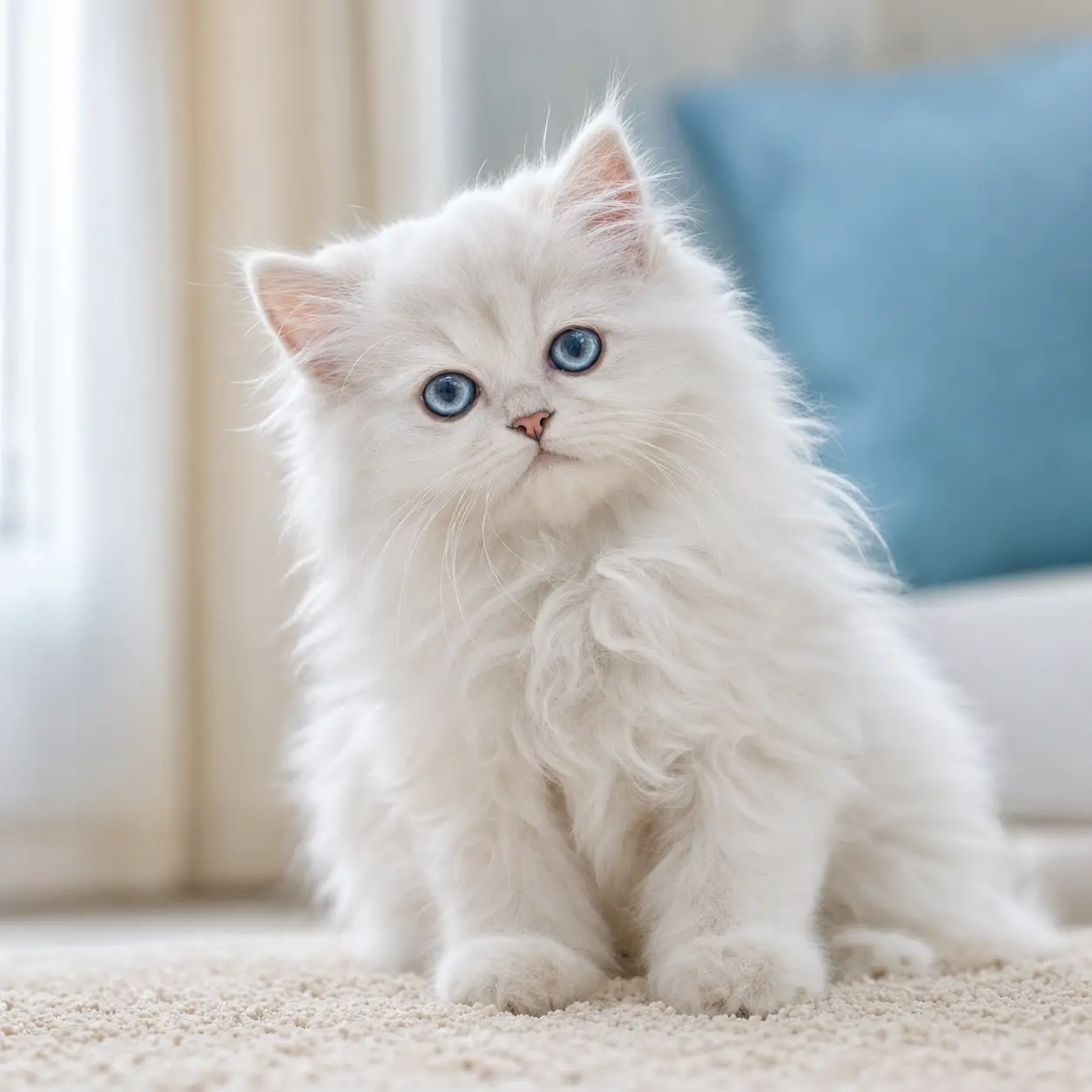
White cats with one or two blue eyes have an increased risk of congenital sensorineural deafness, but the appearance is not a diagnosis. Some white, blue-eyed cats hear normally, while deafness can occur in cats without that coloring. Hearing may also be affected on one side rather than both.
If a white kitten has blue eyes, ask whether its hearing has been assessed. A BAER test is the objective test commonly used to evaluate hearing in cats. Do not rely on whether a kitten seems to notice a sound in a busy room. A hearing-impaired cat can still be an excellent companion, but it may need safer indoor arrangements and visual rather than voice-based cues.
Myth 3: Himalayan means the cat is not a Persian
This is partly a naming issue. Some registries treat the colorpoint type as Himalayan, while others place colorpoint cats within the Persian breed or a Persian division. The practical question is not which label sounds most correct; it is which registry and pedigree the breeder is referring to.
Myth 4: Rare color means a better or healthier kitten
Unusual coloring may be attractive, but rarity does not prove quality. A healthy kitten should have appropriate veterinary care, a sound breathing pattern, clean eyes and ears, good body condition, and a well-documented background. Be cautious when marketing focuses heavily on “rare” colors while avoiding questions about health testing or the parents’ welfare.
Myth 5: Coat color determines grooming needs
Color can make tear staining or loose hair more noticeable, particularly on a white coat. It does not usually determine how much brushing the cat needs. Coat density, hair length, facial structure, and the individual cat’s tolerance are more important. Most long-haired Persians need frequent, often daily, combing to prevent mats.
What matters more when choosing a Persian kitten
Persians can be a good fit for households that want a gentle indoor companion and are prepared for regular grooming and veterinary care. They may be a poor fit for someone seeking a low-maintenance cat or expecting a kitten to look after itself.
- Grooming time: Can you comb the coat regularly, check for mats, and teach a kitten that brushing, nail care, and gentle face cleaning are normal?
- Health budget: Are you prepared for routine veterinary visits as well as possible eye, dental, breathing, skin, or coat problems?
- Breathing and facial structure: Choose a kitten that breathes quietly at rest, has open nostrils, and is not visibly struggling after mild play. Extreme flat-faced features can increase welfare concerns.
- Home environment: Persians generally suit indoor living. A calm room, safe climbing options, and gradual introductions are more useful than choosing a color to match the household’s “personality.”
- Children and other pets: Young children should be supervised and taught to handle a kitten gently. Introduce dogs and cats slowly, with separate spaces at first.
- Allergies: A long coat does not make a Persian hypoallergenic. People with allergies should spend time with adult cats before committing, if possible.
- Heat and exertion: Some flat-faced cats tolerate heat and strenuous activity poorly. Good ventilation, shade, and sensible play are important.
Persian cats can also be predisposed to inherited and conformation-related health problems. Polycystic kidney disease is one condition prospective owners should discuss with a breeder. Ask whether the parents have appropriate screening, such as documented genetic testing or veterinary ultrasound where advised. The Cornell Feline Health Center’s overview of polycystic kidney disease explains why family history and screening matter.
Questions to ask a breeder or rescue
A color photograph cannot show breathing quality, dental alignment, hearing, kidney health, or temperament. Before reserving a kitten, ask practical questions and expect clear answers.
- Which registry or standard is being used for the color description?
- Can I meet the kitten’s mother and, where possible, see the father’s health information?
- What health screening has been completed for the parents, including screening relevant to Persian cats?
- Has the kitten received a veterinary examination, vaccinations, parasite care, and identification?
- If the kitten is white with blue eyes, has hearing been assessed?
- How has the kitten been socialized to brushing, handling, household sounds, and a carrier?
- What does the contract cover if a significant health problem appears soon after adoption?
Look for kittens raised in clean, enriched surroundings, with a breeder or rescue willing to discuss limitations as well as strengths. Persistent noisy breathing, severe tear overflow, lethargy, poor weight gain, or a coat already packed with mats deserves veterinary attention rather than being dismissed as a normal Persian trait. International Cat Care offers further guidance on the welfare considerations associated with flat-faced cats in its brachycephalic cat advice.
A simple decision guide
If you love a particular Persian kitten coat color, that is a perfectly reasonable part of your decision. Use it as the beginning of the conversation, not the conclusion.
- Admire the color, then assess the kitten: Look at breathing, eyes, coat condition, body condition, movement, and behavior.
- Match care requirements to your routine: Plan for grooming and face care before bringing the kitten home.
- Verify health information: Request records rather than relying on labels such as “healthy,” “rare,” or “show quality.”
- Choose welfare over exaggeration: A slightly less extreme facial structure can be a meaningful advantage for comfort and function.
- Think beyond kittenhood: Ask what the cat may need at five, ten, or fifteen years old, not just what looks appealing in a current photograph.
FAQ
Are some Persian colors calmer than others?
There is no reliable color-based rule. Assess the individual kitten and ask how it behaves across different situations.
Do white Persian kittens require more grooming?
Not necessarily. Their coat may show staining more clearly, but grooming needs are driven mainly by coat length, density, matting tendency, and facial structure.
Can a Persian kitten’s color change?
Yes. Shaded, smoke, and colorpoint coats can become easier to identify as the kitten matures. Lighting and baby-coat changes can also affect how the color appears.
Is a blue-eyed white Persian automatically unhealthy?
No. The coloring is associated with an increased risk of congenital deafness, so hearing assessment is sensible, but the appearance alone does not determine the kitten’s overall health.
The best color is the one attached to a well-matched companion
Persian coat-color vocabulary can make conversations with breeders, registries, and veterinarians clearer. It should never replace a close look at health, temperament, welfare, and the daily care a Persian needs. Choose the kitten whose needs fit your home, whose breathing and movement look comfortable, and whose background is supported by transparent records—not simply the rarest or most photogenic color.
Ready to learn more about available Persian kittens and responsible next steps? Explore CTkittens.com for more information as you plan for your future companion.

Rachel Cohen is a journalist and producer with a passion for audio storytelling, health and science reporting, and feline companions.
A graduate of Middlebury College, Rachel spends her weekends exploring the mountains and when she isn’t outdoors or chasing a story, she can usually be found hanging out with her cats.