
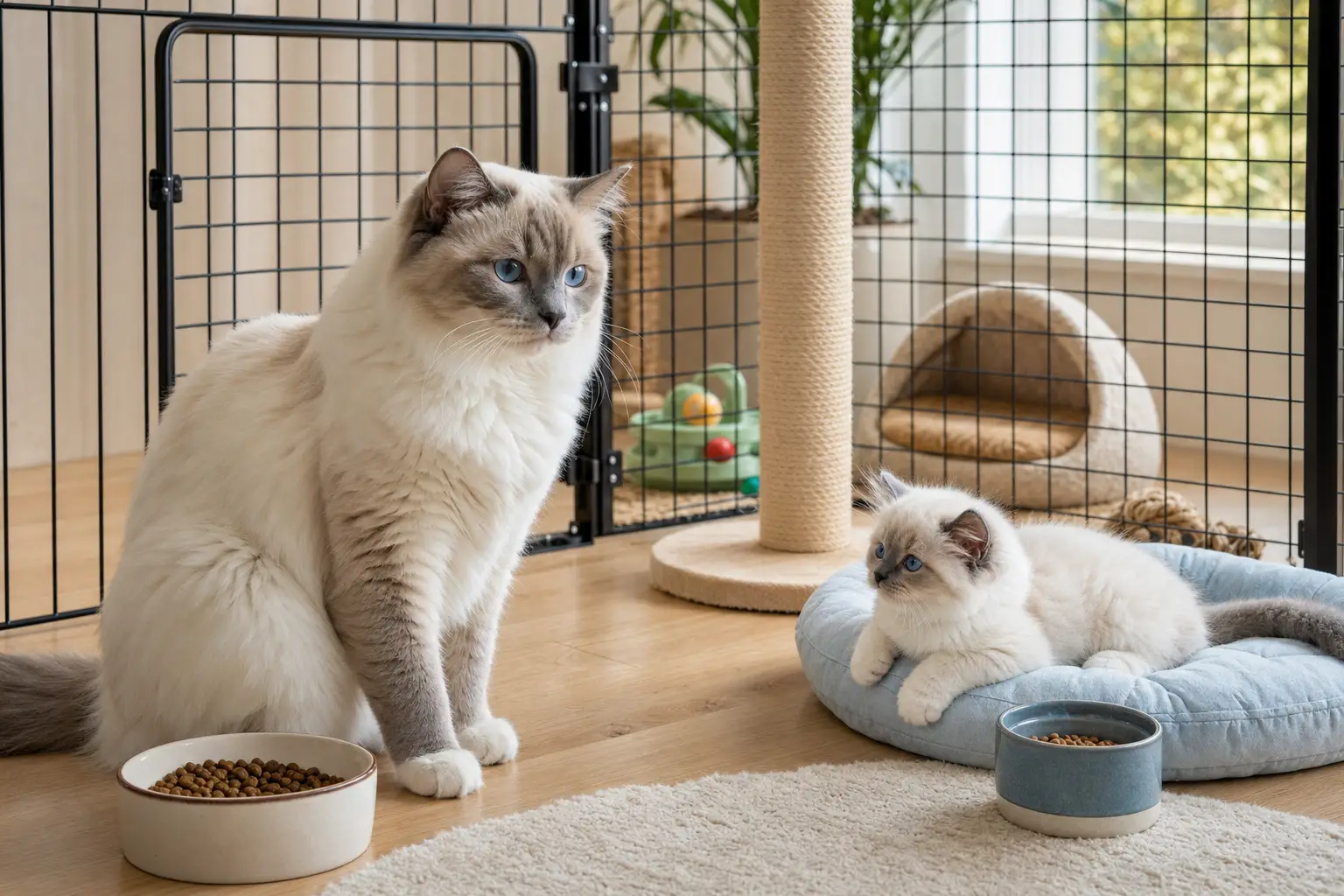
Ragdoll Kitten Routine: Morning to Evening With a New Cat
When a Ragdoll kitten begins moving into the young-adult stage, the household may be changing again. Your once-tiny cat may now be larger, more confident, and ready for new enrichment just as a younger kitten or cat arrives.
The best Ragdoll kitten routine is not a rigid timetable. It is a dependable rhythm of separate meals, play, rest, scent work, and carefully managed introductions. Keep the resident cat’s familiar routine in place while giving the newcomer a protected space of their own. Then let body language, appetite, litter habits, and comfort determine how quickly the cats move forward.
This approach celebrates the older cat’s next life stage without treating them as if they have suddenly stopped needing play and attention.
What changes from kitten to young adult?
Veterinary life-stage guidelines commonly describe cats up to about one year old as kittens and cats from roughly one to six years old as young adults. Those labels are useful for planning care, but they are not an overnight switch. A cat approaching or just past the one-year mark may still be filling out, learning social skills, and enjoying kitten-like bursts of energy.
Ragdolls are a large, slow-maturing breed, and many continue developing physically after their first birthday. That does not mean every Ragdoll needs the same feeding plan or calorie level. Use your veterinarian’s advice, body-condition assessment, and growth pattern rather than age alone when deciding whether to change food.
| What to keep | What to gradually add |
|---|---|
| Regular meals, predictable sleep areas, daily interactive play, and calm handling | More challenging puzzle feeders, short training sessions, climbing options, and supervised social experiences |
| Private access to food, water, litter boxes, and resting places | Choice: the resident cat should be able to approach or retreat instead of being forced to interact |
Ragdolls are typically blue-eyed colorpoint cats. A pale kitten may develop darker ears, face, legs, and tail as the coat matures, so coat color is not a reliable sign that a cat is ready for adult food, less play, or unrestricted contact with another cat.
Prepare before the younger cat arrives
Successful introductions begin before the cats meet. Set up a separate room for the newcomer with food, water, a litter box, a scratching surface, hiding options, and a comfortable bed. The resident cat should still have familiar areas that are not suddenly taken over by the new arrival.
- Arrange a veterinary examination. Ask about age-appropriate vaccines, parasite control, infectious-disease testing, and whether the new cat’s medical history creates any special precautions. Keep the cats separated until your veterinarian says direct contact is appropriate.
- Provide duplicate resources. Feed cats separately, and offer multiple water stations, scratching posts, beds, and elevated resting places. For litter boxes, one per cat plus one extra is a useful starting point, placed where each cat can reach a box without being cornered.
- Protect the resident cat’s routine. Keep breakfast, bedtime, favorite play sessions, and access to familiar rooms as consistent as possible. A new kitten should add experiences, not erase the older cat’s sense of security.
- Plan for vertical and visual escape routes. Cat trees, shelves, sturdy furniture, and open carriers can give a cat distance without requiring a sprint past the other cat.
For a detailed overview of gradual introductions, see Cornell Feline Health Center’s guidance on introducing cats. The basic principle is simple: begin with scent and sound, add controlled visual contact, and only then consider brief shared-room sessions.
A Ragdoll kitten routine that grows with your cats
The following schedule is a framework rather than a rulebook. Adjust the times to your household, but keep the order predictable. The younger cat may need more sleep and shorter play sessions, while the young adult may benefit from more demanding play and continued one-on-one attention.
Morning: meals, litter care, and individual attention
Start with a quiet check-in. Notice whether both cats are alert, eating normally, using their litter boxes, and moving comfortably. A change in appetite, elimination, or behavior can be an early sign of illness or stress and should not be dismissed as a social problem.
Feed the cats in separate areas, ideally where they cannot stare at or block each other. This prevents mealtimes from becoming a competition and makes it easier to see how much each cat eats. If the younger cat is still growing, follow the feeding guidance for that cat’s age rather than copying the resident cat’s portion.
After breakfast, scoop the litter boxes and refresh water. Then offer the resident Ragdoll a short interactive play session with a wand toy or another safe toy. Move the toy like prey, allow the cat to catch it, and finish with a small treat or meal when appropriate. This familiar sequence can reassure the resident cat that their morning has not been replaced.
The newcomer can have a separate play session in the safe room. Keep it brief if the kitten becomes overstimulated. A young cat who starts biting, racing wildly, or ignoring toys may need a nap rather than more excitement.
Late morning: scent exchange without pressure
Once both cats are comfortable eating and resting in their own areas, begin scent work. Swap bedding, or use separate soft cloths to collect scent from each cat’s cheek area and place the cloth in the other cat’s room. Never restrain a cat and press the cloth onto their face.
Pair the unfamiliar scent with something pleasant, such as a meal, a lickable treat, or calm play. If either cat refuses food, hides for a long time, or becomes tense near the scent, make the change smaller. You might place the item farther away or return to a familiar-smelling blanket for a while.
When it is safe and both cats are relaxed, a controlled room swap can provide more information without direct contact. Put the resident cat in a comfortable closed room while the newcomer explores a limited area, then reverse the arrangement. Skip this step if either cat is distressed or if your veterinarian has advised continued separation for health reasons.
Afternoon: rest, enrichment, and a confidence-building routine
Afternoons should include plenty of sleep. Cats do not need constant entertainment, and repeated forced interaction can make introductions harder. Offer each cat a quiet retreat where the other cannot follow.
Use food puzzles, safe cardboard boxes, scratching posts, and rotating toys to provide independent enrichment. For the young adult Ragdoll, vary the height and movement of toys so play does not become predictable. For the younger cat, choose age-appropriate toys without loose parts that could be swallowed and supervise toys that contain strings or feathers.
You can also practice simple behaviors separately: responding to a name, stepping onto a mat, entering a carrier, or accepting gentle handling. Keep sessions to a few minutes and reward calm choices. Training is useful during introductions because it gives each cat something constructive to do, but it should never be used to force proximity.
Early evening: controlled visual contact
When scent exchanges are calm, let the cats see one another through a secure mesh barrier, tall gate, screen door, or a door opened only a small amount. Begin far enough away that both cats can still eat treats, play, or look away.
Keep the first sessions short. End while the cats are still relaxed rather than waiting for a hiss, lunge, or chase. A brief hiss is communication, not proof that the relationship is impossible, but repeated hard staring, growling, swatting at the barrier, or blocking the other cat’s path means the session is too difficult.
Give the resident cat a rewarding activity during these sessions, such as a favorite treat or toy, so the presence of the younger cat predicts good things. Do the same for the newcomer. Do not hold the cats nose-to-nose, carry one toward the other, or punish vocalizations.
Night: separate sleep and preserve familiar rituals
Until the cats have shown consistent calm behavior during supervised shared time, separate them overnight. This is not a setback. It prevents an unsupervised chase or fight and gives each cat a dependable period of rest.
Before bed, give the resident Ragdoll their usual affection or play session. The new cat should also receive quiet attention, but not at the cost of removing every familiar ritual from the older cat’s evening. If one cat is highly social and the other prefers distance, respect those differences rather than expecting equal interaction.
Let behavior set the pace
There is no universal number of days for introducing cats. Some pairs progress in a week; others need several weeks or longer. Move forward when both cats can eat, play, groom, use the litter box, and rest normally around the current level of exposure.
Good signs include loose body posture, soft blinking, curiosity followed by looking away, normal appetite, and the ability to disengage. Slow down if either cat persistently hides, guards a doorway or resource, stops playing, changes litter habits, vocalizes continuously, or seems unable to settle after a session.
If a fight begins, do not put your hands between the cats or try to pick up an agitated cat. Use a solid barrier, such as a large piece of cardboard or a door, to separate them safely. Allow both cats to calm down, return to a previous step, and ask your veterinarian or a qualified feline behavior professional for help if conflict continues.
Contact a veterinarian promptly for illness signs such as not eating, repeated vomiting or diarrhea, breathing difficulty, pain, marked lethargy, or urinary changes. Stress can affect health, but a medical problem should not be assumed to be purely behavioral.
Common mistakes to avoid
- Changing everything at once: A new cat, new food, new litter, and rearranged furniture can create avoidable stress. Change one major variable at a time when possible.
- Giving the kitten unlimited access: A playful kitten may pester a young adult who needs a break. Use gates, doors, and scheduled naps to protect both cats.
- Measuring success by cuddling: Peaceful coexistence is a successful outcome. The cats do not have to sleep together or become inseparable.
- Forgetting the resident cat: Continue solo play, grooming, training, and affection. The older cat should not have to compete for every valuable resource.
- Assuming a Ragdoll will tolerate anything: Breed tendencies do not replace individual temperament. A gentle, people-oriented cat may still need distance from a lively newcomer.
FAQ
When can my Ragdoll and the younger cat be left alone together?
Wait until they have had repeated, supervised sessions with no chasing, cornering, resource guarding, or escalating conflict. Start with short periods while you remain nearby, and keep them separated when you cannot respond quickly.
Should the resident young adult get more attention than the new kitten?
Both cats need individual attention, but maintaining the resident cat’s established routine is especially helpful. Schedule separate play and affection so neither cat has to compete for access to you.
Is hissing always a bad sign?
No. Hissing can communicate discomfort and may stop when the cat gets more distance. Treat it as information: end or reduce the intensity of the interaction rather than scolding the cat. Persistent aggression, fear, or physical conflict calls for a slower plan and professional advice.
A calmer way to mark the transition
Your Ragdoll’s move into young adulthood is worth celebrating, but the best celebration is not a dramatic change in routine. Keep the dependable parts of daily life, add age-appropriate enrichment, and introduce the younger cat in small, positive steps.
Over time, the goal may be friendship, comfortable coexistence, or simply two cats who can share a home without fear. All three are worthwhile outcomes. For more kitten-care guidance and information about Ragdoll cats, explore CTkittens.com.
For additional veterinary context, consult your own veterinarian and review the feline life-stage guidelines from the American Association of Feline Practitioners.

Rachel Cohen is a journalist and producer with a passion for audio storytelling, health and science reporting, and feline companions.
A graduate of Middlebury College, Rachel spends her weekends exploring the mountains and when she isn’t outdoors or chasing a story, she can usually be found hanging out with her cats.

