
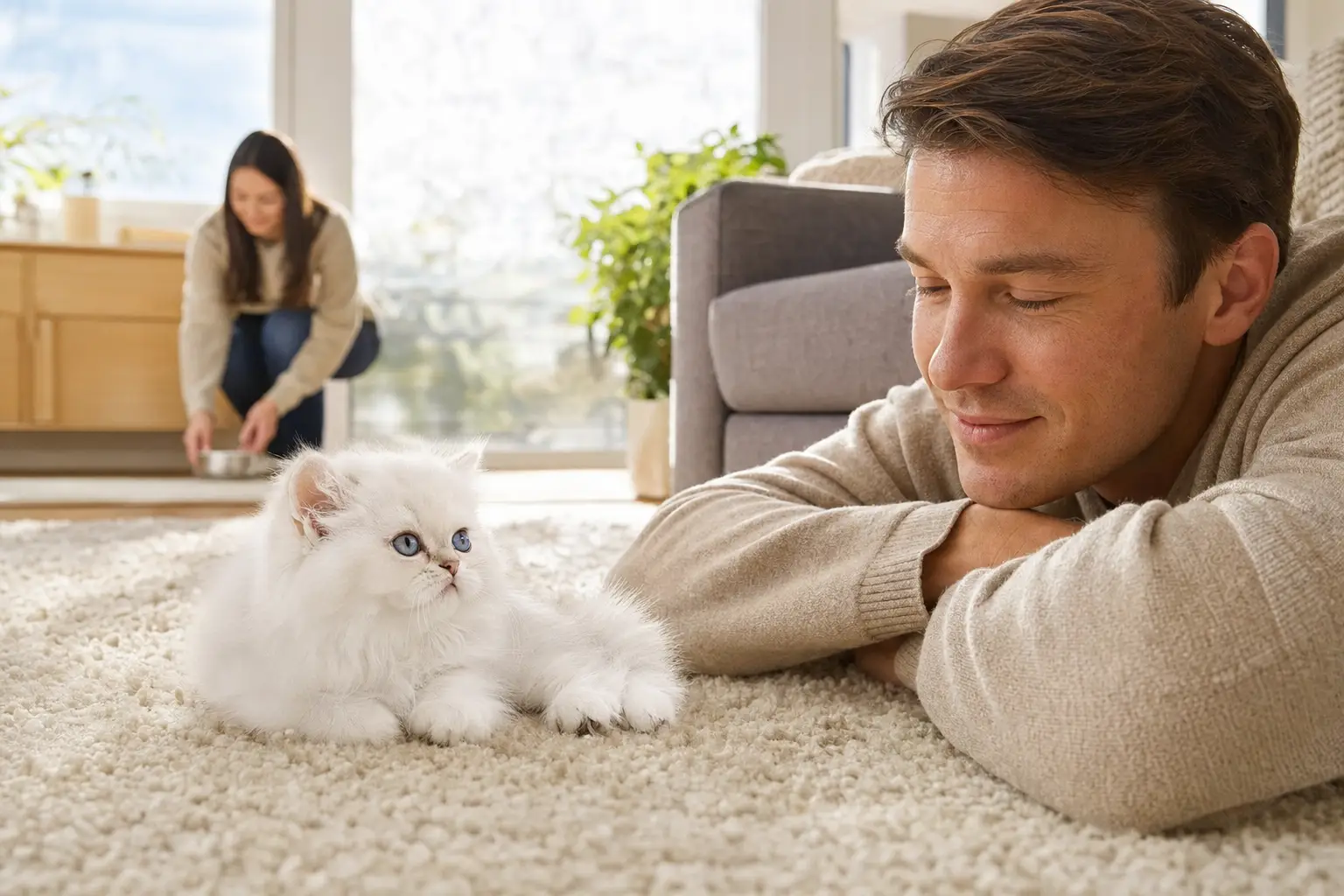
Persian Kitten Communication: What Slow Blinks Look Like in a Busy Home
When several family members share care, Persian kitten communication is less about teaching one perfect trick and more about creating a predictable rhythm. A slow blink can be part of that rhythm: one person softens their gaze, the kitten may blink back or look away, and everyone allows the interaction to end without pressure.
That is the real-life version of a slow-blink conversation. It is not a command, a test, or proof that a kitten is bonded equally with every person in the household. It is a low-pressure signal that can support trust when it is paired with calm handling, consistent care, and plenty of choice.
What a slow blink actually communicates
A relaxed slow blink usually begins with a kitten looking toward a person without a hard, fixed stare. The person softens their face, gently narrows or closes their eyes for a moment, then looks slightly away. The kitten might return the blink, close their eyes briefly, turn their head, approach, or simply continue resting.
Those responses can all be compatible with comfort. A kitten does not need to copy the exact movement for the exchange to be useful. In many cases, the most meaningful response is what happens next: the kitten stays in the room, resumes grooming, settles on their side, or chooses to come closer.
Research published in Scientific Reports found that cats were more likely to approach after people made slow eye-narrowing movements than after a neutral expression. That supports the idea that a slow blink can be a friendly cat-human signal, but it does not establish a detailed language or guarantee that every cat will respond. You can read the study in Scientific Reports.
A useful way to think about it is this: a slow blink is an invitation to remain relaxed, not an instruction to interact.
Why the Persian part matters—and why personality matters more
Persian kittens are often selected for their gentle appearance and their quiet, expressive faces, but breed is not a personality guarantee. One Persian kitten may greet everyone, while another prefers one calm person and takes longer to approach new voices or hands. Their individual history, early social experiences, health, and temperament all affect how they communicate.
The long coat can also make some body signals less obvious. A swishing tail may be harder to notice under dense fur, so caregivers should watch the ears, whiskers, posture, movement, and facial tension as well as the tail. A kitten who is comfortable may have a loose body, neutral or forward ears, normal grooming, and an easy willingness to eat or play nearby.
Persian kittens also need routine coat care. That creates an important distinction between contact the kitten chooses and contact the household must gradually teach them to tolerate. Brushing, checking around the eyes, examining paws, and gentle handling should happen in short, manageable sessions. A slow blink may help keep the mood calm, but it cannot replace a gradual handling plan.
The same principle applies to eye appearance. A relaxed two-eye blink with a soft face can be social communication. Persistent one-sided squinting, redness, swelling, cloudiness, obvious pain, or unusual discharge is different and deserves veterinary advice. Do not interpret a kitten’s uncomfortable eye as a charming slow blink.
What the conversation looks like with several caregivers
In a one-person household, a kitten may learn one person’s voice, footsteps, feeding routine, and approach. In a family home, there are more variables: a tall adult leaning over the kitten, a child moving quickly, someone arriving in noisy shoes, and another person handling the morning meal. The goal is not to make every person behave identically. It is to make the important parts predictable.
A realistic morning example
- One person enters quietly. They avoid walking directly at the kitten and pause before reaching down.
- The person offers a brief slow blink. They look toward the kitten softly, close their eyes for a moment, and then look away.
- The kitten keeps the choice. If the kitten approaches, the person can offer a hand to sniff. If the kitten stays on a bed, the person continues with breakfast without coaxing them out.
- The care remains consistent. Food, fresh water, litter care, and a calm departure happen whether or not the kitten returned the blink.
Later, another family member can use the same sequence. The second person does not need to repeat the blink five times or compete for a response. They simply become another predictable source of food, play, comfort, and respectful space.
This matters because trust is built from patterns. If one person slow-blinks but immediately scoops the kitten up, while another slow-blinks and lets the kitten walk away, the kitten may learn that the signal itself does not reliably predict what will happen next. The cue works best when the human behavior after it is also calm and consistent.
Build a shared family language
A household does not need a formal training chart, but a few agreed habits can prevent mixed messages. Consider making these the family rules:
- Use one gentle approach. Pause, turn slightly sideways, soften your gaze, and offer a slow blink from a comfortable distance.
- Do not crowd the kitten. One person interacts while others give space, especially during meals, naps, litter use, or grooming.
- Let the kitten finish first. If the kitten turns away, lowers their body, pins their ears, or leaves, stop the interaction.
- Pair contact with good experiences. Short play sessions, food, quiet company, and praise can teach the kitten that people are predictable without requiring physical affection.
- Keep handling brief. End brushing or paw-touching before the kitten becomes overwhelmed, then build duration gradually over future sessions.
- Share observations. Tell one another what the kitten enjoys, avoids, and tolerates so nobody accidentally repeats a stressful approach.
Children can take part, but they should not be responsible for reading every subtle signal. An adult should supervise contact and teach children to sit down, keep hands low, avoid chasing, and allow the kitten to leave. A slow blink is especially useful for children because it gives them something calm to do instead of reaching immediately.
How to read the response beyond the eyes
A returned blink is a pleasant response, but it is only one piece of information. Look at the whole kitten:
- Comfort may look like: a loose posture, relaxed whiskers, normal grooming, a soft face, resting nearby, approaching with a neutral tail, or returning to food after noticing you.
- Uncertainty may look like: freezing briefly, crouching, keeping the body angled away, watching closely, or moving off after the interaction. Give more distance and avoid reaching.
- Overstimulation or fear may look like: flattened ears, a tightly tucked body, rapid tail movement, hissing, swatting, hiding, or trying to escape. Stop and give the kitten a quiet route away.
Not every behavior has one fixed meaning. Purring, for example, can occur during contentment but also during stress or discomfort. A single signal should never outweigh the kitten’s overall posture and the situation around it.
Common slow-blink mistakes
Repeating the blink until the kitten answers
Several slow blinks in a relaxed exchange may be fine, but repeated attempts can become pressure if the kitten is trying to disengage. One calm invitation is usually enough. The kitten’s freedom to ignore it is part of what makes the signal low pressure.
Staring first and blinking dramatically
A long, direct stare can feel intense. Keep your gaze soft and brief rather than locking eyes and then closing them forcefully. You are aiming for relaxed facial movement, not a performance.
Using the blink before unwanted handling
If every blink is followed by nail trimming, eye cleaning, or being picked up, the kitten may become cautious about the interaction. Necessary care still has to happen, but separate quiet social moments from unavoidable handling whenever possible.
Assuming silence means rejection
Some kittens respond by staying still, resting, or continuing what they were doing. A cat who does not blink back may still be comfortable. Look for the absence of tension and for the kitten’s willingness to remain nearby.
A simple routine for a busy household
Choose one or two quiet moments each day rather than asking everyone to interact constantly. At breakfast, one caregiver can offer the blink and refresh the kitten’s resources. In the evening, another person can sit nearby for a few minutes while the kitten plays or rests. A third person can handle a short grooming session only when the kitten is calm, using treats or a favorite activity afterward.
Keep a brief family note for the first few weeks: who fed the kitten, whether grooming was attempted, what the kitten chose, and what seemed to cause tension. The purpose is not to score affection. It is to spot patterns, such as a kitten who is relaxed after play but not before meals, or one who prefers contact on the floor rather than on a sofa.
Over time, the slow blink becomes one small part of a larger message: the people in this home notice my signals, provide what I need, and do not make every approach turn into restraint.
FAQ
Should every family member slow-blink at the Persian kitten?
They can, but nobody needs to do it constantly. A shared, gentle approach is more useful than several people trying to get a response at once. Let the kitten interact with one person before another joins.
What if the kitten never blinks back?
Do not force a response. Continue offering predictable care, calm play, food, and space. Staying relaxed near you, eating comfortably, or choosing to remain in the room may be more meaningful signs of trust for that individual kitten.
Can slow blinking help a nervous kitten?
It may make a human approach less intense, but it is not a treatment for significant fear. Give the kitten hiding places, reduce noise and crowding, and ask a veterinarian or qualified behavior professional for guidance if fear persists or worsens.
Is squinting always a friendly signal?
No. A soft blink with both eyes and a relaxed body can be social. Ongoing squinting, especially in one eye or alongside redness, discharge, swelling, cloudiness, or pain, should be discussed with a veterinarian.
Make room for the kitten’s answer
The best slow-blink conversation is not the one with the most obvious reply. It is the one in which a Persian kitten can communicate without being cornered, passed around, or tested. When several people share care, consistency becomes more valuable than enthusiasm: the same calm approach, the same respect for retreat, and the same dependable daily routines.
Ready to learn more about living well with a Persian kitten? Explore the care and kitten resources at CTkittens.com for more practical guidance.

Rachel Cohen is a journalist and producer with a passion for audio storytelling, health and science reporting, and feline companions.
A graduate of Middlebury College, Rachel spends her weekends exploring the mountains and when she isn’t outdoors or chasing a story, she can usually be found hanging out with her cats.

