
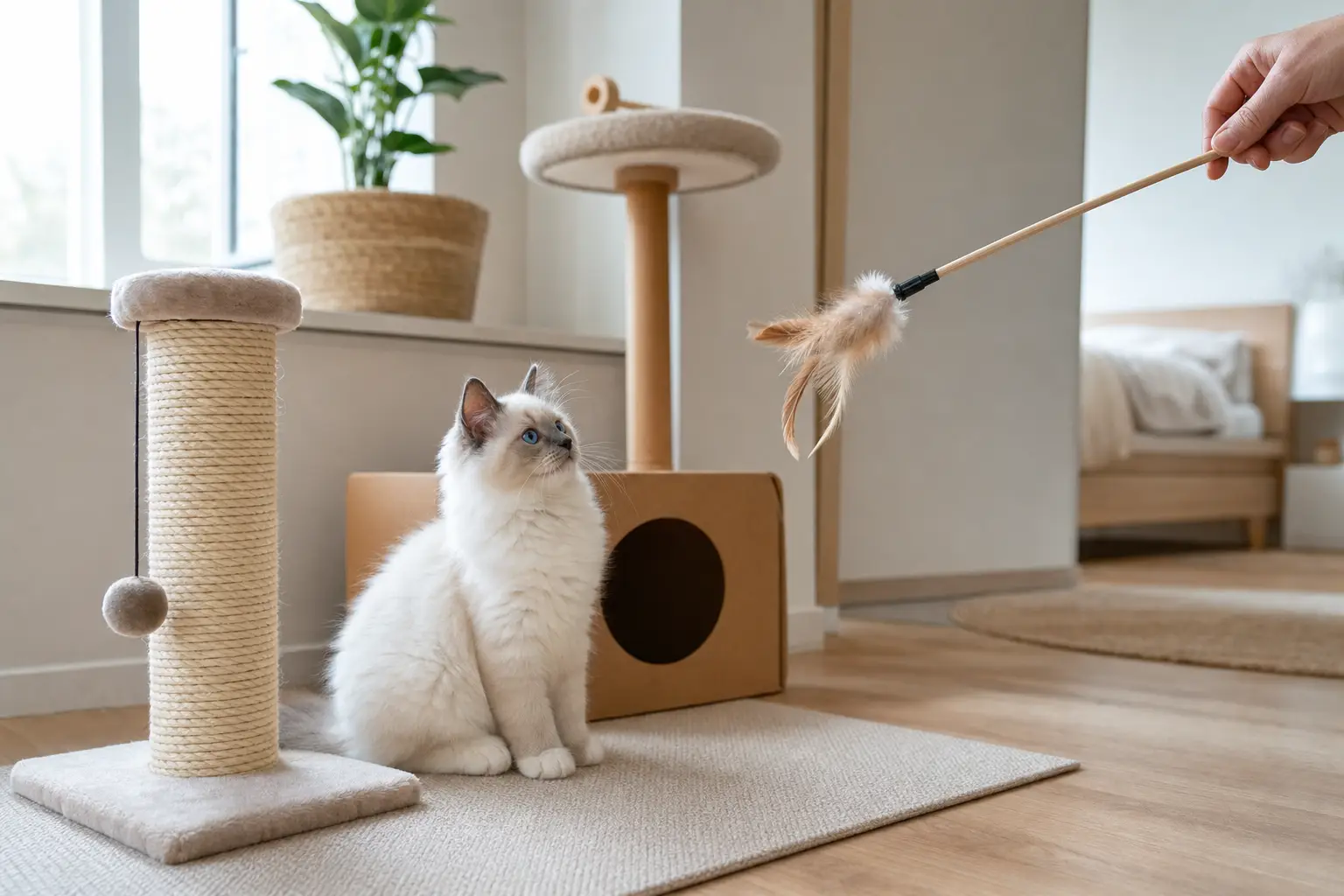
How to Create a Ragdoll Kitten Play Corner in a Studio Apartment
Yes, you can create a useful Ragdoll kitten play corner in a studio apartment without giving up half your living space. Start with a compact strip of floor—roughly 2 by 3 feet if your furniture allows—and combine a sturdy scratching surface, a washable mat, a small hideaway, a vertical perch, and a basket for supervised toys. Then spend ten minutes a day resetting the area and playing with your kitten.
The goal is not to build a miniature cat playground packed with equipment. It is to make one reliable location where your kitten can scratch, climb, hide, chase, and settle. For a Ragdoll, stability matters more than having the most elaborate accessories. The breed has a substantial build and a semi-long coat, so choose equipment that will not wobble and surfaces that are easy to clean.
One caution: ten minutes is a maintenance routine, not a complete exercise prescription. Kittens often benefit from several short play opportunities throughout the day. If your kitten is still racing around after the routine, offer another brief session later rather than expecting one timed block to meet every need.
What belongs in a compact Ragdoll kitten play corner?
Think in terms of activities rather than products. Every item should serve at least one of these purposes: scratching, climbing, hiding, chasing, resting, or exploring. In a studio, the best setup usually uses vertical space and has more than one function.
| Need | Compact choice | What to look for |
|---|---|---|
| Scratch | A tall sisal post or a sturdy horizontal scratcher | A broad, non-slip base and enough length for a full stretch |
| Climb | A secured cat tree, shelf, or window perch | A weight rating, wide platform, and no rocking when touched |
| Hide | A fabric cube, cardboard box, or covered bed | One clear entrance and enough room for the kitten to turn around |
| Play | A small toy basket and one rotating puzzle toy | Easy storage; no loose strings or small parts left unattended |
| Rest | A washable mat or bed beside the activity area | A quiet edge of the room, away from constant foot traffic |
1. Start with a stable base
Place a non-slip, washable mat beneath the main equipment. This visually defines the corner, protects the floor from litter and scratching debris, and makes the area easier to reset. A bath mat with a secure backing can work if it does not have loose loops that a kitten can pull apart.
Do not force every item onto the mat. A tall perch may need its own footprint, and a scratcher is more useful when it sits where your kitten naturally walks or wakes up. The mat is a boundary for the corner, not a rule that every object must fit inside it.
2. Choose a scratcher for a full-body stretch
Many kittens prefer a scratcher that lets them extend their front legs and pull downward. A short, lightweight post may look tidy in a studio but become frustrating if it tips over. Look for a heavy base, a firm covering, and enough height for your growing kitten.
If floor space is limited, add a horizontal cardboard scratcher or a wall-protected scratching panel. Some cats prefer horizontal scratching, so offering one vertical and one horizontal option can be more useful than buying two identical posts.
3. Add height without creating a fall hazard
Vertical territory can make a small home feel more interesting without adding much floor area. A compact cat tree, a properly anchored shelf, or a secure window perch can provide a lookout point. Select a platform that is large enough for a Ragdoll to sit comfortably as it grows.
If you rent, avoid improvising with unstable stacks of boxes or furniture that can slide. Follow the manufacturer’s installation instructions for shelves and wall furniture, and anchor tall cat trees when recommended. Adhesive hooks are not a substitute for a load-bearing attachment.
4. Give the corner a retreat
A play area should include somewhere to pause. A cardboard box turned on its side, a covered bed, or a fabric cube can provide a simple retreat. Keep one entrance clear and avoid placing the hideaway where a door, vacuum, or busy walkway will repeatedly startle the kitten.
The hiding spot does not need to be expensive. In fact, a plain box that is replaced when it becomes worn may be easier to maintain than a bulky enclosed bed. Remove it if it becomes damp, torn, or difficult to clean.
The ten-minute daily reset
A play corner works best when it is refreshed regularly instead of being filled with every toy at once. Use this routine as a starting point and adjust it to your kitten’s age, energy, and attention span.
- Minutes 0–2: Inspect and reset. Pick up stray objects, check that the scratcher and perch are stable, and remove any toy with loose threads, broken parts, or damaged feathers.
- Minutes 2–7: Play together. Use a wand toy to imitate prey: move it along the floor, pause behind the box, let your kitten stalk, and allow regular catches. Short pauses often keep the game engaging better than constant fast movement.
- Minutes 7–9: Offer a calm activity. Rotate in a kicker toy, a treat puzzle, or a few pieces of the kitten’s regular food scattered in an easy-to-search area. Supervise any puzzle that has removable parts.
- Minute 10: Put away interactive toys. Store wand toys, ribbons, elastic, and string-based items in a closed container. Leave out only toys that are appropriate for independent use and have no detachable or swallowable parts.
Try ending the chase with a successful catch rather than abruptly removing the toy at peak excitement. You can then offer a meal or normal feeding opportunity if that fits your household routine. The sequence of chase, catch, and settle gives the session a clear ending, but it should not replace regular feeding guidance from your veterinarian.
Three studio-friendly layouts
The wall-side strip
Place the scratcher and hideaway along one wall, with a low perch or cat tree at the end. Keep the center clear so your kitten can run from one activity to another. This arrangement works well beside a sofa or desk and keeps the play area from becoming a trip hazard.
The window-and-corner setup
Use a secure window perch as the highest point, a scratching post below it, and a bed or box to one side. Keep blind cords, curtain cords, and dangling decorations out of reach. A window view can add interest, but it should not be the only source of enrichment; not every kitten enjoys a busy street view.
The fold-away setup
For a very small studio, keep a stable scratcher and bed in place while storing the toy basket in a nearby cabinet. Bring out one wand toy and one puzzle at a time. A foldable tunnel can be opened during play and stored afterward, provided it is not used as a replacement for a secure resting area.
Safety details that matter in a small apartment
Compact homes make it easier to see your kitten, but they also concentrate hazards. Before using the corner, check the whole route your kitten might take—not just the mat.
- Secure windows. Use a properly fitted, secure screen or window guard and keep damaged screens closed. Never assume a loose insect screen will restrain a kitten.
- Control cords. Move blind cords, charging cables, headphones, and dangling decorations away from the play path. A kitten may investigate anything that swings or moves.
- Store string toys. Strings, ribbons, elastic, and feather attachments can be dangerous if chewed or swallowed. Use them only during supervised play, then put them away.
- Check plants. Remove plants that may be toxic to cats or verify their safety through the ASPCA’s cat plant database.
- Keep pathways open. Do not place a tree, box, or tunnel directly beside a hot appliance, heater, stove, or frequently opened door.
- Separate essentials. Keep the litter box away from the play corner and place food and water where the kitten can eat without being crowded by activity.
Inspect the setup whenever you clean. A post can loosen, a shelf can shift, and a cardboard box can become sharp after repeated use. Replacing one damaged item is cheaper and safer than trying to repair a toy with exposed staples, glue, or loose wire.
How to keep the corner interesting without buying more
Novelty does not require a growing pile of toys. Keep most toys stored and rotate two or three at a time every few days. Change the direction of the wand game, move the box to a different side of the mat, or hide a few pieces of regular food in simple paper cups that your kitten cannot ingest.
Watch what your kitten chooses. If it ignores a tall tower but repeatedly uses the cardboard scratcher, give the preferred activity more space. If the kitten hides whenever the wand appears, slow the toy down and start at a distance. A breed name can suggest general physical traits, but it cannot predict an individual cat’s confidence, play style, or preferred texture.
The AAFP and ISFM environmental-needs guidelines describe the importance of safe places, opportunities for play and predatory behavior, and appropriate access to essential resources. Your studio corner does not need to look elaborate; it needs to give your kitten meaningful choices.
Common mistakes to avoid
- Buying for appearance instead of stability. A beautiful tower that wobbles will not be reassuring to a growing kitten.
- Filling the corner with every toy. Clutter reduces usable space and makes damage harder to notice.
- Using play as a substitute for companionship. Ragdolls are often described as social, but individual personalities vary. Quiet interaction, grooming, and simply being near you may matter as much as chasing a toy.
- Leaving the laser as the only game. If you use one, finish with a tangible toy or treat so the session includes a physical catch. A wand toy also makes it easier to observe and control the kitten’s play.
- Skipping growth checks. Reassess the perch, hideaway, and scratcher as your kitten becomes larger and more active.
FAQ
Is ten minutes of play enough for a Ragdoll kitten?
It is a useful daily habit, but not a universal total. Kittens commonly have changing bursts of energy, and some will need several short sessions. Use the ten-minute routine to maintain the corner and provide focused interaction, then add sessions when your kitten remains active or seeks play.
How much space does a Ragdoll kitten need in a studio?
There is no single minimum footprint that suits every apartment or cat. A thoughtfully arranged 2-by-3-foot starting area can work when it includes vertical space, a stable scratcher, and a clear path. As the kitten grows, prioritize comfortable platforms and safe movement over keeping the corner the same size.
Where should the play corner go?
Choose a spot that is visible to you but not in the middle of constant traffic. A living-room wall, the edge of a home office, or a quiet area near a secure window can work. Keep the litter box separate, avoid loud appliances, and make sure your kitten can retreat without being trapped.
Ready to make the rest of your home kitten-friendly? Explore CTkittens.com for Ragdoll kitten information and helpful next steps as you prepare your space.
Sources and further reading

Rachel Cohen is a journalist and producer with a passion for audio storytelling, health and science reporting, and feline companions.
A graduate of Middlebury College, Rachel spends her weekends exploring the mountains and when she isn’t outdoors or chasing a story, she can usually be found hanging out with her cats.


Kinda wild how this setup is basically tiny-home design for cats, where giving each inch a job matters way more than cramming in more stuff lol.