
The Doorway Pause Map: Designing a Better Room for a Ragdoll Kitten
A Ragdoll kitten can make a grand event out of crossing a room. Instead of marching directly toward a toy, the kitten may stop at the doorway, sit half in and half out, and study the entire space as if someone has changed the scenery overnight.
That little pause is more than a charming habit. It can reveal how your kitten prefers to explore, where household movement feels comfortable, and which parts of a room invite a closer look. With a simple observation project called the Doorway Pause Map, you can arrange a room around your Ragdoll kitten’s actual interests rather than around an imagined perfect setup.
Why Doorways Become Important Observation Posts
A doorway offers several kinds of information at once. From the threshold, a Ragdoll kitten can see furniture legs, hear activity in another room, detect changing light, and decide whether to enter immediately or wait for a quieter moment.
Ragdolls are often interested in participating in household life without necessarily rushing into the middle of it. A doorway gives them a useful compromise: close enough to watch, far enough away to retreat. One kitten might stretch forward with its front paws while keeping its back feet on the hall rug. Another may sit beside the frame and wait for a person to pass.
These pauses should not be treated as a strict breed rule. A confident kitten may charge through every opening, while a thoughtful one may inspect each new angle. The point is to notice the individual pattern.
How to Make Your Doorway Pause Map
Choose one room your kitten visits regularly. For three or four days, observe the entrances without rearranging anything. You are not conducting a formal study; you are simply collecting clues.
Use a notebook or phone and record:
- Which doorway your kitten stops at most often
- Whether the pause lasts a few seconds or several minutes
- What your kitten watches: people, windows, sounds, shadows, or another room
- Whether the kitten enters along the wall, through the center, or beneath furniture
- Which surface is under the paws at the stopping point
- What makes the kitten continue, such as a familiar voice or a moving paper toy
Try observing at different times. Morning light may make one threshold appealing, while evening household activity may shift the preferred viewing spot. A Ragdoll kitten who ignores a doorway at noon may sit there during dinner preparation simply because the room has become more interesting.
The Three-Point Route
Once you have a few observations, create a small route with three points: a lookout, a pause surface, and a destination. These do not need to be elaborate.
The lookout might be the open doorway itself. The pause surface could be a folded cotton mat placed just inside the room, giving your kitten a clear change in texture. The destination might be a low bed, a sturdy scratcher, or a quiet cushion positioned where the kitten can still see the entrance.
The route should feel optional. Do not lure or carry your kitten from station to station. Let the arrangement work as an invitation. If the kitten walks from the hall to the mat, stops, and then wanders away, that is still useful information. The route may be too exposed, too busy, or simply less appealing than the windowsill on that particular day.
One afternoon, you might place a low cardboard box just beyond the threshold. Your Ragdoll kitten inspects it, ignores the carefully chosen cushion, and settles beside the box instead. That choice tells you something valuable: the object’s edge may be more interesting than its interior, or the box may be helping the kitten feel partially hidden while watching the room.
Use Furniture as Visual Punctuation
Many rooms are arranged for human convenience, with large furniture creating broad open lanes. Kittens often experience those lanes differently. A completely open floor can be less inviting than a sequence of small visual markers.
You can create gentle “punctuation” with safe, stable items:
- A low stool placed well away from shelves, cords, or unstable objects
- A washable mat where a smooth floor changes to a textured one
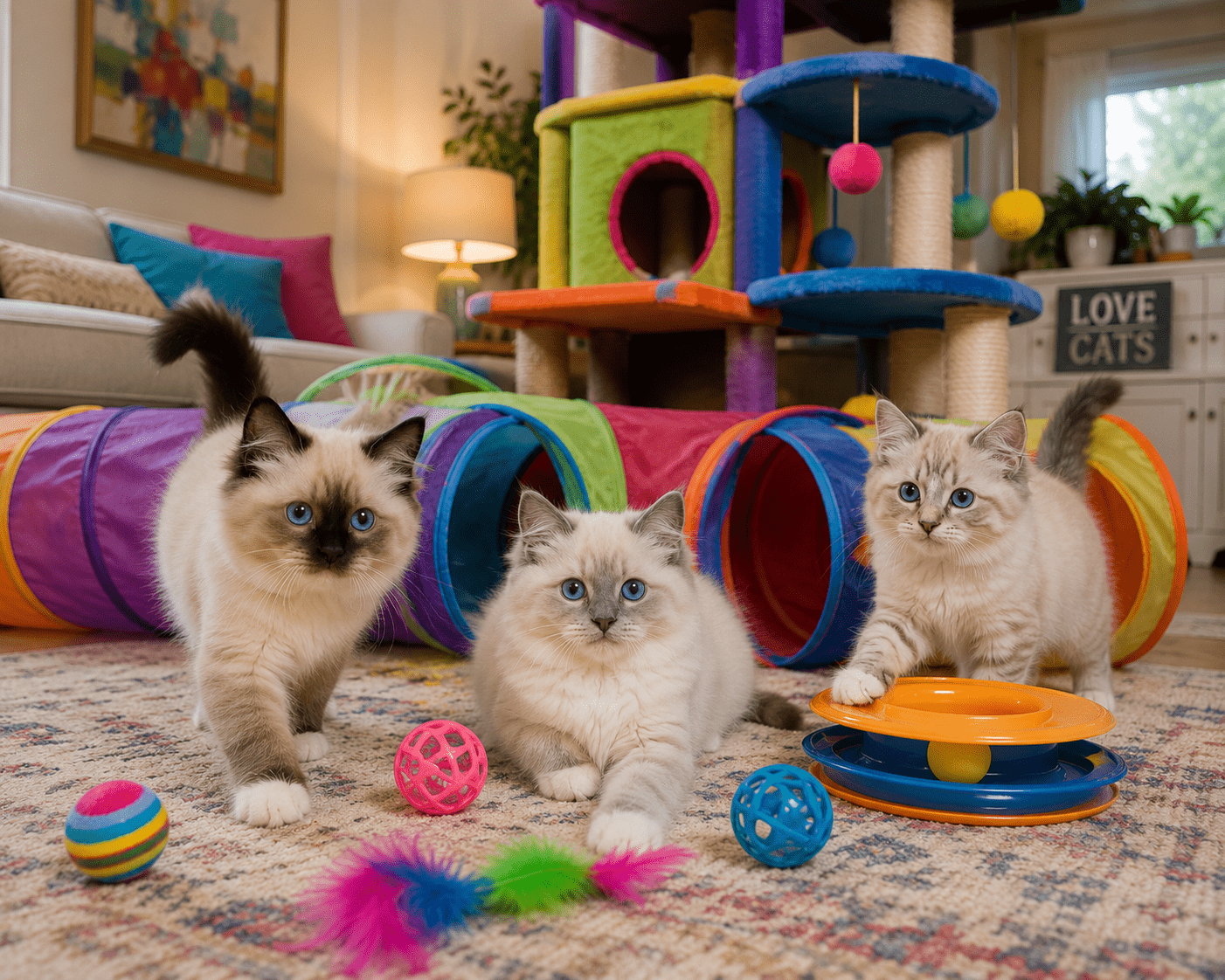
- A short tunnel positioned sideways rather than pointing directly into the room
- A box with two open sides, allowing an easy exit
- A cushion beside—not blocking—a common walking path
These features give your kitten choices without turning the room into an obstacle course. Keep routes wide enough for normal household movement, and check that nothing can tip, slide, snag, or become trapped. The most successful layout may look almost boring to you: a mat, a box, and a clear line of sight can be more compelling than a crowded collection of equipment.
Read the Pause, Not Just the Destination
Owners often focus on where a kitten finally settles. The doorway map pays attention to the decisions before that moment.
A kitten who pauses, looks toward a television, and backs away may prefer a quieter route during screen time. A kitten who repeatedly watches feet in the hallway may be interested in household traffic rather than in the room itself. A kitten who enters only after someone sits down may be using the person as a signal that the environment has become predictable.
There are also clues in body position. A relaxed sit with loose whiskers and an ordinary tail suggests comfortable observation. A crouched posture, repeated retreat, or persistent attempt to hide means the space may be too stimulating for that kitten at that time. Simply reduce activity and preserve an easy way out. The map is meant to reveal preferences, not test bravery.
A Small Weekend Layout Experiment
For one weekend, change only one feature near a frequently used doorway. Move a mat a short distance, rotate a box, or open a previously closed interior door. Then watch what changes.
Ask three questions:
- Does the kitten cross the threshold more often?
- Does the kitten pause for longer or shorter?
- Does the kitten choose a different route through the room?
Return the room to its original arrangement afterward if you like. The value is not in finding a permanent formula. It is in learning whether your kitten notices edges, textures, sightlines, or changes in household access.
For a work-from-home household, this experiment can be especially revealing. A Ragdoll kitten may prefer a doorway with a view of your chair, allowing it to remain connected to your routine without climbing onto your desk. A small resting place near—but not in—the busiest footpath can create a comfortable “meeting room” for quiet companionship.
Persian and Ragdoll Kittens at the Threshold
A Persian kitten may be more drawn to a calm, visually sheltered doorway where the next room can be inspected from a cozy edge. A Ragdoll kitten may be more likely to use the threshold as a social observation point, especially when people are moving between rooms. These are tendencies, not instructions: an outgoing Persian or independent Ragdoll may choose the opposite pattern.
For either breed, a low, stable pause spot and an unobstructed retreat route matter more than a complicated design. Let the kitten decide whether the doorway is a lookout, shortcut, or place to nap.
What the Map Can Teach You
After a week, you may discover that your kitten has a preferred “geography” of movement. Perhaps the best route follows the sunny side of the room. Perhaps the kitten avoids the center and travels from rug to rug. Perhaps the most popular doorway is simply the one that gives a view of the household.
Those details can guide future room changes, photography setups, and quiet-time routines. They can also make your home feel more legible to a young kitten. Instead of asking how to fill every corner with stimulation, you begin to notice where a small pause naturally belongs.
For more thoughtful ideas about living with Persian and Ragdoll kittens, explore the breed-focused articles and kitten resources at CTkittens.com.

Rachel Cohen is a journalist and producer with a passion for audio storytelling, health and science reporting, and feline companions.
A graduate of Middlebury College, Rachel spends her weekends exploring the mountains and when she isn’t outdoors or chasing a story, she can usually be found hanging out with her cats.