
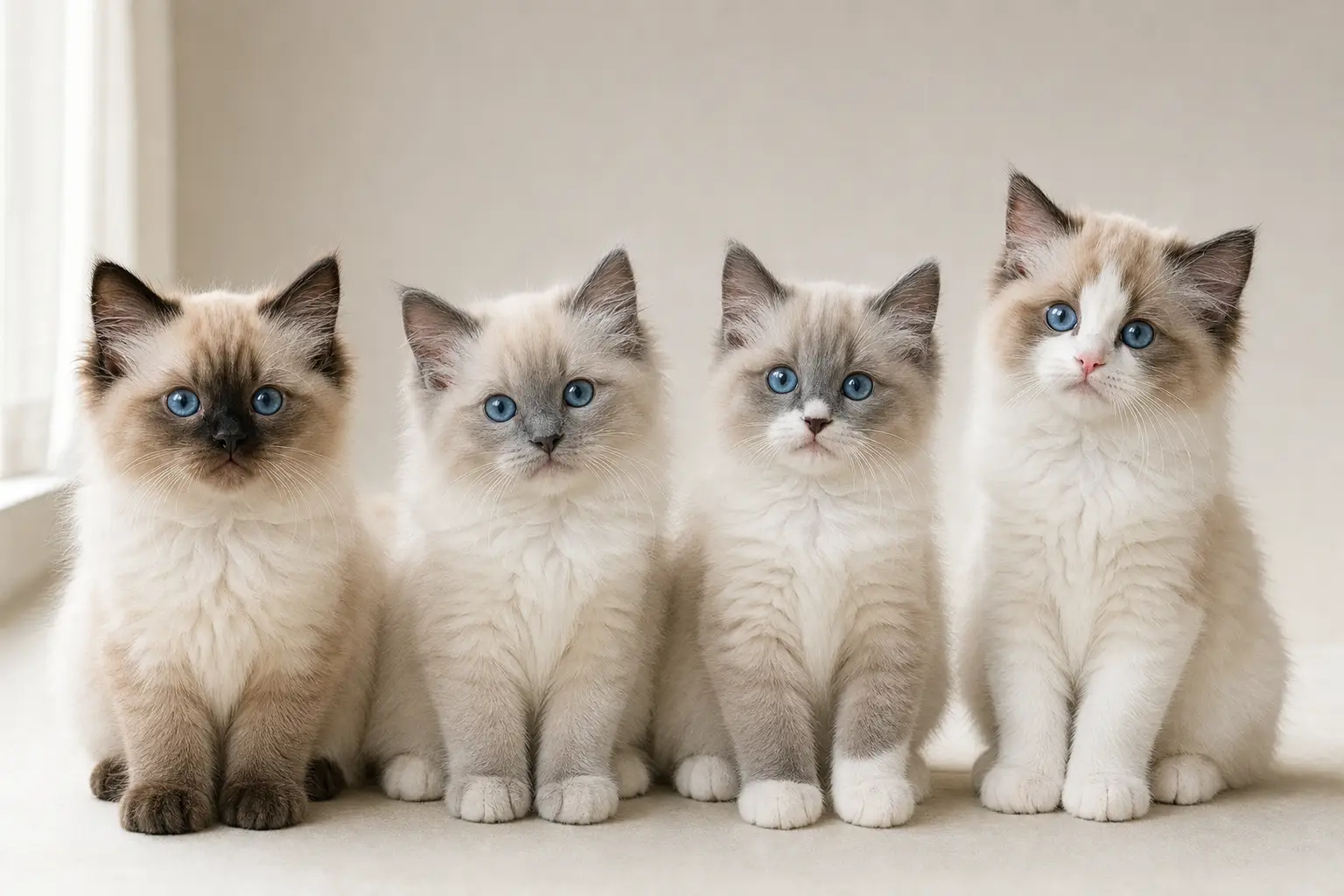
Quick answer: The most useful change in a side-by-side photo comparison is not in the kittens’ coats—it is in the way we describe them. Instead of calling one kitten “light” and another “dark,” you can separate color from pattern: for example, a seal bicolor, a blue mitted, or a lilac colorpoint.
That distinction makes Ragdoll kitten colors easier to compare and helps prevent common mix-ups. A kitten’s age, lighting, coat development, and the naming system used by a registry can all affect what you see.
Ragdoll Kitten Colors: What Side-by-Side Photos Teach Us
Ragdolls are especially interesting to compare in photographs because their bodies are usually pale while their ears, faces, legs, and tails carry the strongest color. Those darker areas are called the points. As a result, two kittens may look broadly similar at first glance while having different point colors or patterns.
Looking at photos side by side encourages a more precise question: are we seeing a different color, a different pattern, or simply a different stage of development?
The vocabulary shift: color is not pattern
The simplest way to describe a Ragdoll coat is:
Color + pattern = the full description.
Seal, blue, chocolate, lilac, red, and cream describe the point color. Colorpoint, mitted, and bicolor describe where white markings appear—or do not appear. Terms such as lynx and tortie add another layer to the point pattern.
For example, “blue mitted” is more informative than “gray and white.” “Seal bicolor” tells you both that the points are a deep brown and that the kitten has the bicolor white pattern.
Formal definitions can vary slightly between cat registries. The Cat Fanciers’ Association Ragdoll standard and The International Cat Association’s Ragdoll information are better references than informal labels used in advertisements.
How Ragdoll kitten colors look in side-by-side photos
When photographs are taken under similar lighting, the point color is usually the best place to start. Focus on the ears, mask, tail, and legs rather than the pale body fur.
| What may appear in the photo | Likely vocabulary | What to look for |
|---|---|---|
| Deep brown points | Seal | A rich brown that can look nearly black in shadow, especially on the mask and tail. |
| Cool gray or slate points | Blue | A soft blue-gray appearance, not blue in the bright primary-color sense. |
| Warm medium-brown points | Chocolate | A warmer, lighter brown than seal. |
| Pale gray with a soft pink or lavender cast | Lilac | A delicate, diluted-looking version of chocolate. |
| Orange or reddish points | Red or flame | “Flame point” is a familiar informal term; registry language may use red. |
| Pale cream or buff points | Cream | A softer, less saturated version of red. |
These descriptions are guides, not color chips. Indoor bulbs can make a seal point look warmer, while cool daylight can make a blue point appear more pronounced. Camera white balance, shadows, a wet coat, and the color of the background can all change the impression of a photograph.
Pattern words explain the white markings
Colorpoint
A colorpoint Ragdoll has colored points without the defined white gloves or facial markings associated with mitted and bicolor patterns. The body is generally pale, while the ears, face, legs, and tail are darker.
Mitted
A mitted Ragdoll has white paws that resemble small gloves. The pattern commonly includes a white chin and bib, although the exact boundaries matter in formal show descriptions. In a photo, check all four feet rather than judging from the front paws alone.
Bicolor
A bicolor Ragdoll typically has more extensive white, including white legs and underside, along with a lighter or white area on the face that may form an inverted V. The shape is often easiest to see in a front-facing photograph, while a side view shows how far the white extends across the chest and belly.
Lynx and tortie
Lynx refers to tabby-like striping layered over the points. You may notice stripes on the forehead, cheeks, legs, or tail. Tortie describes a mixture of red or cream with another point color. A kitten can combine these terms with a base pattern, so labels such as seal tortie, blue lynx, or tortie bicolor may appear.
This is why a single word rarely captures the whole coat. Two kittens can both be blue, yet one may be blue colorpoint and the other blue mitted. Their point color is related; their white pattern is not.
Why a Ragdoll kitten’s appearance changes with age
Ragdoll kittens are born very pale, often with little visible point color. Their darker markings develop as they grow. This happens because the colorpoint gene affects a pigment-producing enzyme that works better in cooler parts of the body. The ears, face, feet, and tail are cooler than the torso, so pigment becomes more visible there.
The UC Davis Veterinary Genetics Laboratory describes this temperature-sensitive colorpoint mechanism in its cat colorpoint information. It is also why a kitten’s coat should not be judged too confidently from a very early photograph.
Point color can deepen for months, and the adult coat may look more defined than the kitten coat. The body often remains much lighter than the points, but the exact contrast depends on genetics, age, season, and the individual cat.
For a useful photo comparison, record the kitten’s age. A two-week-old image and a six-month-old image may show the same cat at very different stages—not a sudden change in genetic color.
A practical method for comparing photos
If you are trying to identify or explain Ragdoll kitten colors, use the following order:
- Check the lighting. Compare images taken in similar natural light when possible. Avoid judging a color from a heavily filtered photograph.
- Start with the points. Look at the ears, mask, tail, and legs. Decide whether the tone appears brown, blue-gray, chocolate, lilac, red, or cream.
- Look for white boundaries. Examine the paws, chin, chest, face, belly, and legs to distinguish colorpoint, mitted, and bicolor patterns.
- Check for overlays. Forehead striping may suggest lynx, while patches of red or cream may suggest tortie coloring.
- Compare age and coat condition. A young kitten, a recently groomed kitten, and a kitten photographed with damp fur may all reflect light differently.
- Use cautious wording when needed. If the photo is dark or color-corrected, “appears to be blue mitted” is more accurate than presenting a guess as a confirmed classification.
A helpful caption might read: “Blue mitted Ragdoll kitten, photographed in daylight at 10 weeks.” That tells the reader more than “gray and white kitten” and leaves room for the coat to develop.
Common Ragdoll color mix-ups
- Blue eyes do not mean blue point. Traditional Ragdolls are known for blue eyes, but eye color and coat color are separate features. A seal point can have blue eyes, just like a blue point.
- Blue does not mean bright blue fur. In cat-coat terminology, blue usually describes a diluted blue-gray version of black pigment.
- Seal is not the same as black. Seal points can look almost black in a low-light image, but they are generally described as deep brown.
- Colorpoint is not a color. It describes the distribution of darker pigment and the absence of the defined white markings found in other patterns.
- “Snow” is not a complete Ragdoll color description. Sellers may use creative or informal terms. Ask which recognized color and pattern the label is intended to describe.
- Mink and sepia need context. These terms may appear in breeding discussions or advertisements, but they should not automatically be treated as interchangeable with traditional Ragdoll color and pattern terms. Ask which registry’s standard is being used.
What coat vocabulary can—and cannot—tell you
Coat terminology is useful for describing appearance, comparing photographs, and understanding a pedigree. It does not predict a kitten’s personality, sociability, or future relationship with its family. Nor can a photograph confirm pedigree, overall health, or responsible breeding practices.
If you are choosing a kitten, treat color as only one part of the conversation. Ask for the kitten’s age, parents’ registered colors and patterns, health records, vaccination details, and the breeder’s contract. A careful breeder should be willing to explain which terms are formal and which are simply descriptive.
It is also wise to remember that show terminology and everyday pet terminology do not always line up perfectly. A family may call a kitten “blue and white,” while a registry or experienced breeder gives the more specific description “blue mitted.” Both phrases may be understandable, but the second carries more information.
FAQ about Ragdoll kitten colors
When do Ragdoll kittens get their color?
They are usually born very pale, and their points become more visible during the first weeks and months. The coat can continue to mature well beyond the earliest kitten photographs.
Are all Ragdoll kittens blue-eyed?
Blue eyes are a defining feature of traditional Ragdolls and are included in major breed standards. The shade can range from pale blue to a deeper, more vivid blue. Eye appearance in a photograph can also be affected by lighting and camera exposure.
Can a photo prove a kitten’s exact color?
No. A clear, unfiltered photo can provide a useful visual estimate, but age, lighting, camera settings, and coat development can lead to uncertainty. Pedigree records and the applicable registry standard provide stronger identification than a photograph alone.
Final takeaway
Side-by-side photos become much more useful when you stop asking only which kitten looks lighter or darker. First identify the point color, then identify the white pattern, and finally consider age and lighting. That simple sequence turns vague descriptions into a practical vocabulary for understanding Ragdoll kitten colors.
Ready to compare more Ragdoll kittens and learn what makes each coat distinctive? Explore CTkittens.com for more breed information and kitten resources.

Rachel Cohen is a journalist and producer with a passion for audio storytelling, health and science reporting, and feline companions.
A graduate of Middlebury College, Rachel spends her weekends exploring the mountains and when she isn’t outdoors or chasing a story, she can usually be found hanging out with her cats.

Kinda wild that the same kitten can look like a whole different color a few months later, so asking the age before judging pics is def the move.
Kinda wild that the “blue” label is about gray points and not the eyes, coz thats exactly where I woulda got fooled lol.
The temp-sensitive pigment thing kinda blew my mind, like Ragdolls are basically tiny living mood rings except its their ears and tails lol.
Kinda wild that a kitten’s age and crappy indoor lighting can make the same coat look like a whole different color, so yeah I’m def not trusting breeder pics alone anymore.
Ngl the temperature-sensitive pigment bit blew my mind, like their lil ears and paws are basically developing color based on where they’re colder lol.
Kinda wild that a kitten’s ears and tail are more reliable color clues than its whole fluffy body, I been judging these lil dudes totally wrong lol.
Kinda wild that the same kitten can look seal in bedroom lighting and blue by a window, so yeah maybe breeders should include daylight pics with the age instead of makin buyers play coat-color detective lol.