
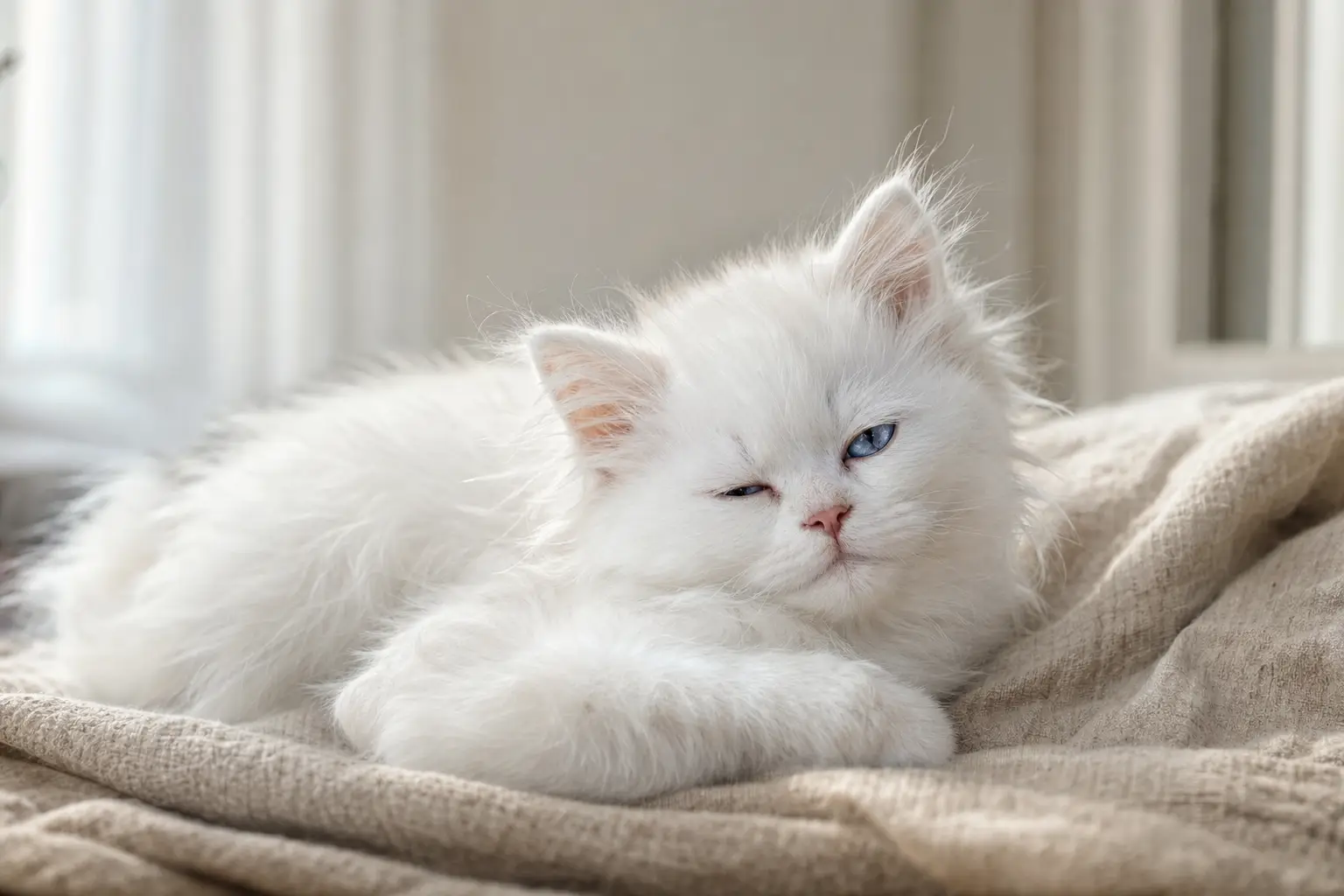
Persian Kitten Slow Blink: Capturing the First One Naturally
A Persian kitten slow blink is not something you can reliably stage on command. The most genuine moment usually happens when the kitten is comfortable, the room is quiet, and the camera is ready before anyone asks for a pose.
In real life, the photograph may not be perfectly symmetrical. The kitten may be sitting slightly sideways, one eye may be more closed than the other, and a whisker may cross the face. That is part of what makes the image meaningful: the kitten is communicating in a relaxed moment rather than performing for the camera.
The practical approach is simple: settle the kitten in a familiar space, sit nearby without reaching, offer a soft gaze and a slow blink of your own, then wait. If the kitten returns the gesture, take the photograph. If the kitten looks away or leaves, let the session end.
What a Persian kitten slow blink may mean
Cat eye-narrowing movements are commonly associated with relaxed, affiliative interaction. A peer-reviewed study published in Scientific Reports found that cats were more likely to approach people after people used slow-blink movements, and that cats also responded with similar eye narrowing. The research supports slow blinking as a useful part of friendly cat-human communication, but it does not prove that every blink has one fixed meaning.
Context matters. A relaxed blink is different from persistent squinting caused by irritation or pain. A comfortable kitten will usually have a loose body, natural whiskers, and the freedom to turn away or move closer. A kitten with an eye problem may keep one eye closed, rub at the face, show redness or discharge, or seem uncomfortable in bright light.
For the photographer, the goal is not to make the kitten blink. It is to make the setting calm enough that a natural interaction can happen.
Read the Scientific Reports study on cat eye-narrowing communication.
What the moment looks like in real life
Forget the idea of a kitten sitting perfectly upright with both eyes aimed at the lens. A natural first slow blink may happen while the kitten is resting on a rug, looking past your shoulder, or pausing after a little play.
You may see the upper and lower eyelids move toward each other for a brief moment. The eyes may open again immediately. Sometimes the kitten looks at you, blinks, and then turns its head away. That does not mean the photograph failed. It may simply mean the interaction was complete.
The best image is often captured just before or just after the eyelids narrow, when the kitten’s face is soft and the body remains loose. A burst mode or short video can help you preserve the sequence without asking the kitten to repeat it.
Prepare the room before bringing out the camera
A calm setup makes natural behavior more likely and prevents the camera from becoming the center of the kitten’s attention.
- Choose a familiar surface. Use a non-slip rug, blanket, or floor area the kitten already knows. Avoid high furniture where a startled kitten could fall.
- Use soft, indirect light. Window light from the side can show the eyes without making the kitten squint. Avoid a bright lamp aimed at the face and avoid direct flash.
- Reduce sudden noise. Silence notifications, keep other people from calling the kitten, and move slowly around the room.
- Keep the camera close to your face. A phone held beside your cheek allows the kitten to see you while you frame the shot. A remote shutter or timer can make this easier.
- Have the camera ready first. Do not interrupt a relaxed moment by reaching for a device across the room.
Do not make eye contact intense or unbroken. For many cats, a fixed stare can feel more confronting than friendly. Look gently toward the kitten, soften your expression, slowly close your eyes, pause briefly, and open them again. Then look slightly away.
How to capture the first slow blink without forced posing
1. Let the kitten choose the distance
Start several feet away and allow the kitten to investigate or settle. Do not carry the kitten into position unless it is already comfortable being handled and you have a separate welfare reason for doing so. For a photograph, there is no need to override the kitten’s choice.
2. Wait for the body to relax
Look for a body that is resting rather than bracing. The paws may be tucked under, the shoulders may be loose, and the head may move naturally. Do not use pupil size by itself as a comfort test; pupils change with light as well as arousal.
3. Offer one gentle slow blink
Face the kitten at an angle rather than leaning directly over it. Make brief, soft eye contact, close your eyes slowly, and reopen them. Then pause. The pause is important. Repeating the gesture rapidly can turn a quiet exchange into a demand for attention.
4. Give the kitten an easy way to respond
Keep your hands still. Do not wave a toy above the lens, hold a treat directly between the kitten’s eyes, or make clicking sounds to force a head turn. If the kitten wants to respond, it can do so without being directed.
5. Move the camera only after the interaction begins
If the kitten returns a blink, move the phone or camera gradually while keeping your movements smooth. A phone’s live-photo, burst, or video function can be useful because the blink may last less than a second. If the kitten looks away when the camera moves, lower it and give the kitten space.
6. End while the session is still comfortable
One genuine blink is enough. You do not need a series of identical images. Ending early helps preserve the kitten’s trust and makes future, voluntary interactions more likely.
How to tell whether the pose is voluntary
A photograph can look peaceful even when a kitten has been made uncomfortable, so watch the behavior before and after the shutter. A natural interaction often includes some combination of:
- the kitten approaching or remaining nearby by choice;
- ears that are neutral or gently forward rather than pinned back;
- a loose posture and ordinary breathing;
- the ability to turn the head, stand up, or leave;
- the kitten returning to the same area after a short break.
Pause or stop if the kitten repeatedly turns away, crouches low, flattens its ears, lashes its tail, hides, vocalizes in distress, or tries to escape your reach. These signs should not be treated as a challenge to solve with more treats, more noise, or tighter restraint.
Do not hold the eyelids open, restrain the head, scruff the kitten, wrap it tightly for a pose, or keep repositioning it after it moves. Forced stillness may produce a technically neat image, but it is not a natural slow blink and it does not respect the kitten’s ability to opt out.
Persian kitten considerations for a clear, comfortable photo
Persian kittens have a dense coat and facial features that can make the eye area visually busy. A low camera angle and soft side light can separate the eyes from the surrounding fur without requiring the kitten to hold its head in a particular position.
Persian cats can also have facial structure and tear-flow patterns that vary from one kitten to another. Do not turn a photo session into an unplanned grooming session. If the kitten is already accustomed to gentle facial care, routine cleaning should be done separately and with appropriate veterinary guidance. Avoid introducing eye products, combs, cotton swabs, or repeated wiping just to improve a picture.
Persistent tearing, thick discharge, redness, cloudiness, swelling, frequent rubbing, or repeated squinting deserves attention from a veterinarian rather than a photography adjustment. Eye discomfort can be easy to mistake for a cute sleepy expression, especially in a long-haired or flat-faced cat. The Merck Veterinary Manual overview of feline eye disorders explains why changes in the eye should be assessed in context.
What if the kitten never slow blinks?
Nothing has gone wrong. A kitten may be tired, curious, overstimulated, unfamiliar with you, or simply more interested in exploring than communicating with the camera. Some cats respond with a head turn, a relaxed glance, or quiet proximity instead of a visible slow blink.
Try again on another day in a familiar room, but do not make the kitten rehearse the behavior. The most valuable outcome is a kitten that remains comfortable around people. A photograph of the kitten choosing to walk away is more honest than a close-up created through pressure.
FAQ
Should I stare at a Persian kitten to get a slow blink?
No. Use brief, gentle eye contact rather than a fixed stare. Offer one slow blink and wait. The kitten should be able to look away without being followed or repositioned.
Is a slow blink proof that a kitten trusts me?
It can be a friendly, relaxed signal, but it is not a complete test of trust. Consider the kitten’s entire body language and whether it chooses to remain near you or return after leaving.
Should I use treats to capture the moment?
A treat can be appropriate if the kitten already enjoys treats and you are using them calmly, but do not hold food in front of the lens to force eye contact. The blink should come from a comfortable interaction, not from keeping the kitten’s attention trapped.
A better definition of the perfect photo
The perfect Persian kitten slow blink photograph is not necessarily the sharpest or most symmetrical frame. It is the frame that preserves a voluntary moment: a soft gaze, a relaxed face, and a kitten that still feels free to move.
Prepare the room, slow yourself down, and let the kitten decide what happens next. The camera can wait. Comfort comes first.
Want more thoughtful guidance for life with Persian kittens? Explore CTkittens.com for additional kitten care and breed information.

Rachel Cohen is a journalist and producer with a passion for audio storytelling, health and science reporting, and feline companions.
A graduate of Middlebury College, Rachel spends her weekends exploring the mountains and when she isn’t outdoors or chasing a story, she can usually be found hanging out with her cats.
Tiny nitpick, shooting a short video feels way less fiddly than burst mode since them lil eyelids move stupid fast and you can just grab the best frame later.
Ngl, realizing the “imperfect” sideways blink might be the most honest shot made me wanna stop fussing with camera angles and just vibe with the kitten.
Ngl, holding the phone beside your cheek instead of shoving it in the kitten’s face is such a tiny detail but it makes the whole setup feel way less weird for them lol.
Kinda wild how getting one tiny blink turns into a whole lesson on consent, like the best pet pics happen when we stop treating animals like props n just let em choose.
Lowkey the smartest tip here is filming the whole blink instead of chasing one perfect frame, cause cats somehow know exactly when you hit the shutter lol.
Only thing I’d add is burst mode can sound like a tiny machine gun and spook some kittens, so silent video might be the better move tbh.
Honestly the reminder that a wonky whisker or half-closed eye can make the pic better kinda changed how I’ll shoot my kitten, coz chasing “perfect” usually ruins the whole vibe anyway.