
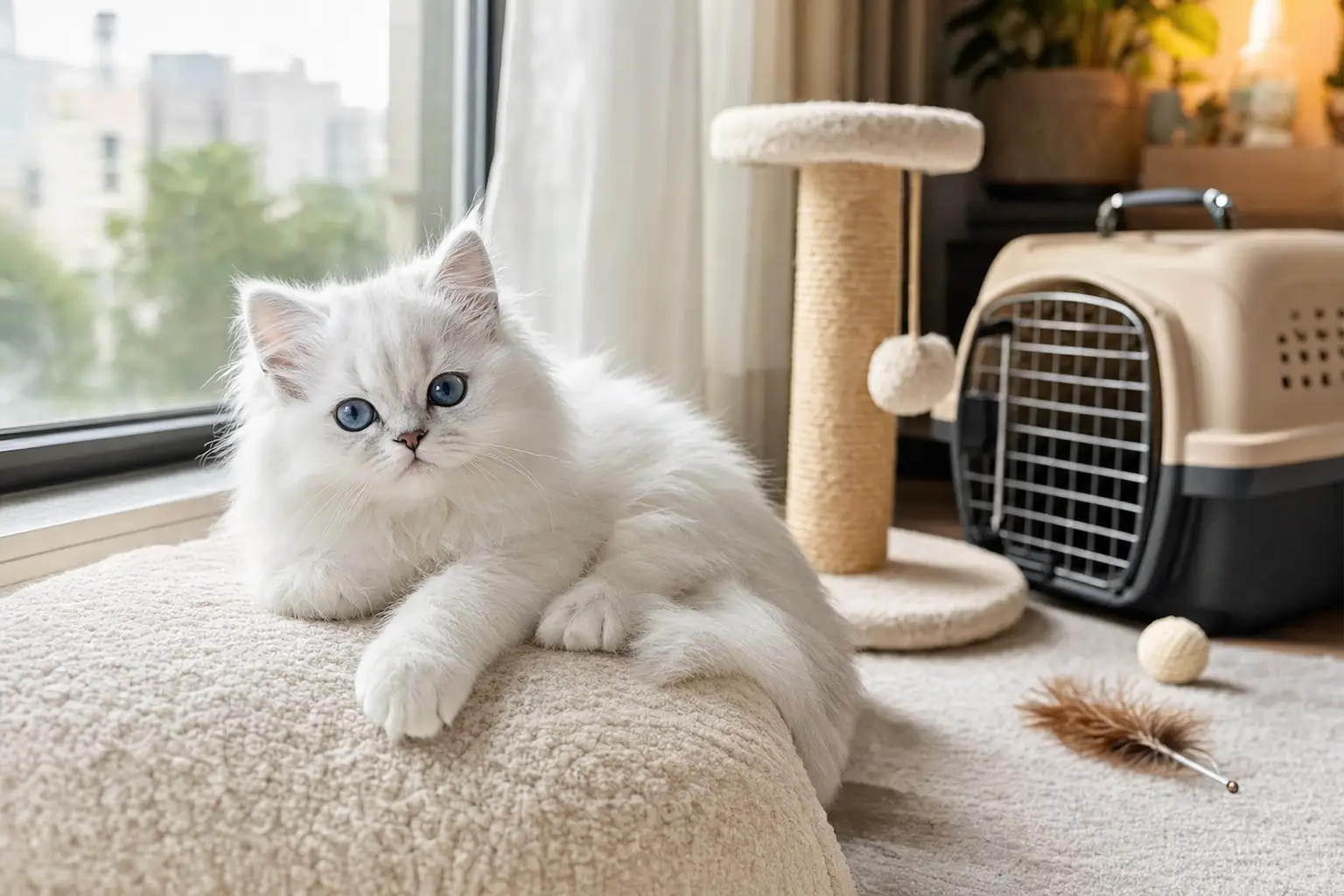
Persian Kittens for Apartment or House Living
Short answer: a Persian kitten does not need a large house or outdoor access to be happy. Persian kittens for apartment or house living can do well in either setting when they have safe windows, comfortable resting areas, daily interaction, enrichment, and a family prepared for regular coat and facial care.
The better question is not simply, “Is my home big enough?” It is, “Can I provide a secure, predictable, enriching indoor life, and is this kitten’s temperament a good match for my household?” That question becomes especially useful when you are working with a breeder from another state and cannot visit easily.
Apartment or house: which is better for a Persian kitten?
Neither type of home is automatically the better choice. A well-managed apartment may offer a quieter, more controlled environment than a busy house. A house may offer more room, but it can also include open doors, inaccessible hiding places, stairs, other animals, or household activity that a young kitten finds overwhelming.
| Home factor | Apartment considerations | House considerations |
|---|---|---|
| Space | Use vertical territory, window perches, scratching areas, and rotating toys. | More rooms are helpful, but the kitten may still need a quiet starter room. |
| Noise | Consider elevators, hallways, neighbors, alarms, and shared entrances. | Consider children, visitors, appliances, dogs, and frequent door activity. |
| Safety | Secure windows and balconies; check whether screens are firmly fitted. | Secure exterior doors, windows, garages, fireplaces, and other escape routes. |
| Enrichment | Plan short daily play sessions and create several resting and climbing options. | Do not rely on extra floor space alone; play and interaction still matter. |
Persians are often selected for their gentle appearance and companionable nature, but individual kittens vary. Breed descriptions from the Cat Fanciers’ Association and The International Cat Association can help you understand general breed characteristics, while a breeder is better positioned to describe a particular kitten’s confidence, energy, and social habits.
What a Persian kitten needs in either home
For Persian kittens for apartment or house living, the essentials are similar:
- A quiet, secure room for the first days or weeks
- Clean litter boxes placed away from food and water
- A sturdy scratching surface and safe, age-appropriate toys
- Protected windows, cords, plants, cleaners, and small objects
- A carrier that can remain open as a familiar resting place
- Regular play, gentle handling, and predictable routines
- A grooming plan suited to the kitten’s coat, face, and tolerance for handling
Many Persian coats need frequent, often daily, combing to prevent tangles and mats. Some kittens also need routine attention around the eyes and face. Ask the breeder to show you the exact tools and technique they use rather than assuming every Persian requires the same routine.
Some Persians have very short facial structure. Facial conformation can affect tear drainage, grooming needs, breathing comfort, and heat tolerance in individual cats. A breeder should be able to discuss the kitten’s actual features honestly and provide veterinary records. If you have concerns, ask your own veterinarian for an assessment rather than relying on photographs alone.
Questions to ask a Persian kitten breeder
A thoughtful breeder question list should go beyond price, color, and availability. It should help you evaluate health practices, socialization, temperament, and the practical details of bringing a kitten across state lines.
1. How would you describe this kitten’s temperament?
Ask for specific examples: Does the kitten approach new people? How does it respond to handling, household sounds, grooming, and being placed in a carrier? Is it more active, cautious, cuddly, independent, or vocal than its littermates?
For an apartment, a kitten that settles well after normal play may be a comfortable match. For a busy house, confidence around movement and noise may matter more. There is no universally perfect personality; there is a better fit for your routine.
2. What socialization has the kitten experienced?
Ask whether the kitten has encountered adults, children, other cats, calm dogs, grooming, nail trims, household sounds, and short periods away from its littermates. Ask how the breeder introduces these experiences and whether the kitten has had time to retreat when overwhelmed.
Instead of accepting a general statement such as “well socialized,” ask for a recent video showing ordinary behavior. A live video call can be more informative than a carefully selected photograph.
3. What do the parents’ temperaments and health histories look like?
Parent temperament can provide useful context, although it does not guarantee a kitten’s adult personality. Ask what the breeder knows about the parents’ behavior, longevity, prior litters, and any recurring health concerns in the line.
Ask which health screenings have been performed, by whom, and whether you may review the results. Rather than looking for a vague promise that a line is “healthy,” ask how the breeder handles breed-relevant risks, veterinary examinations, vaccinations, parasite care, and any concerns related to facial structure. Your veterinarian can help interpret records you receive.
4. What grooming and face care should we expect?
Ask the breeder to demonstrate combing, bathing if appropriate, eye-area cleaning, nail care, and safe restraint. Also ask what the kitten currently tolerates. A Persian that has been gently introduced to grooming may have an easier transition than one whose first full grooming happens after arrival.
Ask how often the breeder recommends professional grooming, whether the coat is prone to matting, and what signs mean you should contact a veterinarian. Do not use scissors near mats or the face unless a qualified professional has shown you how to do so safely.
5. What will the kitten come home with?
Request a written record of veterinary examinations, vaccinations, deworming or parasite prevention, microchip information if applicable, feeding instructions, and the date of the most recent health check. Ask whether the kitten has been tested for any condition relevant to its circumstances and what follow-up is recommended.
Also ask for the current food, litter, daily routine, and sleep schedule. Keeping those details familiar for the first few days can make the move less stressful.
6. What does the contract say about health and returns?
Read the contract before sending a deposit. Look for the health guarantee, required veterinary visit after arrival, registration or breeding terms if relevant, spay or neuter expectations, and the breeder’s policy if your circumstances change.
A responsible breeder should explain what happens if your veterinarian identifies a concern, if the kitten is not a suitable match, or if you can no longer keep the cat. A return-to-breeder policy is a sign that the breeder is thinking about the cat’s lifetime welfare, not only the handoff.
7. How will the kitten travel to our state?
Ask who will handle the transport, how long the journey will take, where the kitten will stay during stops, how temperature and ventilation will be managed, and what happens if a flight or ground trip is delayed. Ask whether the kitten will travel in the cabin with a person, by a professional ground transporter, or through another arrangement.
Airline rules, state entry requirements, age rules, and health certificates can vary. Check the destination state’s current requirements and review the USDA APHIS pet travel resources where applicable. The AVMA travel guidance also recommends planning around identification, veterinary documentation, and the animal’s comfort.
Because some Persians have shortened muzzles, ask your veterinarian whether the planned method of travel is appropriate for your individual kitten. Never assume that a transport plan is safe simply because it has been used for another cat.
How out-of-state families can evaluate a breeder remotely
Distance does not make a good breeder impossible to evaluate, but it does make documentation and communication more important. Before committing, request a live video call that shows the kitten, its mother when possible, the living areas, and the way the breeder handles the cats. You should be able to ask questions without being rushed.
Ask whether the breeder has placed kittens with apartment families, long-distance families, first-time Persian owners, or homes with other pets. That experience is not a guarantee, but it may help the breeder recommend a kitten thoughtfully rather than matching by color alone.
Do not feel pressured to hide that you live in an apartment, work outside the home, or have limited square footage. Give an accurate picture of your household, including other animals, children, travel, work hours, stairs, balcony access, and the room where the kitten will initially stay. A good conversation should feel like a mutual fit assessment.
Preparing your home before the kitten arrives
Set up one quiet room first. Put the litter box, food, water, bed, scratcher, toys, and carrier within easy reach, while keeping food and water separate from the litter area. Let the kitten expand access gradually instead of expecting it to explore a whole apartment or house immediately.
Before arrival, check every window and balcony, secure loose screens, remove toxic plants such as lilies, hide electrical cords, and block narrow spaces where a frightened kitten could become trapped. Arrange a veterinary appointment and decide who will manage grooming before the kitten comes home.
For an out-of-state arrival, keep the first day deliberately quiet. Offer the familiar food recommended by the breeder, provide water, allow rest, and monitor eating, drinking, litter use, breathing, and general responsiveness. Contact a veterinarian promptly if anything concerns you.
Warning signs during the breeder conversation
Be cautious if a seller refuses a live video call, will not provide basic veterinary records, uses pressure to secure an immediate deposit, avoids questions about the mother, or offers vague transport arrangements. Be equally cautious if every kitten is described as identical, no written contract is available before payment, or the seller dismisses reasonable questions about grooming, facial structure, or follow-up care.
One awkward conversation does not prove that a breeder is dishonest, and polished websites do not prove that a breeder is responsible. Look for consistent information, clear records, realistic answers, and a willingness to prioritize the kitten’s welfare over a quick sale.
Frequently asked questions
Can a Persian kitten live happily in an apartment?
Yes. An apartment can be a good home when windows and doors are secure, the kitten has enrichment and vertical space, and the family can provide daily interaction and grooming. Square footage alone does not determine quality of life.
Does a Persian need outdoor access?
No. A carefully enriched indoor environment can meet a Persian’s needs without the risks associated with unsupervised outdoor access. If you want outdoor enrichment, discuss secure options such as a properly enclosed catio or supervised harness training with your veterinarian.
What is the most important question for an out-of-state breeder?
Ask for a complete picture of the kitten’s health, temperament, socialization, grooming routine, contract, and travel plan. The best answer is not just reassuring; it is specific and supported by records or observable examples.
Choose the home that matches the kitten and the plan
Persian kittens for apartment or house living can flourish when the home is secure, calm, and prepared for their individual needs. A breeder should be evaluating your daily routine and the kitten’s temperament together—not using “apartment” or “house” as a shortcut for suitability.
Make your question list, review the contract before paying, confirm travel requirements, and plan the first week around rest and routine. To learn more about Persian kittens and explore available information at CTkittens.com, continue browsing the site or contact us with your questions.
Helpful references

Rachel Cohen is a journalist and producer with a passion for audio storytelling, health and science reporting, and feline companions.
A graduate of Middlebury College, Rachel spends her weekends exploring the mountains and when she isn’t outdoors or chasing a story, she can usually be found hanging out with her cats.


Lowkey never thought to leave the carrier open as a regular chill spot, but that makes the eventual vet trips way less scary than dragging it outta storage like some doom box lol.
Ngl, leaving the carrier open as a chill nap spot before travel is such a smart lil trick, my cat used to act like hers was a haunted box lol.
Only thing I’d push back on is grooming being framed kinda casually, cuz daily face wiping and combing can be a bigger deal than apartment size tbh.
Ngl this made me rethink the whole “cats need a big house” thing, cause a calm apartment with window perches and daily grooming sounds way better than a huge chaotic place anyway.
Honestly the bit about leaving the carrier open as a chill spot is lowkey genius, mine only feared hers because I kept hiding it till vet day lol.
Kinda wild how this applies to most pets tbh, people obsess over square footage when a stable routine and actual attention matters way more.
Kinda wild how folks obsess over square footage when a quiet starter room, secure windows, and daily grooming matters way more than having some huge ass house.