
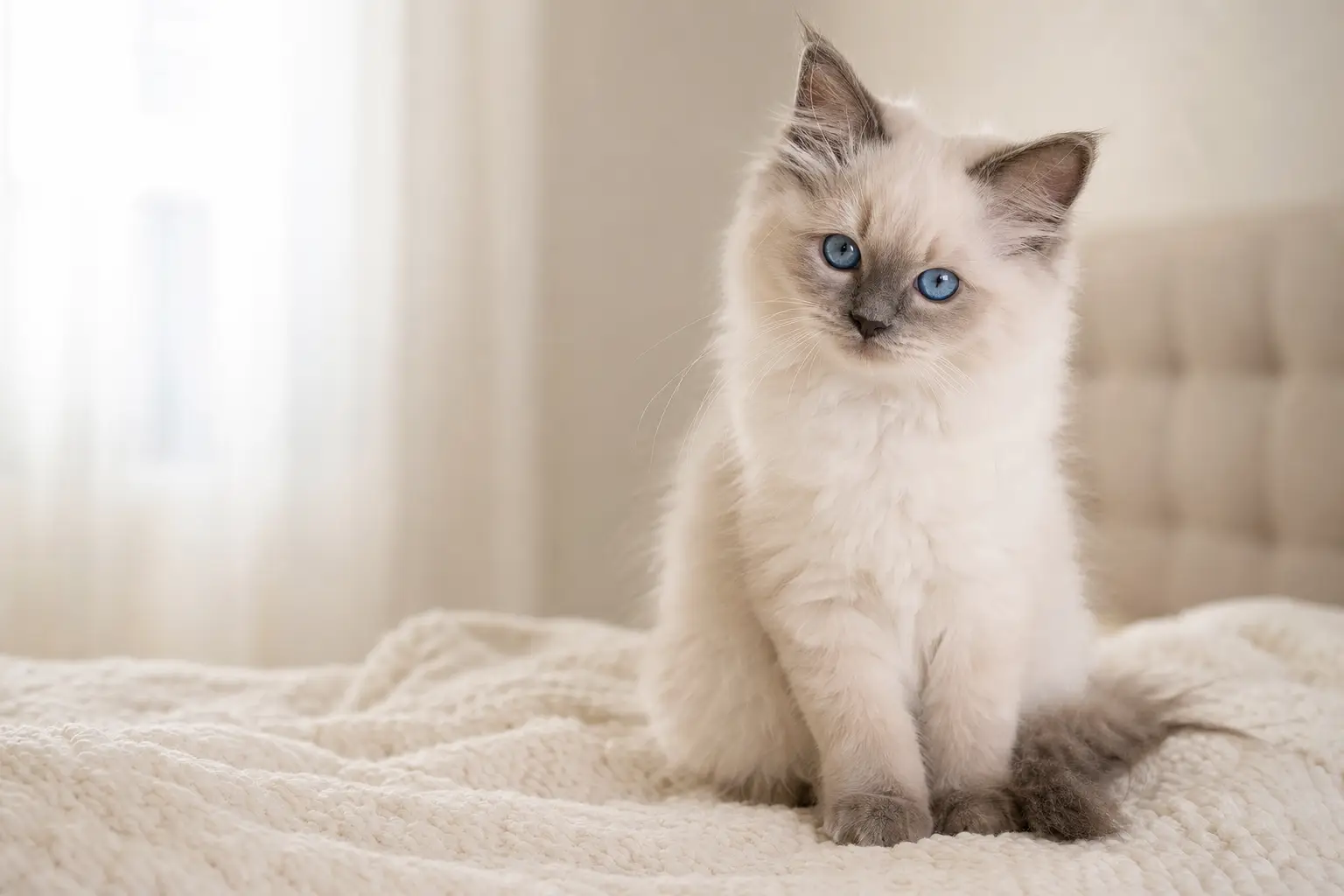
Ragdoll kitten colors are described in two layers: the color of the darker points and the pattern or white placement on the body. Common color terms include seal, blue, chocolate, lilac, red, and cream. Those colors may appear as colorpoint, mitted, or bicolor patterns, with lynx and tortie markings adding another layer of vocabulary.
There is one reason Ragdoll kittens can seem especially mysterious: many are born very pale. Their ears, face, legs, and tail gradually develop color as they grow, so the coat you see at eight weeks may not be the finished picture.
The kitten’s voice in this article is a storytelling device, not a personal case history. It is here to make inheritance and coat terminology easier to understand.
The short answer: how Ragdoll color names work
Think of a complete description as a small family name. The first word usually identifies the point color, while the following words describe the pattern. For example, a cat might be called a blue mitted Ragdoll, a seal bicolor, or a seal lynx colorpoint.
- Point color: the shade on the ears, mask, legs, paws, and tail.
- Pattern: how that color is arranged, such as colorpoint, mitted, or bicolor.
- Overlay: extra markings such as lynx striping or tortoiseshell color.
- Eye color: Ragdolls are known for blue eyes, but blue eyes alone do not identify a Ragdoll.
The standard Ragdoll is a pointed breed. Its body is usually lighter than its cooler extremities, and its blue eyes are a defining breed feature in traditional registry descriptions. A pedigree and the applicable registry standard matter more than a color label in an online advertisement.
A kitten’s first family story
Imagine a newborn Ragdoll kitten named Willow. On her first day, she looks almost like a little cloud: pale body, pale paws, and only the faintest suggestion of darker ears. Her family calls her color “seal,” but a visitor wonders how a nearly white kitten could have a dark brown color name.
Willow’s answer, in our imaginary story, would be simple: “Wait for my points.”
Ragdolls carry a temperature-sensitive colorpoint gene. Pigment production is limited in the warmer parts of the body and becomes more visible on cooler areas, including the ears, face, legs, and tail. That is why a kitten can begin life looking very pale and develop stronger contrast over the following weeks and months.
Willow’s mother might be a seal mitted Ragdoll, with brown points and white paws. Her father might be a blue bicolor, with soft gray points and a broad area of white. Those family descriptions are useful clues, but they are not a simple paint chart. Hidden genes, including recessive color genes and the inheritance of red-based color, can affect what a litter produces.
In other words, a kitten’s color vocabulary tells part of the family story. It does not tell the entire story from the parents’ visible coats alone.
Ragdoll point colors, translated
Here is the most useful starting point for reading a Ragdoll color description.
| Term | What it usually looks like | Helpful distinction |
|---|---|---|
| Seal | Rich dark brown to brown-black points | Often creates the strongest contrast against the pale body |
| Blue | Cool gray or slate-blue points | “Blue” describes the coat, not the blue eyes |
| Chocolate | Warm milk-chocolate brown points | A genetically distinct color from seal |
| Lilac | Soft pinkish gray or frosty gray points | A dilute expression related to chocolate |
| Red | Warm orange, apricot, or flame-colored points | Often called flame in casual pet vocabulary |
| Cream | Light buff or pale apricot points | A dilute form of red |
Descriptions can combine these colors with pattern words. A seal point and a seal bicolor share the same basic point color, but their white markings are arranged differently. Similarly, blue mitted and blue lynx are not interchangeable terms: one describes white placement, while the other describes tabby-like striping over the blue color.
Pattern words: colorpoint, mitted, and bicolor
Colorpoint
A colorpoint Ragdoll has darker ears, mask, legs, and tail without the characteristic white mittens or bicolor facial blaze. The torso remains lighter, although the contrast can become more pronounced with age.
Mitted
A mitted Ragdoll has colored points plus white mittens on the front paws and white boots on the hind legs. A white chin, bib, or belly stripe may also be part of the pattern description. Exact markings can vary, and show standards may describe placement more precisely than everyday pet conversations do.
Bicolor
A bicolor Ragdoll generally has more extensive white than a mitted cat. The face often shows an inverted-V-shaped white area, while the legs and underside may be white and the back carries more of the point color. The shape of the facial marking is not identical on every kitten, so a photograph should accompany the label.
White pattern and point color are separate pieces of the description. That is why “seal bicolor” is more informative than simply “white Ragdoll.” The first phrase tells you both the dark color and the arrangement of white.
Lynx and tortie: the extra words in the family album
Lynx
Lynx describes tabby-like stripes layered over a point color. You may notice lines on the forehead, rings on the tail, or striping on the legs. A seal lynx can look quite different from a solid seal point even though both have seal-colored points.
Tortie
Tortie is short for tortoiseshell. It describes a mixture of a dark color with red or cream, often appearing as mottled patches or flecks on the points. Tortie coloring is usually seen in females because of how the relevant color genes are carried on the X chromosomes, although rare male torties can occur.
Lynx and tortie may also appear together. A label such as “blue cream lynx” can sound complicated, but it is simply stacking descriptions: a dilute blue-based color, cream, and tabby-like striping.
Why a Ragdoll kitten’s coat changes
The colorpoint gene affects pigment production in a temperature-sensitive way. The warmer central body stays lighter, while cooler extremities show more pigment. Newborn kittens have spent their development in a warm environment, so they often arrive with very little visible point color.
As the kitten grows, the ears, mask, legs, and tail become easier to read. The coat may continue to deepen or shift in appearance with maturity. Individual development varies, so a breeder’s description, photographs of older relatives, and the kitten’s pedigree are more dependable than a prediction based on one newborn photograph.
This also explains why a Ragdoll’s body and points are not expected to be one uniform shade. A pale torso beside darker ears is not a flaw; it is part of the pointed pattern.
What a family history can—and cannot—predict
Color genetics are more like a family recipe than a set of visible crayons. A parent may carry a recessive color gene without displaying it. Red and cream inheritance also follows a different pattern from seal, blue, chocolate, and lilac, which makes casual predictions particularly unreliable.
If you are comparing kittens in a litter, use the family story responsibly:
- Start with the parents’ documented descriptions. Ask whether the names come from a registry pedigree, a breeder’s working terminology, or an informal advertisement.
- Separate color from pattern. “Blue” does not tell you whether the kitten is colorpoint, mitted, or bicolor.
- Look at older relatives when possible. Photos of the parents and previous kittens can show how point color developed over time.
- Expect uncertainty in young kittens. A breeder can make an informed description, but coat development is not always perfectly predictable from appearance alone.
- Ask about the registry. Terms such as mink, sepia, and solid may appear in advertisements or in discussions of related breeding programs. Their acceptance and meaning can vary by registry and pedigree.
A responsible breeder should be comfortable explaining the label in plain language. If the description sounds impressive but the breeder cannot explain which part refers to color and which part refers to pattern, ask for clarification.
Choosing a kitten: look beyond the color name
Coat color can be beautiful, but it does not predict personality, affection, intelligence, or general health. When evaluating a Ragdoll kitten, give at least as much attention to the breeder’s transparency and care practices as to the shade of the points.
- Ask to see the kitten with its mother and, when appropriate, littermates.
- Request the kitten’s exact color and pattern description in writing.
- Ask how the breeder expects the coat to develop and whether photographs of older relatives are available.
- Review veterinary records, vaccination information, and the planned age for going home.
- Ask what health screening is performed on the breeding cats and what documentation accompanies the kitten.
- Be cautious of guarantees based only on coat color, eye shade, or a marketing phrase such as “rare.”
Blue eyes are a hallmark of the Ragdoll type, but a blue-eyed, white-looking kitten is not automatically a Ragdoll. Many cats and mixes can share those visible traits. Breed identification comes from documented ancestry and, where relevant, registration—not appearance alone.
Frequently asked questions
Can Ragdoll kittens change color?
Yes. Many are born very pale and develop darker points as they grow. The amount and timing of change vary by kitten, and the final appearance may not be obvious from a newborn photograph.
What is the difference between a blue Ragdoll and a blue-eyed Ragdoll?
“Blue” in a color description refers to a cool gray coat color. “Blue-eyed” refers to eye color. Standard Ragdolls are known for blue eyes across their accepted point colors, so these two uses of blue describe different features.
Is a white Ragdoll a recognized color?
A traditional Ragdoll is a pointed cat, not simply an all-white cat. A young kitten may look nearly white before its points develop, and bicolor Ragdolls can have extensive white markings. Ask for the pedigree and complete color-and-pattern description rather than relying on the word “white.”
Does coat color determine a Ragdoll’s temperament?
No. Color and pattern describe appearance. They are not a reliable personality test. Temperament is influenced by genetics, early socialization, environment, and the individual cat.
A clearer way to read the label
When Willow grows up, her family story becomes easy to read: perhaps she is a seal mitted Ragdoll with a pale body, dark brown points, white paws, and blue eyes. Another kitten from the same broad family may be blue bicolor or chocolate colorpoint. The names differ because several inherited features are being described at once.
That is the useful secret behind Ragdoll kitten colors: do not treat the label as a single color swatch. Read it as a compact description of point shade, white placement, and optional overlays such as lynx or tortie. Once those layers are separated, breeder conversations, pedigree records, and kitten photographs become much easier to understand.
For a baseline breed description, compare the information from The Cat Fanciers’ Association with the registry named on a kitten’s pedigree. Standards and accepted terminology can differ, so the relevant registry is the best authority for show classification.
Ready to keep exploring? Visit CTkittens.com for more thoughtful guides to Ragdoll kittens, responsible kitten selection, and life with these striking blue-eyed cats.

Rachel Cohen is a journalist and producer with a passion for audio storytelling, health and science reporting, and feline companions.
A graduate of Middlebury College, Rachel spends her weekends exploring the mountains and when she isn’t outdoors or chasing a story, she can usually be found hanging out with her cats.

