The best way to photograph a Persian kitten’s first slow blink is to make the camera almost irrelevant. Set up a quiet room, use soft window light, sit nearby without reaching, and let the kitten choose whether to look toward you. When the eyelids narrow and open in a relaxed face, capture a short sequence rather than chasing a perfect single frame.
A slow blink can be a relaxed social signal, but it is not a guaranteed test of trust or affection. Your kitten may also be sleepy, distracted, or reacting to bright light. The goal is a comfortable moment that looks and feels natural in the final family keepsake.
What a Persian kitten’s slow blink looks like
A relaxed slow blink usually happens with a soft body and neutral ears. The kitten’s eyes narrow gradually, close briefly, and open without a startled head movement. Some kittens repeat the gesture, while others offer it only once before looking away or settling down.
Context matters. A single closed-eye frame does not tell the whole story, especially with Persian kittens, whose facial structure can make their eyes look naturally round, shaded, or partially covered by fur.
| Signs of a relaxed moment | Reasons to pause the session |
|---|---|
| Loose posture, neutral ears, soft facial muscles, and an easy return to looking around | Repeated squinting, one eye staying closed, redness, discharge, pawing, or turning away from the light |
| The kitten remains free to leave, stretch, groom, or settle somewhere else | Flattened ears, a rapidly lashing tail, crouching, hiding, or repeated attempts to escape |
Prepare a calm setup before photographing a Persian kitten
Choose a familiar room where the kitten has already had time to explore. A bed, rug, blanket, or low sofa can create a simple background, but avoid placing the kitten on a high surface where a startled movement could cause a fall.
Keep the equipment simple:
- A phone or camera with enough battery and storage for a short burst of frames
- Soft, indirect light from a window rather than direct sun
- A quiet or silent shutter setting if your device offers one
- A small toy or treat only if the kitten already enjoys it
- A clean, stable surface with an easy route away from the camera
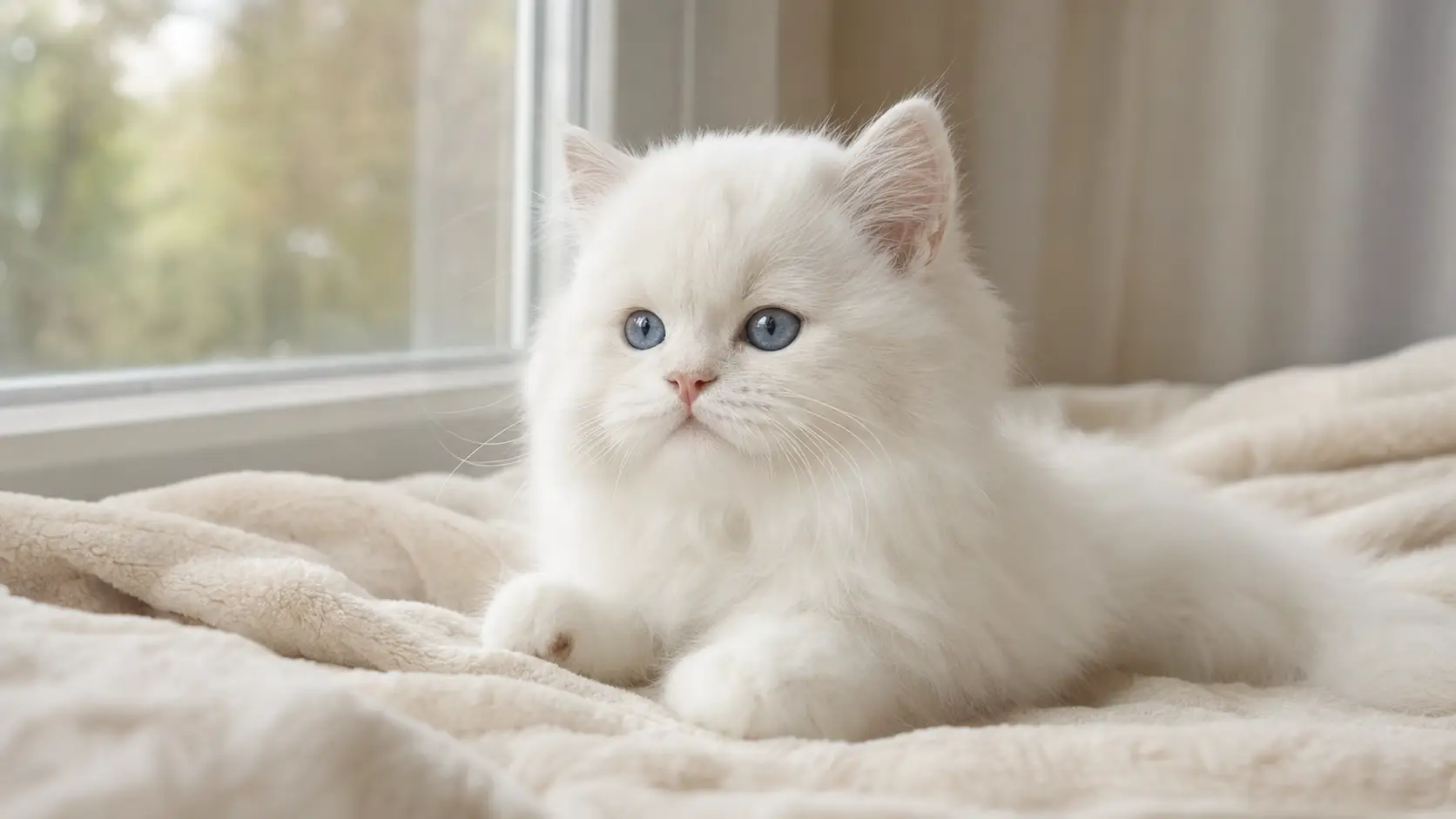
Turn off harsh overhead lights and avoid flash. A flash can startle a young kitten, create distracting reflections in the eyes, and make the interaction feel less gentle. Natural window light is usually more flattering for white fur and blue eyes.
Step-by-step photo walkthrough
1. Start with a wide frame
Before moving close, take one or two quiet photographs that show the whole scene: the kitten on its blanket, the window, and a little of the surrounding room. This opening frame gives the keepsake a sense of place and proves that the session was unhurried.
Photo cue: Keep the camera at the kitten’s eye level. Leave space in front of the face so the image feels open rather than boxed in.
2. Let the kitten get used to the camera
Place the camera down for a moment and allow the kitten to sniff it if interested. Do not follow the face with the lens every time the kitten moves. A camera that stays relatively still is less intrusive than one that constantly rises, clicks, and retreats.
Sit at an angle instead of facing the kitten head-on. Looking slightly past the kitten can reduce the pressure of direct eye contact. If the kitten walks away, let that be the end of this attempt. A future session will be more useful than a forced photograph.
3. Position soft light across the face
Place the kitten beside, not directly in front of, a bright window. Side light can show the shape of the muzzle, whiskers, and eyelids while keeping the white coat from becoming a flat, glowing patch. Sheer curtains can soften strong daylight.
Check the preview for detail in the fur. If the white areas look completely blank, move farther from the window, angle the kitten slightly away from the light, or reduce exposure. The eyes should remain the visual focus, but the fur should still have visible texture.
4. Offer one slow blink of your own
Once the kitten is settled, look in its direction with a soft expression. Slowly close your eyes, pause briefly, and open them again. Then look slightly away and wait. One gentle invitation is enough; repeating it every few seconds can turn a calm exchange into a performance.
Never hold the kitten’s head, touch the eyelids, block its exit, or use a toy to force the face toward the camera. The most meaningful image is the one made while the kitten remains in control of the interaction.
5. Focus on the nearer eye
On a phone, tap the nearer eye or the bridge of the nose and check the exposure before taking the photograph. If your phone has Live Photo, burst, or a similar option, use it for the blink sequence. Avoid heavy digital zoom; moving a little closer or cropping later usually gives a cleaner result.
With an interchangeable-lens camera, a shutter speed around 1/250 second is a useful starting point for a moving kitten. A moderate aperture, such as f/2.8 to f/4, can separate the face from the background while keeping both eyes reasonably sharp. Let the camera raise ISO as needed rather than slowing the shutter so much that the blink becomes blurred. These are starting points, not rules: the kitten’s movement and the available light should decide the final settings.
6. Capture before, during, and after
The strongest keepsake may not be the frame with the eyelids fully closed. Take a short sequence that includes the kitten looking toward you, beginning the blink, completing it, and opening its eyes again. The surrounding frames give the moment an emotional rhythm.
Keep the shutter quiet and the session short. If the kitten relaxes, you can wait for another opportunity. If it becomes restless, stop while the experience is still positive.
7. Finish with a natural portrait
After the blink, lower the camera and allow the kitten to settle. You may get a second photograph with the eyes open, whiskers forward, or paws tucked underneath. Pairing the blink with this calm portrait often makes a more complete family keepsake than treating the blink as the only image that matters.
A simple five-photo story for the final keepsake
If you plan to create a small album, print, or framed sequence, look for these five kinds of images:
- The setting: a wide photograph showing the kitten’s cozy corner.
- The approach: the kitten noticing the camera without being crowded.
- The connection: an open-eyed glance toward you.
- The slow blink: the soft, half-closed or fully closed eyelids.
- The after-moment: a relaxed portrait that shows the kitten returning to its own activity.
This sequence works even if the blink lasts only a fraction of a second. It also protects you from placing too much pressure on one photograph. A family keepsake can tell the story of a gentle interaction rather than claiming to document a scientifically provable first.
Persian kitten details that affect the photograph
Persian kittens have long, soft coats and facial features that can create shadows around the eyes. Brush or tidy the coat only if grooming is already a familiar, comfortable routine. Do not hold the kitten still for grooming just before the photograph; a slightly imperfect tuft is better than a tense expression.
A white, blue-eyed Persian kitten is a striking subject, but that coloring is not universal across the breed. White fur can reflect a lot of window light, while blue eyes can appear pale in an overexposed image. Check the highlights and reduce exposure slightly if needed rather than brightening the face until the eyes lose detail.
Persistent squinting, redness, swelling, cloudiness, unusual discharge, or frequent rubbing is not a photography problem to edit away. End the session and ask a veterinary professional for advice, especially if the change is sudden or affects one eye.
Edit the image without losing the real moment
For a natural family photograph, make small adjustments: correct the white balance, lift shadows gently, reduce highlights on the coat, and crop to give the face room. Avoid smoothing away whiskers, reshaping the eyes, or removing visible signs that would help someone understand the kitten’s actual condition.
Save the original file before editing and keep a full-resolution copy. If the image will be printed, check the crop at the intended size. A close-up that looks sharp on a phone may reveal motion blur when enlarged, so choose the frame with the clearest eye rather than automatically choosing the most dramatic blink.
Frequently asked questions
Does a slow blink mean my kitten trusts me?
It can be a relaxed social signal, but it is not proof on its own. Look at the whole body, the kitten’s ability to leave, and what happens after the blink. A kitten that remains loose and comfortable is giving you more useful information than the eyelids alone.
How long should I wait for the first slow blink?
There is no reliable timetable. It may happen quickly, after several quiet minutes, or during a different session entirely. Waiting without staring, moving the camera constantly, or repeatedly prompting the kitten gives you the best chance of seeing a natural moment.
What if my kitten never slow-blinks on camera?
That does not mean anything is wrong with the relationship. Some kittens blink when they are drowsy, while others look away or become active when a camera appears. Photograph the kitten doing something comfortable instead. The resulting image may be a better keepsake than a forced imitation of a slow blink.
Ready to preserve more quiet kitten moments? Explore CTkittens.com for more Persian kitten guidance and inspiration for welcoming a new companion home.

Rachel Cohen is a journalist and producer with a passion for audio storytelling, health and science reporting, and feline companions.
A graduate of Middlebury College, Rachel spends her weekends exploring the mountains and when she isn’t outdoors or chasing a story, she can usually be found hanging out with her cats.