
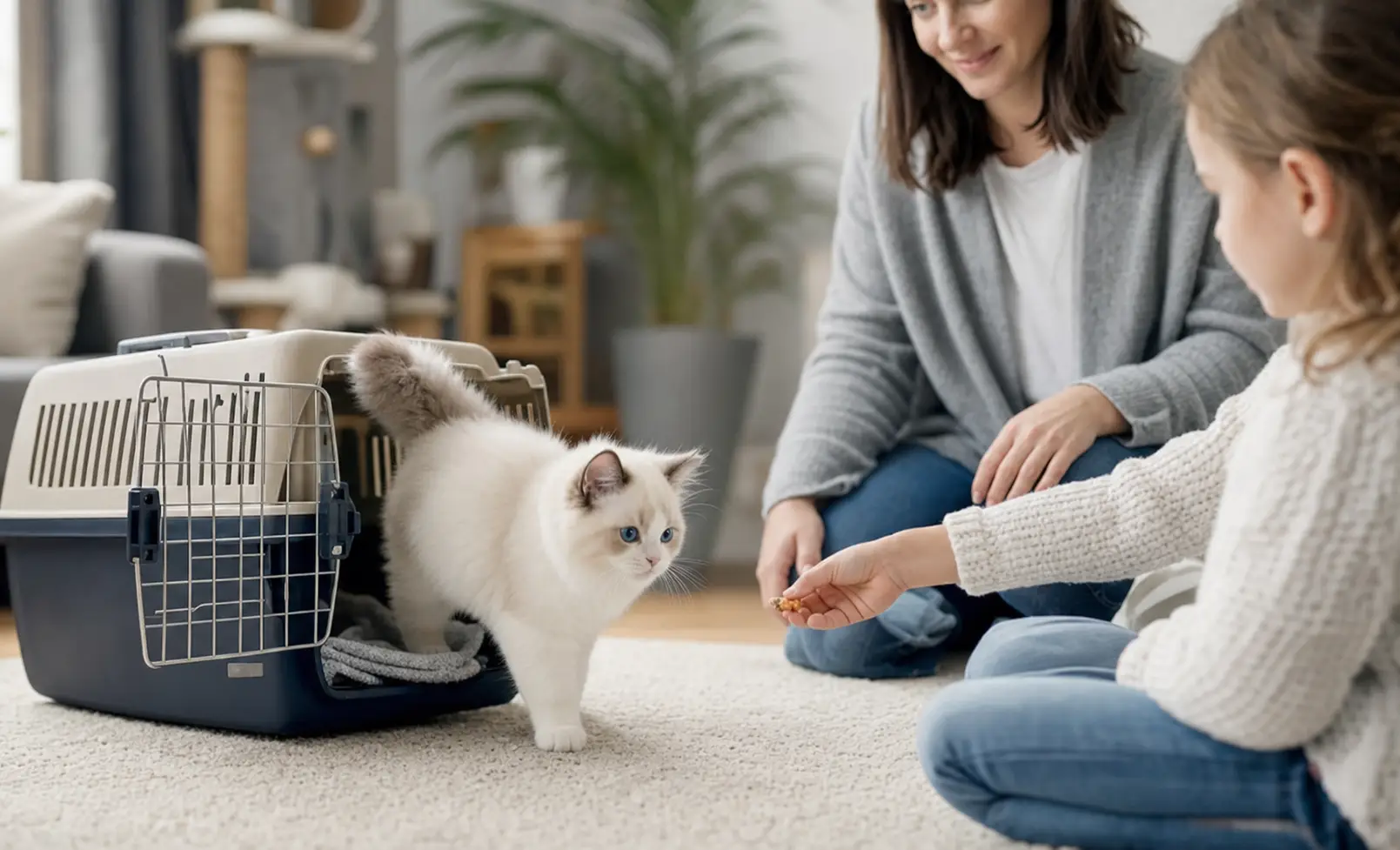
Ragdoll Kitten Carrier Training: A Family Plan
The easiest time to teach a Ragdoll kitten to enter a carrier is before the next veterinary appointment. Leave the carrier available, reward small voluntary choices, and increase the challenge one step at a time. Children can take part, but an adult should manage the door, lifting, and travel.
This approach turns the carrier from a signal that something frightening is about to happen into an ordinary part of the home. The goal is not to make a kitten tolerate being chased into a box. It is to build a reliable habit: notice the carrier, walk toward it, step inside, and remain comfortable while the experience gradually becomes more realistic.
Why tiny daily rewards work
Cats learn from the immediate result of their behavior. If a kitten looks at the carrier and immediately receives a small, appealing reward, the carrier becomes associated with something worthwhile. As confidence grows, you can reward a closer approach, one paw inside, all four paws inside, and eventually a short period with the door closed.
Keep the reward small enough that it does not replace a meal. A teaspoon-sized lick of the kitten’s usual wet food, a crumb-sized cat treat, or a few pieces of the kitten’s regular kibble may work. Use food your kitten already tolerates, and ask your veterinarian for advice if the kitten has dietary restrictions or is not gaining weight normally.
Ragdolls are often described as sociable and easygoing, but a breed description cannot predict how an individual kitten will react to restraint, movement, or a car. Some Ragdolls will investigate a carrier immediately; others need a slower introduction. Let the kitten’s body language set the pace.
Prepare the carrier before training begins
Choose a sturdy carrier that allows the kitten to stand, turn around, sit, and lie down naturally. Remember that a Ragdoll may become a large adult cat, so check the carrier’s weight and size limits rather than buying only for the kitten’s current dimensions. A carrier with a removable top or a wide opening can make future veterinary examinations easier.
Place the carrier in a quiet, familiar room with the door secured open. Add a washable towel or bedding that smells like home. Do not hide the carrier away between appointments. It should become ordinary furniture rather than an object that appears only when the kitten is about to leave.
Use a consistent marker such as a soft “yes” or a clicker to identify the exact behavior you want. The sequence is simple: the kitten makes the desired choice, you mark it immediately, and you deliver the reward. If a clicker excites or distracts your child, use a quiet word instead.
Ragdoll kitten carrier training: a gradual plan
Practice for about three to five minutes once or twice a day. Some kittens progress in a few sessions; others need several days at one stage. Move forward only when the current step looks relaxed. A kitten that crouches, freezes, backs away, swats, or stops taking a familiar reward is telling you that the step is too difficult.
- Reward calmness near the carrier. Start with the carrier several feet away. When your kitten glances at it, mark and reward. Do not call the kitten over repeatedly or place the reward inside yet. You are simply making the carrier’s presence predictable and positive.
- Reward an approach. When the kitten walks toward the carrier, mark the approach and place the reward on the floor nearby. Let the kitten leave whenever it wants. Choice matters because it prevents the carrier from becoming a trap.
- Reward investigation. When the kitten sniffs the opening, looks inside, or touches the carrier, mark and reward. You can put the reward just inside the entrance, but keep it close enough that the kitten does not feel pressured to reach deeply.
- Build from one paw to four. Move the reward a small distance farther inside only after the kitten is comfortable. Mark one paw, then two, then all four paws. Do not close the door simply because the kitten has finally entered. For now, entering and leaving should remain safe and predictable.
- Add a short pause. Once the kitten walks fully inside, wait for one calm second before marking and rewarding. Gradually extend the pause by a second or two. If the kitten turns to leave, allow it. You can make the next repetition easier.
- Introduce the door separately. Move the door a few inches, open it again, and reward. Repeat until the movement is unremarkable. Then close it briefly, mark, reopen, and reward. Increase closed-door time in small increments rather than jumping straight to several minutes.
- Practice gentle movement. When the kitten is comfortable with a closed door, lift the carrier only an inch or two and set it down. Reward. Later, carry it a few steps around the room. Keep the carrier level and avoid swinging it.
- Rehearse the real routine. Practice carrying the secured carrier to the doorway, placing it down, and returning indoors. Only after that should you introduce the car. The first car session can be sitting in a stationary vehicle with the engine off, followed by a short drive on another day.
At each stage, one successful repetition may be enough. Ending while the kitten is still comfortable is more useful than squeezing in extra practice. If your kitten rushes out, that is not a failure; simply return to the last step that produced relaxed behavior.
A child-friendly household plan
Children can help create positive associations, but they should not be responsible for safety-critical parts of the routine. An adult should supervise every session, especially with a young or excitable kitten.
- One child at a time: Keep the room quiet and avoid several people reaching toward the carrier.
- Use a clear rule: Children may place or toss a reward only when an adult says “now.” This prevents repeated luring, grabbing, or blocking the exit.
- Keep hands out: A child should never reach into the carrier, pull the kitten out, hold the door shut, or put fingers near the latch.
- Do not carry the kitten: The adult handles lifting and moving the carrier. A child can sit nearby and read quietly while the kitten investigates.
- Respect the exit: If the kitten walks out, nobody follows or corners it. Wait, reset, and make the next repetition easier.
- Use calm voices: Shouting, excited cheering, and repeated commands can make a small room feel threatening.
Teach children to notice relaxed behavior: normal walking, sniffing, taking a reward, and choosing to enter or leave. Those are better signs of progress than simply getting the kitten inside.
Common setbacks and what to do
| What you see | Better response |
|---|---|
| The kitten avoids the room after the carrier appears | Move the carrier farther away, leave it open, and reward calm behavior at a greater distance. |
| The kitten enters only when food is placed at the back | Stop moving the reward deeper. Reward the entrance and let the kitten come back out freely. |
| The kitten panics when the door moves | Return to rewarding a stationary open door. Later, move it just slightly and reopen immediately. |
| The kitten accepts the carrier but dislikes lifting | Separate lifting from door practice. Start with a tiny lift, set the carrier down, and reward at once. |
| The kitten will not take treats | Reduce the difficulty or end the session. Refusing a normally valued reward can indicate that the kitten is too worried. |
Avoid chasing, dragging, shaking treats inside while blocking the exit, or saving all carrier practice for appointment day. Force may be unavoidable during an urgent medical situation, but it should not be the normal training method. If an appointment is necessary and your kitten is frightened, call the veterinary clinic in advance for handling advice.
Making travel safer
Before leaving home, check that the carrier is latched securely and that bedding cannot cover ventilation openings. In the car, secure the carrier so it cannot slide or tip. Never allow a cat to travel loose in the passenger compartment, and do not open the carrier outdoors or in a parking area, even if the kitten is vocal.
Keep the first drives short and quiet. A towel over part of the carrier may reduce visual stimulation, but do not block airflow. Follow your veterinary team’s advice about feeding before travel, medication, motion sickness, or signs of illness. Heavy drooling, repeated vomiting, extreme distress, or trouble breathing warrants a call to a veterinarian rather than more training.
For additional feline-friendly handling and travel guidance, see Cat Friendly Homes’ veterinary visit guidance, International Cat Care’s carrier advice, and the AVMA guide to traveling with pets.
Frequently asked questions
How long does carrier training take?
There is no reliable timetable. A confident kitten may progress quickly, while a cautious kitten may need days or weeks. The useful measure is relaxed behavior at each step, not the calendar.
Should the carrier stay open all the time?
During early training, yes, if it is safe and practical. An open carrier in a quiet area gives the kitten opportunities to investigate without the pressure of an upcoming trip. Once the carrier is familiar, occasional short closed-door practices keep the skill current.
Can I use the carrier as a bed?
Yes. Comfortable bedding and occasional rewards can make it a pleasant resting place. Do not use it as punishment or shut the kitten inside for long periods as a training shortcut.
A small routine that pays off
Carrier training works best as a household habit rather than a one-time project. A few quiet minutes, a reward delivered at the right moment, and a child who understands when to give the kitten space can make future veterinary visits considerably easier.
For more practical guidance on raising and caring for Ragdoll kittens, explore CTkittens.com.

Rachel Cohen is a journalist and producer with a passion for audio storytelling, health and science reporting, and feline companions.
A graduate of Middlebury College, Rachel spends her weekends exploring the mountains and when she isn’t outdoors or chasing a story, she can usually be found hanging out with her cats.

