
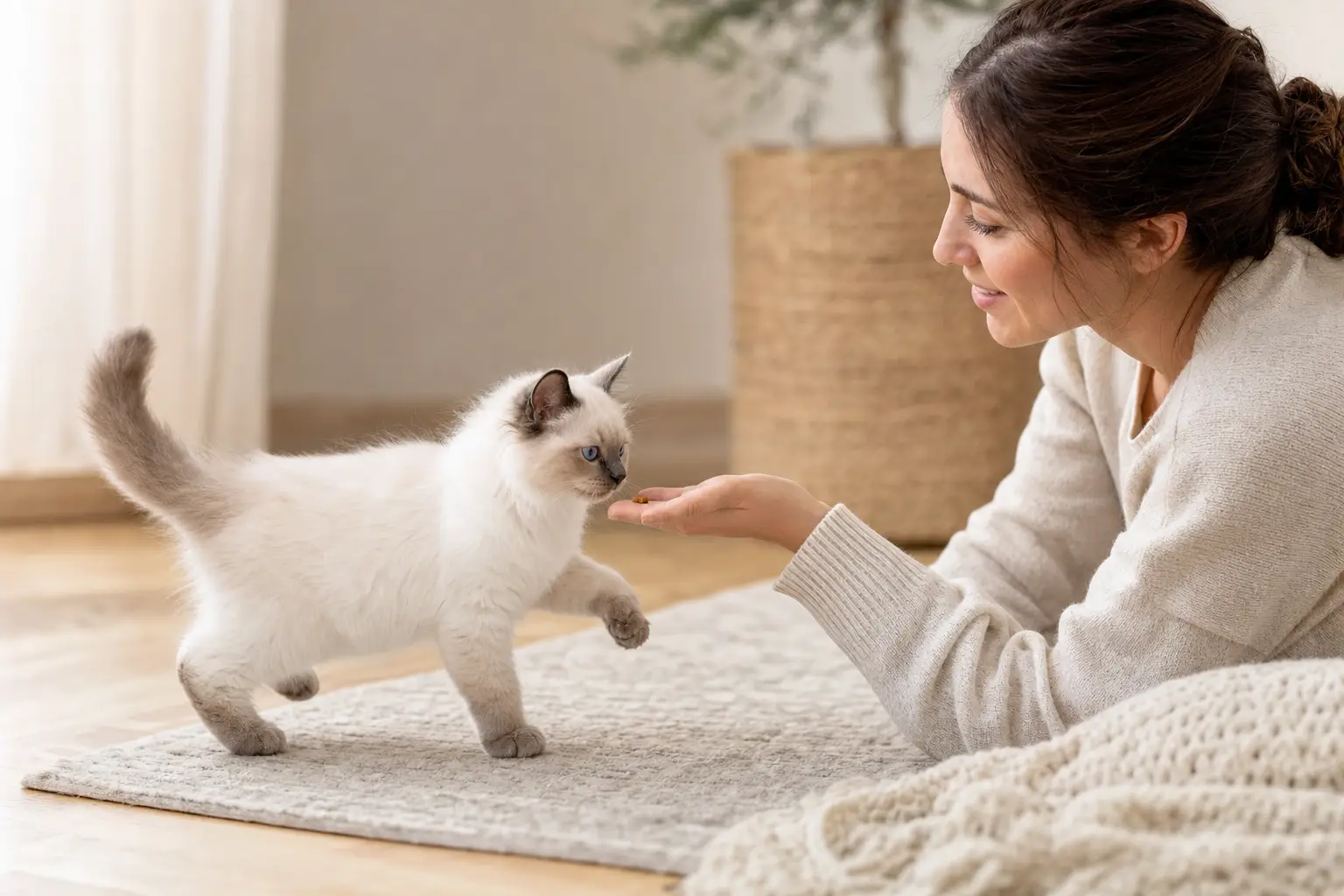
How to Teach a Ragdoll Kitten Its Name: A Calm Start-to-Finish Plan
To teach a Ragdoll kitten its name, say the name once in a relaxed voice, reward any small sign of recognition, and slowly practice in new places. A head turn, ear flick, glance, or step toward you all count as progress. Your kitten does not need to run across the room every time you call.
The aim is to make the name a pleasant, meaningful sound. With short sessions and consistent handling, your kitten can learn that hearing its name is a reason to look toward you—not a warning that something unpleasant is about to happen.
What a name response actually means
A name and a recall cue are not quite the same thing. A name usually means, Pay attention to me. A separate cue, such as come or a particular kiss sound, can eventually mean, Move toward me.
That distinction makes early training easier. If your kitten looks at you after hearing its name, reward the look before asking for anything else. You are building recognition first. A reliable approach can come later.
Research published in Scientific Reports found evidence that domestic cats can distinguish their own names from other spoken words in controlled settings. The study does not mean that every cat will come immediately when called, but it supports the idea that a name can become a meaningful sound through repeated, relevant use.
Prepare for a calm first lesson
Ragdolls are often described as easygoing, but breed reputation should not replace attention to the individual kitten. One kitten may enjoy food rewards, another may prefer a wand toy, and a third may respond best to gentle attention. Follow your kitten’s comfort level rather than expecting a particular personality.
Choose a name and reward system
- Use one main pronunciation. Family members can use a nickname later, but start with a consistent sound.
- Pick a name that is easy to say. A clear, relaxed voice is more useful than trying to find a supposedly perfect number of syllables.
- Prepare tiny rewards. Use a few pieces of the kitten’s usual food, an appropriate kitten treat, a favorite toy, or brief petting if your kitten genuinely enjoys it.
- Keep rewards small and occasional. Training should not replace balanced meals or turn into constant feeding.
Choose a quiet room where your kitten already feels safe. Begin after a nap or gentle play, not when the kitten is hiding, frightened, overtired, or intensely focused on something else. A first session can last less than a minute.
How to teach a Ragdoll kitten its name
1. Pair the name with something pleasant
Stand or sit near your kitten. When the kitten is already calm, say the name in a friendly voice. Immediately offer the reward. At this stage, you are not testing whether the kitten understands. You are simply creating an association between the sound and a positive outcome.
Repeat this a few times, then stop while the session is still easy. Two or three brief lessons are usually more useful than one long practice period. Avoid saying the name continuously. Repetition without a consequence can turn it into background noise.
2. Reward the smallest response
Once your kitten has heard the name during several easy pairings, wait for a natural pause. Say the name once, then watch closely. Reward an ear movement, head turn, glance, or change in body orientation as soon as it happens.
Do not wait for a perfect approach. If you only reward the biggest response, your kitten may miss the lesson. Early success often looks very small. As recognition improves, you can reserve the best reward for a clearer look or a step toward you.
3. Add a little distance
Practice from a short distance in the same room. Say the name once, wait, and reward the response. If your kitten does not react, reduce the distance or return to an easier version instead of saying the name several more times.
Build difficulty gradually: beside your kitten, a few steps away, near the doorway, and then in another familiar part of the home. Move forward only after your kitten is responding comfortably at the current level. Several easy successes in a row are a better guide than a strict timetable.
4. Introduce mild distractions
A name learned beside the food bowl may not yet be understood during play or in a busy room. Add distractions one at a time. You might begin with a quiet toy across the room, then try while another family member is sitting nearby.
Lower your expectations as the environment becomes more interesting. In a distracting situation, reward a glance even if your kitten does not walk over. If the kitten becomes too absorbed to respond, make the exercise easier again.
5. Teach the approach separately
When your kitten reliably looks toward you, add a second cue for coming closer. Say the name, wait for the look, then use your chosen recall cue and invite the kitten with a toy, open arms, or a reward. When the kitten approaches, reward generously.
This sequence keeps the name useful and positive. It also prevents the name from becoming a demand that always ends play, leads to being picked up, or signals a trip to the carrier. If you need to handle your kitten for medication, grooming, or veterinary care, use extra rewards and calm preparation rather than relying on the name alone.
6. Use the name naturally throughout the day
Once the response is developing, include the name in ordinary, pleasant moments. Say it before offering a toy, placing down a meal, beginning a gentle game, or greeting your kitten. You do not need to turn every interaction into a formal lesson.
Use the name before attention, not only before restraint. If every name call ends with your kitten being carried away from something enjoyable, the association may weaken. When the name must precede something less appealing, pair the experience with patience and a reward.
A simple first 10-day practice plan
This schedule is a flexible framework, not a deadline. Some kittens move faster, while cautious kittens may need more time.
- Days 1–2: In a quiet room, say the name and immediately reward. Try two or three sessions of roughly 30 to 60 seconds.
- Days 3–5: Pause after saying the name and reward any orientation. Practice from a short distance and vary whether the reward is food, play, or attention.
- Days 6–7: Add a little movement. Say the name when your kitten is calm but not already looking directly at you.
- Days 8–10: Practice in another familiar room and around one mild distraction. Return to an easier step if responses become inconsistent.
- After day 10: Maintain the skill with occasional rewards. Keep the name relevant in daily life and refresh it with short games.
End each session after a successful response. Stopping while your kitten is still interested helps keep the exercise cheerful rather than tiring.
Common problems and gentle fixes
Your kitten ignores the name
Move closer, remove distractions, and use a reward your kitten values more. Look for a tiny ear or head movement instead of waiting for the kitten to cross the room. Do not repeat the name louder and louder. If the kitten is sleepy, stressed, or deeply engaged in play, try again later.
Your kitten responds only when it sees food
That is common during early learning. Keep the reward out of sight, say the name, and reveal the reward after the response. Gradually mix food with play, a favorite toy, or brief affection. The goal is not to eliminate rewards; it is to teach your kitten that responding has several pleasant outcomes.
Family members use different versions
Agree on the main name and pronunciation for the first few weeks. If you want to use a nickname, introduce it after the original name is familiar by pairing the two sounds and rewarding the response. Avoid using the name during scolding. A calm interruption such as leave it is clearer than making the kitten’s name sound negative.
There are several cats in the home
Start with individual practice in separate spaces. Say one cat’s name, reward that cat, and keep the other cats occupied. Once each cat understands its own sound, practice short turns together. Distinct names and precise timing will help prevent everyone from receiving a reward for responding to someone else’s name.
Your kitten never reacts to sounds
A kitten that does not orient to voices, toys, food preparation, or other everyday sounds should be discussed with a veterinarian. Lack of response to a name alone may simply mean the association is not established yet, but a broader lack of sound response deserves professional attention.
FAQ
How long does it take to teach a Ragdoll kitten its name?
There is no dependable deadline. Some kittens begin turning toward the sound after a few short sessions; others need consistent practice over several weeks. Measure progress by increasingly reliable orientation, not by whether your kitten comes every time.
Do I need treats?
No. Treats are convenient, but play, a meal, praise, or gentle contact can work if your kitten values them. Use the reward your individual kitten finds motivating and keep sessions brief.
Should I say the name more than once?
Usually, say it once and give your kitten a moment to respond. If there is no response, make the next repetition easier by moving closer or removing a distraction. This keeps the sound distinct instead of teaching your kitten to wait through several repetitions.
Can the name also mean come here?
It can, but teaching a separate recall cue is clearer. First reward looking toward you after the name. Then add a consistent invitation to approach, and reward your kitten for coming when you use that cue.
Further reading
The name-recognition research cited above is Domestic cats discriminate their names from other words, published in Scientific Reports. For broader welfare-focused guidance on feline learning and handling, see International Cat Care’s cat training guidance.
Preparing for life with a new kitten? Explore CTkittens.com for more practical guidance as you build a calm, happy routine together.

Rachel Cohen is a journalist and producer with a passion for audio storytelling, health and science reporting, and feline companions.
A graduate of Middlebury College, Rachel spends her weekends exploring the mountains and when she isn’t outdoors or chasing a story, she can usually be found hanging out with her cats.


Gonna try rewarding the lil ear flicks instead of waiting for a full-on sprint, cuz honestly I was probably expecting way too much too soon.
Gonna start using my kitten’s name for “look at me” and a kissy noise for recall, cause rn I been mashing both cues together lol.
Kinda wondering if names that sound alike would mess up training in a multi-cat house, even when each kitten gets practiced with separately?
Anyone tried the separate recall cue thing long-term, cuz my cat hears his name fine but acts like coming over wasnt in the contract lol?
Counting a tiny ear flick as progress is such a smart detail, cuz honestly most of us would be waiting for a full Disney-style sprint and think the training aint working.
Calling out that even a tiny ear flick counts is such a useful detail, cause honestly most of us would miss that and assume the lil dude aint learning anything.