
Yes, you can build a slow-blink conversation with a Persian kitten. The goal is not to train a kitten to perform on cue. It is to create enough calm, predictability, and choice that your kitten begins to answer a soft eye-narrowing gesture with one of their own.
A slow blink is best understood as a small social exchange, not a guaranteed sign of affection. In a 2020 peer-reviewed study, cats narrowed their eyes more often after humans made similar movements and were more likely to approach after a human slow blink. The finding supports slow blinking as a useful cat-human communication signal, while still leaving room for individual differences.
In a busy household, the most meaningful before-and-after change may be subtle: a kitten who once watched from under a chair begins to soften their eyes from the doorway, pause instead of retreating, or walk over after the household has quieted. That is progress, even if there is no immediate blink in return.
What the Persian kittens before-and-after story really shows
Picture the same room photographed from the same angle. In the first image, the kitten is tucked behind a table while people move, talk, and pass through the room. Their eyes are wide, their body is low, and every approach feels like an event.
In the second image, the kitten is still aware of the activity, but they are sitting in an open spot. Their body is less tense. They look toward a familiar person, narrow their eyelids for a moment, and either remain where they are or choose to come closer.
The change is not that the kitten has become permanently relaxed or that a blink proves complete trust. It is that the kitten has learned this particular interaction is predictable and does not remove their control.
| Stage | What you may see | A helpful response |
|---|---|---|
| Before | Wide eyes, hiding, turning away, crouching, or watching from a distance | Reduce pressure. Sit still, keep your gaze soft, and let the kitten choose the distance. |
| In progress | Brief eye narrowing, a pause before retreating, relaxed ears, or staying visible | Repeat the same quiet signal and stop before the kitten becomes uncomfortable. |
| After | A slow blink, relaxed posture, a voluntary approach, or resting nearby | Accept the response without reaching immediately. Calm consistency matters more than excitement. |
These signs are context-dependent. A kitten can have wide eyes because they are curious, not frightened; a slow blink can happen because they are drowsy; and looking away may be a way to reduce social pressure. Read the whole body, not the eyelids alone.
How to build a slow blink with a Persian kitten
1. Start with the room, not the eyes
A kitten cannot focus on a quiet social exchange while someone is vacuuming, a child is running past, or a dog is standing close to their hiding place. Begin during a predictable low-traffic moment. Turn down sudden noise, keep other pets at a comfortable distance, and make sure the kitten has an easy retreat.
A safe retreat is not a failure of bonding. It is what makes interaction voluntary. A covered bed, open carrier, cat tree, or elevated shelf can give your kitten a place to observe without being surrounded.
2. Use a soft gaze from a comfortable distance
Face your kitten loosely rather than leaning over them. Look toward the general area of their face, then narrow your eyelids slowly for about a second. You do not need to squeeze your eyes shut. Afterward, look slightly away or turn your head a little.
That final step matters. A fixed stare can feel intense, especially to a kitten who is still learning your habits. The message is closer to I see you, and I am not asking you to come closer than Look at me now.
3. Wait without filling the silence
Give your kitten time to respond. They may blink back, relax their whiskers, turn their head, groom, remain still, or do nothing visible. All of those responses are information. Do not repeat the gesture rapidly or move closer to force a result.
If your kitten leaves, let them leave. Ending an interaction safely can make the next one easier. A slow blink should never be used to block a retreat, restrain a kitten, or justify picking them up.
4. Pair the signal with something your kitten already enjoys
Use the blink during a routine your kitten understands, such as sitting nearby before a meal, resting together after play, or offering a favorite treat on the floor. The reward does not need to be food. Some kittens prefer a quiet voice, a toy placed at a distance, or simply being left undisturbed.
Keep handling separate from the eye exchange at first. A kitten may accept your gaze but still dislike a hand reaching toward their face. If you are beginning grooming, offer one gentle stroke or comb pass, pause, and observe whether the kitten remains relaxed. A slow blink is not blanket permission for touch.
The busy-household version of the routine
Consistency does not mean every person must behave identically. It means the kitten should not receive mixed messages. A simple household plan can help:
- Choose one quiet station: Use the same chair, mat, or corner for short interactions so the kitten knows where they can observe safely.
- Give everyone the same rule: Soft gaze, slow blink, no chasing, and no reaching into a hiding place.
- Protect sleep and meals: Avoid turning the kitten’s resting or feeding area into a busy meeting point.
- Let children watch instead of approach: A child can practice slow blinking from the floor while an adult supervises, but the kitten should decide whether to come closer.
- Manage other pets: Start the exercise when a dog or another cat is not crowding the kitten. Add normal household activity gradually.
- Keep sessions short: One calm exchange is more useful than a long session that ends in hiding.
You can also make a simple visual diary. Take a photo from the same position once or twice a week, without using flash or disturbing the kitten. Record the distance between you, the kitten’s body posture, the amount of household activity, and whether the kitten chose to remain visible. This shows progress that a single dramatic before-and-after photograph may miss.
What is special about doing this with a Persian kitten?
Persian cats are individuals, not a single personality type. Some are socially confident; others prefer quiet observation. A Persian kitten’s long coat, facial structure, age, early experiences, and health can all affect how they respond to handling and household activity. Do not assume that a breed label predicts how quickly your kitten will blink back.
Facial fur and tear overflow can also make the eye area look different from one kitten to another. Keep the area clean only with a method recommended by your veterinarian, particularly if the kitten has a very flat face or recurrent discharge. Never use human eye drops or unverified tear-stain products without veterinary guidance.
Watch for signs that are not part of a communication exercise: persistent squinting, one eye held closed, redness, cloudiness, swelling, heavy discharge, repeated rubbing, or a sudden change in eye behavior. These can indicate discomfort or illness. A kitten with an eye problem needs a veterinary assessment, not more slow-blink practice.
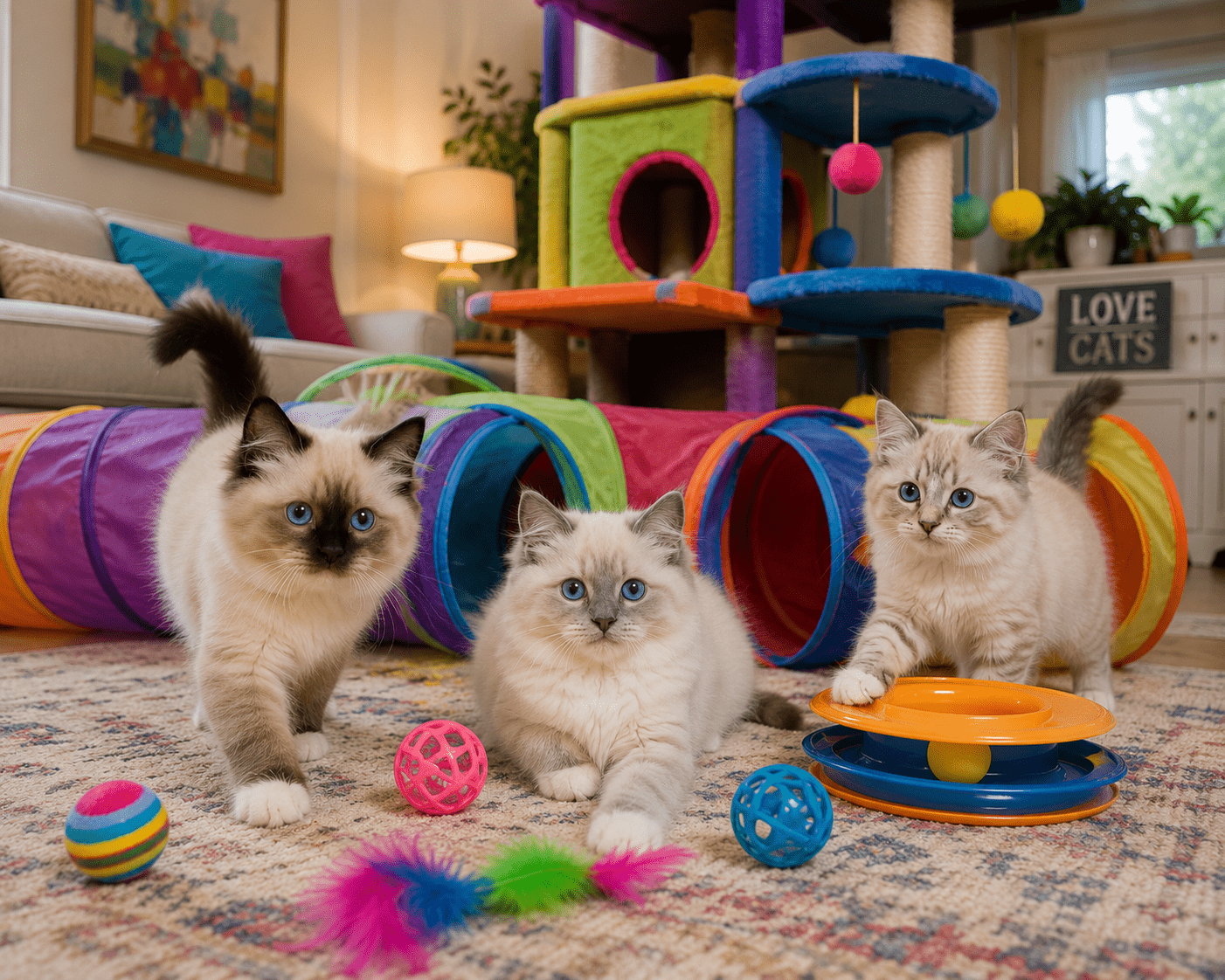
The white fur and blue eyes often shown in Persian kitten imagery are a beautiful visual combination, but they are not requirements for the breed and do not predict trust or temperament. Focus on the individual kitten in front of you rather than trying to produce a particular expression for a photograph.
Common mistakes that interrupt the conversation
- Staring too long: A prolonged, direct gaze can feel confrontational rather than friendly.
- Moving in immediately: If you approach every time your kitten looks at you, they may stop offering eye contact.
- Expecting a fixed timeline: There is no validated schedule that guarantees a response in three days or two weeks.
- Using the blink to test trust: One response does not prove that your kitten is ready for carrying, grooming, or introductions.
- Ignoring the rest of the body: Flattened ears, a tucked posture, tail lashing, hiding, or sudden agitation mean you should create more space.
- Making the kitten perform for visitors: Social confidence grows more reliably when the kitten can opt out.
Some kittens answer during the first calm session. Others need weeks of predictable contact, and some rarely offer a visible blink even though they become comfortable sitting nearby. The outcome to value is not a perfect photograph. It is a relationship in which the kitten can communicate both interest and refusal without being pressured.
Frequently asked questions
Does a slow blink always mean my Persian kitten is happy?
No. It can be a friendly or affiliative signal, but a sleepy kitten may also narrow their eyes. Check posture, ears, whiskers, movement, and the surrounding situation before interpreting it.
What if my kitten never blinks back?
Do not chase the response. Continue offering calm, optional contact and look for other signs of comfort, such as resting in the same room, eating normally, playing, or approaching voluntarily. A visible slow blink is not the only measure of trust.
Can an adult Persian learn this interaction?
Yes. The exercise is based on low-pressure communication, not kitten age. An adult cat may need more time to adjust to a new person, new home, or busy routine, so let their behavior set the pace.
The real before-and-after
At the beginning, your kitten may respond to a busy household by disappearing. Later, they may stay in view, soften their eyes, and decide whether to share the room with you. That quiet choice is the heart of the slow-blink conversation.
Keep the signal gentle, the routine predictable, and the kitten’s exit available. For more guidance on welcoming and caring for Persian kittens, explore CTkittens.com.
Sources and further reading
- The role of cat eye narrowing movements in cat–human communication, Scientific Reports.
- AAFP and ISFM Feline Environmental Needs Guidelines, Journal of Feline Medicine and Surgery.
- International Cat Care: Understanding your cat’s body language.

Rachel Cohen is a journalist and producer with a passion for audio storytelling, health and science reporting, and feline companions.
A graduate of Middlebury College, Rachel spends her weekends exploring the mountains and when she isn’t outdoors or chasing a story, she can usually be found hanging out with her cats.