
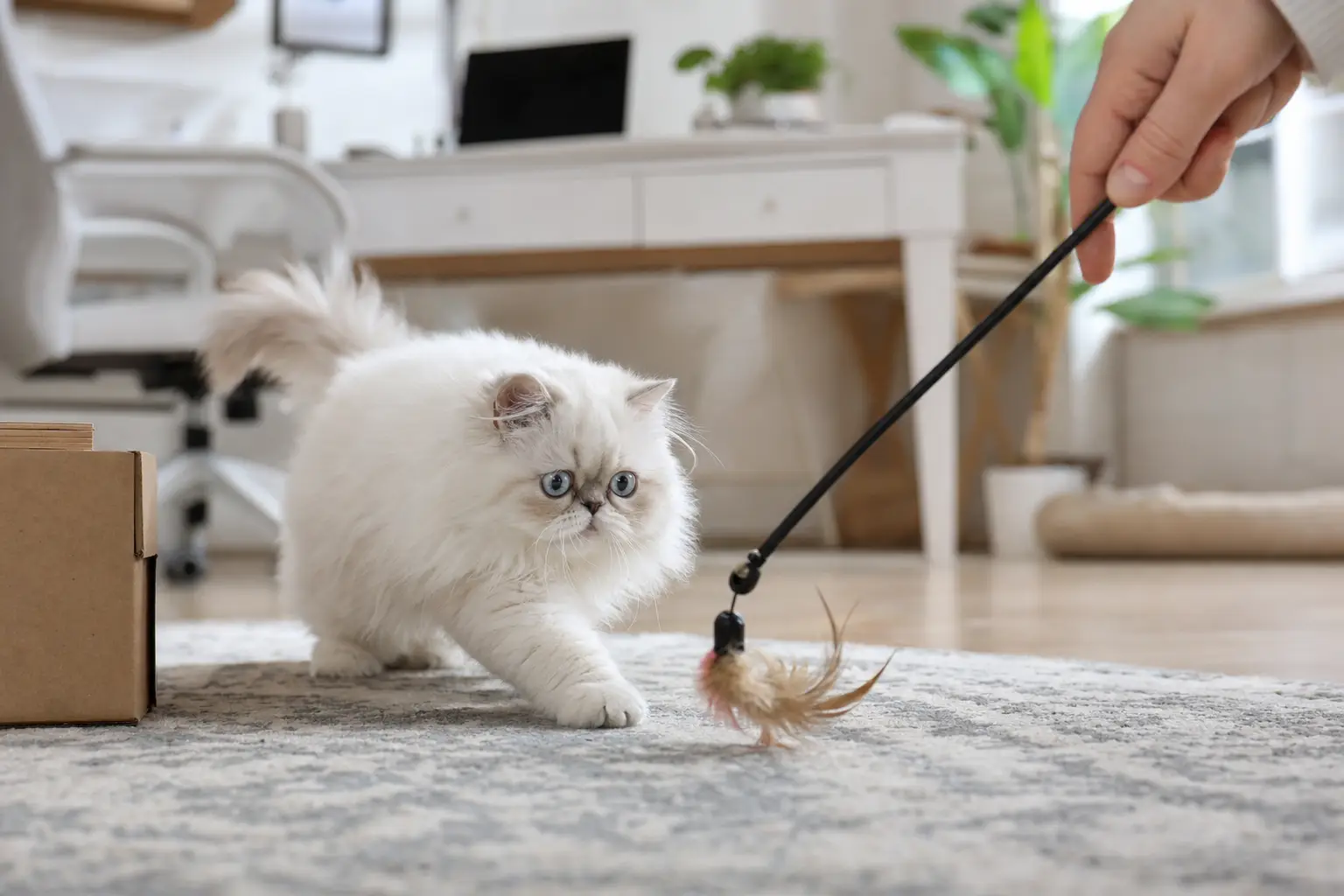
Persian Kitten Wand Toys: DIY or Store-Bought?
Short answer: choose a well-made store-bought wand toy for your regular routine, then use carefully prepared DIY toys for low-cost variety. Neither option should be left with a kitten unattended. The best wand-toy routine is short, predictable, and built around your kitten’s natural sequence of watching, stalking, chasing, pouncing, and catching.
That approach works well when your day is divided by meetings or short work breaks. You do not need a large playroom or a long training session. A focused two-to-ten-minute game can provide useful enrichment, provided the toy is safe and your Persian kitten is allowed to play at a comfortable pace.
DIY or store-bought: which is better for a Persian kitten?
For most households, store-bought is the better starting point for an interactive wand. Purpose-made toys typically have a more secure handle and attachment, and they are quick to replace when worn. DIY toys are useful when you want to change textures, create novelty, or avoid buying several toys before you know what your kitten enjoys.
| Option | Advantages | Limitations | Best use |
|---|---|---|---|
| Store-bought wand | Convenient, reusable, and designed for interactive play | Still needs inspection; feathers, cords, and small parts can loosen | Your everyday work-break toy |
| DIY teaser | Inexpensive, easy to vary, and useful for testing preferences | Attachment strength and materials are your responsibility | Short, supervised novelty sessions |
| DIY floor toy | Very simple and avoids a dangling cord | May be less engaging for a kitten that prefers movement above the floor | Two-minute resets between tasks |
A product label is not a safety guarantee. Before every session, look for loose threads, split plastic, exposed wire, detached feathers, or any piece small enough to swallow. A DIY toy deserves the same inspection, plus a careful look at how the attachment was secured.
What makes a good wand toy?
The wand should give you enough distance to move the toy without putting your fingers in the middle of a pounce. A broad, lightweight lure is usually easier to see and less likely to be swallowed than a tiny bead or hard plastic decoration. Your kitten may prefer one of several textures, including fabric, paper, fleece, or a feather-style attachment.
For a Persian kitten, avoid letting long strands drag across the coat or wrap around the paws. Long-haired cats can also make loose fibers harder to spot. Keep the attachment away from the face and never pull a toy out of a kitten’s mouth. If the toy begins to fray, replace it rather than trimming it and assuming it is safe.
Safer DIY ideas
DIY does not have to mean building a complicated fishing-pole toy. The simplest options are often easier to inspect:
- Slide a folded piece of plain paper across the floor using your hand, keeping your fingers out of reach.
- Make a lightweight paper lure attached to a sturdy, smooth handle for one supervised session.
- Drag a larger piece of fleece or fabric briefly, then put it away immediately after play.
- Use a cardboard box, paper bag with handles removed, or crumpled paper as part of a stalking game rather than attaching it to a cord.
Do not use staples, exposed wire, brittle plastic, elastic bands, hair ties, tiny bells, beads, or loose craft parts. Avoid adhesives where a kitten can chew the dried glue. A cord, ribbon, or string can be particularly hazardous if swallowed; if you suspect your kitten has swallowed one, contact a veterinarian promptly and do not pull on any visible material.
Why short interactive games work better than constant access
A wand toy is an interactive tool, not a decoration. When you control its movement, you can adjust the pace, prevent collisions, and let your kitten complete the chase. Leaving the wand out between work breaks removes that control and creates a risk of chewing, entanglement, or swallowing loose parts.
Short sessions also make it easier to stop while your kitten is still interested. The American Association of Feline Practitioners’ environmental-needs guidance emphasizes opportunities for play and predatory behavior as part of a cat-friendly environment. A predictable play invitation can therefore be more useful than a basket full of toys that never changes.
A wand-toy routine for work breaks
Keep one or two inspected toys in a closed container near your desk. Rotate the attachments instead of presenting every option at once. The following routine is a framework, not a required daily prescription; your kitten’s age, health, temperament, and feeding schedule all matter.
The two-minute reset
- Start with the toy still and visible near a box edge or furniture leg.
- Move it slowly away from your kitten, then pause. Let your kitten look, crouch, or approach.
- Offer two or three short chases along the floor.
- Let your kitten catch the toy once before ending the game.
This is useful between emails or during a brief screen break. It is not meant to exhaust your kitten. If your kitten walks away, stop rather than repeatedly waving the toy in its face.
The five-minute hunt
- Spend the first minute warming up with small movements and pauses.
- For the next two or three minutes, alternate slow stalking with a few quicker escapes.
- Let your kitten catch the lure several times. A chase with no successful catch can become frustrating.
- Finish with a slower movement and a final catch, then store the toy.
Move the toy away from the kitten rather than directly toward its face. Let it disappear briefly behind a cushion or cardboard box, but keep the area free of unstable objects. A Persian kitten does not need high leaps to have a satisfying game; floor-level movement is often easier to control and gentler on a kitten that is still developing coordination.
The ten-minute lunch-break circuit
For a longer break, divide the session instead of making the entire game fast:
- Minutes 1–2: observe what attracts your kitten and use quiet, low movements.
- Minutes 3–6: create several stalk-and-chase cycles with pauses between them.
- Minutes 7–8: change direction or move the toy around a safe box or tunnel.
- Minutes 9–10: slow down, allow a final catch, and offer water. If this fits your veterinarian-approved feeding plan, play can happen before a normal meal.
Do not make every session intense. A kitten that is already sleepy, unwell, overheated, or reluctant should be left alone. The goal is an enjoyable opportunity, not a performance target.
Persian-specific comfort and safety checks
Persian cats vary considerably in face shape, coat, fitness, and play style. Some have a flatter facial structure that can make heat and breathing more challenging. Keep play in a cool, well-ventilated room, avoid forcing vigorous activity, and stop if your kitten seems distressed. Open-mouth breathing, marked breathing effort, weakness, or breathing that does not quickly settle after stopping are reasons to contact a veterinarian urgently. International Cat Care provides additional guidance on brachycephalic cats.
Watch the kitten rather than the clock. Flattened ears, repeated tail lashing, hiding, swatting at the handler, or suddenly biting the toy can mean the game has become too intense. Brief excitement is normal; persistent distress is not. Give your kitten space and try a slower session later.
Because Persian coats can be long and dense, check the lure and your kitten’s paws after play. A loose thread caught around a toe can tighten as the kitten moves. Store every wand in a drawer or closed container, not on the floor or beside the desk.
A practical buying checklist
When choosing store-bought Persian kitten wand toys, look for:
- A smooth handle that is easy for an adult to control.
- An attachment that is securely joined and has no exposed sharp edge.
- A lure large enough not to be swallowed whole.
- Materials that can be replaced when chewed or frayed.
- A design that lets you play from a comfortable distance.
Buy one simple wand before buying a large collection. Your kitten’s response will tell you more than packaging claims. Some kittens chase fluttering fabric, while others prefer a toy that pauses under a box or moves quietly across the floor. Once you know the preferred style, you can choose a safer DIY variation without guessing.
The best choice for most busy households
Use a durable store-bought wand as your dependable option, and reserve DIY toys for supervised experiments and variety. A two-minute reset, a five-minute hunt, or a calm ten-minute circuit can all work. What matters most is controlled movement, the chance to catch the toy, and putting the wand away when the session ends.
For broader enrichment ideas, the AAFP and ISFM feline environmental-needs guidelines offer useful background. The ASPCA’s cat-toy guidance also covers basic toy safety and supervision.
FAQ
Can a Persian kitten play with a wand toy alone?
No. Put away any wand with string, ribbon, elastic, feathers, or detachable parts after interactive play. Choose a separately inspected, kitten-appropriate independent toy if you need to leave the room.
How often should I use a wand toy during work breaks?
There is no universal number of sessions. Start with one or more brief, calm invitations and adjust to your kitten’s interest and energy. Several short sessions may be easier to tolerate than one exhausting game.
What if my kitten ignores the wand?
Try slower movement, longer pauses, a different texture, or a floor-level game. Play when your kitten is naturally alert, and avoid chasing the kitten with the toy. If a sudden loss of interest comes with lethargy, pain, appetite changes, or other symptoms, ask your veterinarian for advice.
Ready to make play part of your routine? Explore CTkittens.com for more practical guidance on caring for and enriching your Persian kitten.

Rachel Cohen is a journalist and producer with a passion for audio storytelling, health and science reporting, and feline companions.
A graduate of Middlebury College, Rachel spends her weekends exploring the mountains and when she isn’t outdoors or chasing a story, she can usually be found hanging out with her cats.

