Brushing a Ragdoll Kitten’s Chest Ruff
Brushing a Ragdoll kitten’s chest ruff should feel more like a calm daily ritual than a wrestling match. Use your fingers to find tangles, choose a wide-toothed comb, work in tiny sections from the ends of the fur, and stop before your kitten becomes overwhelmed. A few relaxed strokes are more useful than one long session that creates fear.
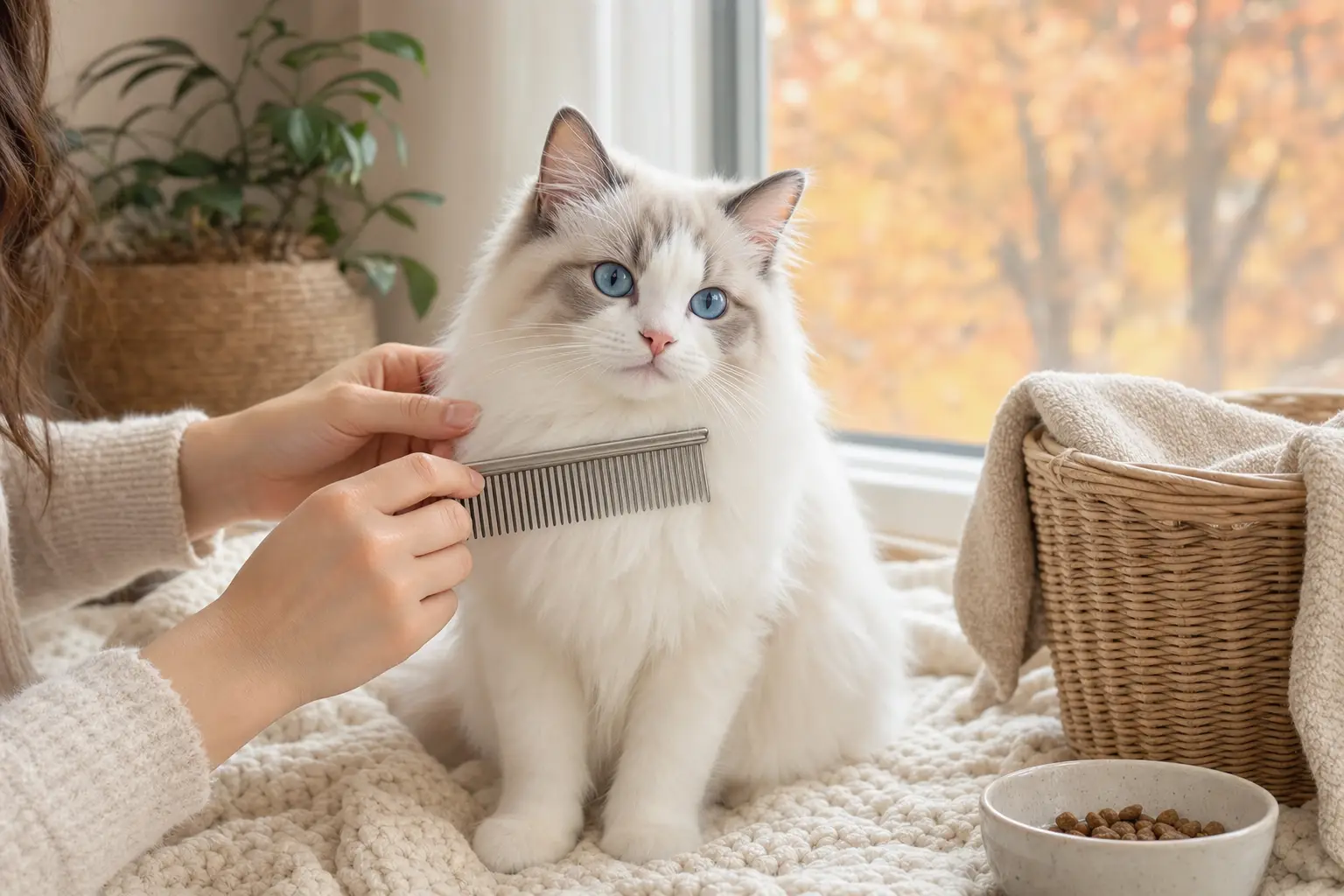
Autumn is a lovely time to build this habit. A soft blanket, a warm room without drafts, and a few favorite treats can make grooming feel predictable. The goal is not to remove every loose hair at once. It is to keep the ruff comfortable, catch small tangles early, and teach your kitten that gentle handling is safe.
Why the chest ruff deserves extra care
Ragdolls have a semi-long, silky coat and a fuller area of fur around the neck and chest. Coat texture varies from kitten to kitten, but the ruff can collect food, water, and loose hair. It also moves against collars and the front legs, which can encourage small knots.
The skin beneath the ruff is easy to miss during a quick brush. A kitten may react strongly if a comb catches a mat close to the skin, if dried food is pulling on the fur, or if the area is already irritated. That reaction is useful information, not bad behavior.
For general feline grooming guidance, the Cornell Feline Health Center’s grooming guide and International Cat Care’s advice on grooming are helpful references.
Create a cozy autumn grooming spot
A sensitive kitten usually does best when the surroundings are quiet and the routine is familiar. You do not need elaborate seasonal décor. Set up a small grooming station that can be used in the same place each time.
- Place a washable, non-slip towel or fleece blanket on a stable surface.
- Keep a wide-toothed metal comb, a soft brush, and treats within reach before bringing in your kitten.
- Choose a comfortably warm room with natural light and no cold draft.
- Keep the session away from noisy appliances, visitors, and other pets.
- Give your kitten an easy way to step away rather than holding them in place.
Choose a time when your kitten is alert but not in the middle of energetic play. After a short play session or a nap can work well. Avoid starting immediately after a large meal if your kitten dislikes being handled.
Autumn scents need some care. Skip essential-oil diffusers, strongly scented sprays, and candles near the grooming area. The ASPCA’s guidance on essential oils and pets explains why concentrated oils can create risks. A plain blanket and quiet background are safer ways to make the space feel seasonal.
How to brush a sensitive Ragdoll kitten’s chest ruff
Think of the first sessions as handling practice, not full grooming. If your kitten accepts only one or two strokes, end there and try again later.
1. Start with a calm introduction
Let your kitten sniff the comb. Offer a small treat, then gently stroke the shoulder or side with your hand. Do not begin under the chin, where many kittens feel particularly vulnerable. Watch the body rather than waiting for a hiss. A tense posture, flattened or sideways ears, tail thumping, repeated head turns, skin twitching, or an attempt to leave means the session is becoming too much.
2. Check the ruff with your fingers
Use your fingertips to separate the fur and locate any knots. Fingers are less likely than a comb to pull suddenly, and they help you notice dampness, crusts, swelling, or a tender spot. If the fur is wet from drinking, gently blot it with a plain, soft cloth and let it dry before attempting to comb through it.
3. Support the fur, not the neck
Let your kitten sit or stand in a natural position. If they calmly lift their chin, you can work on the front of the ruff, but never force the head upward or hold the neck tightly. Use one hand to support a small section of fur near—but not pressing against—the skin. This reduces the pull when the comb moves through the ends.
4. Work from the tips inward
Separate the ruff into sections about the width of two fingers. Begin at the loose ends and make one short stroke outward and downward. If that passes easily, repeat slightly closer to the skin. This “ends first” approach prevents a small knot from tightening into a larger, painful pull.
Keep the comb parallel to the skin rather than stabbing downward. Use very light pressure around the throat and under the chin. Never drag through a snag. Pause, loosen the surrounding fur with your fingers, and try a smaller section.
5. Reward cooperation immediately
Offer a tiny, age-appropriate cat treat after a calm stroke. You can also use a favorite toy or gentle verbal praise. Rewarding the pause, stillness, or decision to return to the blanket teaches your kitten that grooming has a clear and pleasant end.
6. Stop while the session is still successful
For a nervous kitten, one to three minutes may be enough. Finish after a calm moment rather than waiting for resistance. Over several days, gradually add a few strokes to the chest, then include the sides of the ruff. A short routine repeated often is easier to tolerate than an occasional marathon brushing session.
Choosing tools for a delicate chest ruff
| Tool | Best use | What to watch for |
|---|---|---|
| Fingertips | Finding small knots and checking the skin | Do not pinch or pull individual hairs |
| Wide-toothed metal comb | Gentle work through the longer ruff | Use light pressure and begin at the ends |
| Soft cat brush | Removing loose surface hair after detangling | It may glide over a mat without removing it |
| Small slicker brush | Finishing the coat when your kitten is comfortable | Use a light touch; firm pins can scratch skin |
A narrow comb can be useful once your kitten is relaxed, but it is not usually the best first tool for a sensitive chest. Avoid using human hairbrushes, human detangling products, or scented grooming sprays unless your veterinarian specifically recommends a cat-safe product.
Preventing and handling ruff mats
Check the chest with your fingers once a day, especially if your kitten has a wet chin after drinking or tends to get food in the fur. Regular checks do not need to become full grooming sessions. They simply help you find a developing knot before it tightens.
For a very small, loose tangle, separate the surrounding fur, hold the hair close to the skin to reduce tugging, and gently loosen the knot from its outer edge. Stop if your kitten reacts or if the tangle does not give way quickly.
Do not cut a mat out with household scissors. Cat skin can be pulled up into a mat, making it surprisingly easy to cut. Do not repeatedly rake a tight mat with a de-matting tool either. A professional cat groomer experienced with cats or a veterinary team can remove difficult mats more safely, particularly when the kitten is distressed.
Autumn details that make grooming safer
- Keep the blanket washable. Cozy fleece can trap loose hair, so wash it regularly and avoid loose threads.
- Check collars carefully. If your kitten wears a breakaway collar, inspect the fur underneath for dampness, rubbing, or tangles. Kittens grow quickly, so the fit needs frequent checks.
- Use simple seasonal décor. Keep ribbons, twine, artificial leaves, floral wire, and small decorations out of reach because curious kittens may chew or swallow them.
- Avoid direct heat. A warm room is helpful, but do not place a kitten beside a hot radiator or on an unattended heating pad.
- Adapt to shedding. If you notice more loose hair as the season changes, add a brief finger check rather than suddenly increasing brushing pressure or duration.
When sensitivity needs a veterinary check
Contact your veterinarian if your kitten suddenly becomes painful to touch, consistently cries during gentle grooming, or will not allow you near an area that was previously comfortable. Also seek advice for redness, swelling, scabs, discharge, a bad odor, bald patches, persistent licking, or a mat stuck tightly to the skin.
These signs can have several causes, including skin irritation, parasites, injury, or painful matting. Brushing cannot identify or treat the underlying problem. A veterinary examination is the right next step, especially for a young kitten.
FAQ
How often should I brush a Ragdoll kitten’s chest?
Start with a brief check each day and a few gentle combing sessions each week. Adjust according to your kitten’s coat, tolerance, and tendency to tangle. Some kittens need only light maintenance; others benefit from more frequent short sessions.
What if my kitten refuses to sit still?
Do not force a full grooming session. Touch the shoulder, show the comb, give a treat, and stop. Repeat this calmly until your kitten accepts one stroke, then build gradually. A kitten that can leave and return often learns faster than one held through distress.
Can I use scissors to remove one small mat?
It is safest not to use scissors near the skin. Try loosening a tiny, loose knot with your fingers, but have a professional groomer or veterinarian handle anything tight, extensive, or painful.
With a quiet setup, the right tool, and realistic expectations, brushing a Ragdoll kitten’s chest ruff can become one of the gentlest parts of an autumn routine. For more Ragdoll kitten care guidance, explore CTkittens.com.

Rachel Cohen is a journalist and producer with a passion for audio storytelling, health and science reporting, and feline companions.
A graduate of Middlebury College, Rachel spends her weekends exploring the mountains and when she isn’t outdoors or chasing a story, she can usually be found hanging out with her cats.