
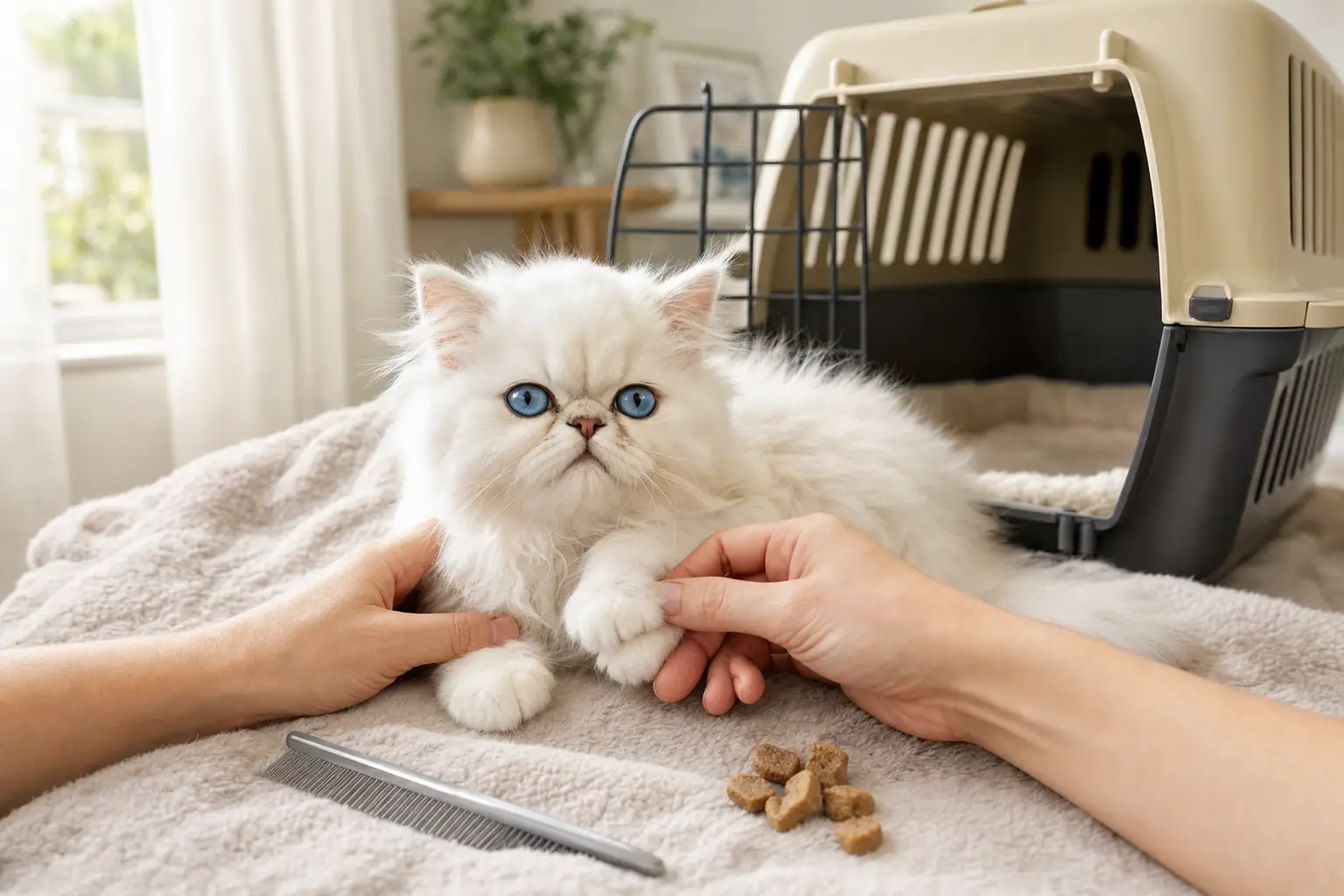
Persian Kittens: Gentle Handling Before the First Vet Visit
For most homes, the best approach is a two-part routine: practice a few calm touches during ordinary home life, then rehearse the carrier and travel separately. This is more effective than trying to stage a complete veterinary examination at once.
Good Persian kitten handling training should help your kitten feel safe, give you a practical grooming routine, and make the first appointment more predictable. It should never depend on pinning, chasing, scruffing, or forcing a frightened kitten to tolerate more.
Which handling approach fits your home?
The right method depends less on the breed label and more on three things: your kitten’s current confidence, the person doing the practice, and the part of the visit most likely to cause difficulty.
Use the comparison below as a starting point. You can change approaches as your kitten learns.
| Home situation | Best starting approach | What to emphasize |
|---|---|---|
| Confident, food-motivated kitten | Short everyday handling sessions | Paws, ears, face, coat, gentle lifting, and brief restraint followed by a reward |
| Shy, easily startled, or newly adopted kitten | Choice-based practice | Let the kitten approach, begin with one-second touches, and stop while the kitten is still relaxed |
| Busy household or several caregivers | One consistent handler and a written routine | Use the same words, location, rewards, and progression so practice stays predictable |
| Kitten already avoids the carrier | Carrier-first preparation | Make the carrier a familiar resting place before combining it with handling or travel |
If you are unsure, start with the gentlest option. A kitten who accepts one calm touch today may accept two tomorrow. A kitten pushed into a long, upsetting session may learn that hands, towels, or the carrier predict loss of control.
What your Persian kitten actually needs to rehearse
The goal is not to imitate every step a veterinarian might perform. Your kitten needs to learn that brief, gentle contact with different body areas is safe and that handling ends before it becomes overwhelming.
Over several sessions, calmly introduce:
- Touching and lightly lifting each paw
- Running your fingers through the coat and using a soft, suitable comb
- Looking at the outer part of the ears without inserting anything
- Briefly touching the cheeks and face
- Lifting the lips for a quick look at the front teeth, only if your kitten remains comfortable
- Placing one hand around the chest and another under the hindquarters for a momentary lift
- Resting a towel loosely over the body
- Standing on a stable surface for a few seconds, with your hand nearby for support
These are preparation exercises, not permission to clean ears, cut nails, open the mouth widely, or inspect the eyes forcefully. Leave medical procedures to the veterinary team unless your veterinarian has shown you a specific home-care technique.
A gentle five-step handling routine
1. Choose the right moment
Practice when your kitten is awake and calm, not during a burst of play, immediately after a stressful event, or when you are rushing. Sit on the floor or beside a secure surface. Keep a small reward nearby, but do not use food to lure a kitten into a situation it is actively trying to escape.
2. Start with a familiar touch
Begin with a stroke your kitten already enjoys, such as a touch along the shoulder or back. After one or two seconds, remove your hand and offer a reward or quiet praise. The release matters: it teaches your kitten that cooperation makes the handling stop.
3. Add one new body area
On a later repetition, touch one paw, ear, or cheek for only a second. Do not stack several new challenges in the same session. If the kitten stays loose and interested, repeat once or twice. If not, return to an easier touch and finish there.
4. Gradually add movement
Once a touch is easy, briefly cup the paw, lift the lip slightly, or place your hand beneath the body. Keep the movement slow and support the kitten’s weight. A short lift is enough; there is no need to hold a kitten suspended for practice.
5. End on success
Sessions can be less than a minute. Several tiny sessions spread across the week are usually easier for a kitten than one ambitious rehearsal. End after a relaxed response, then return to normal activities.
Read your kitten’s signals before continuing
Relaxed body language is your green light. Your kitten may accept a reward, keep a loose posture, explore, or return to you after a brief release.
Slow down when you see a crouched body, turning away, repeated lip licking, tense muscles, flattened or sideways ears, tail flicking, or sudden refusal of food. These signs do not mean your kitten is being difficult; they mean the exercise has become too difficult, too long, or too fast.
Stop and give space after hissing, swatting, frantic escape attempts, or defensive biting. Do not punish these responses. Return at another time to an easier step. If your kitten shows breathing difficulty, collapses, or remains severely distressed, seek veterinary advice promptly. Persian cats can have individual facial and airway differences, so breathing concerns should not be treated as a training problem.
Make grooming part of the plan
Persian coats often need regular grooming, and a kitten who learns that combs predict calm rewards will have an easier routine later. Begin with the tool resting nearby. Reward curiosity, then touch the coat with the tool for one or two strokes and stop.
Work in small sections and pay attention to skin tension. Never pull through a mat. Mats can be painful, and severe or widespread matting may require professional help. Avoid turning the first grooming session into a full-body project; your immediate goal is cooperation, not a perfect finish.
Face handling deserves extra care. Keep fingers away from the eyes, nostrils, and any irritated skin. If you notice discharge, redness, squinting, sores, or discomfort, arrange veterinary advice instead of trying to solve the problem through more practice.
Rehearse the carrier separately
Handling practice cannot compensate for a carrier that only appears on appointment day. Leave the carrier open in a quiet area with familiar bedding. Let your kitten investigate it without being shut inside.
- Reward looking at or approaching the carrier.
- Place rewards near the entrance, then farther inside when your kitten is ready.
- Allow relaxed time inside with the door open.
- Move the door briefly, then open it before your kitten becomes worried.
- Progress to carrying the closed carrier a short distance.
- If needed, practice a brief, quiet car ride before the appointment.
A removable top can make some veterinary examinations easier because the kitten may be able to stay in the familiar bottom half. Ask your clinic what carrier style and setup they prefer. A towel over part of the carrier may reduce visual stimulation during travel, but never block ventilation.
What to do on the first appointment day
Ask the clinic whether it has a quieter time for feline appointments and what records to bring. Take vaccination, deworming, adoption, and previous medical information if available. Bring a familiar towel and a few rewards your kitten already tolerates.
Do not fast a kitten unless the veterinary team specifically tells you to. Ask before giving any calming product or medication, including something marketed as natural. The veterinarian may recommend a pre-visit plan if your kitten becomes highly anxious, but medication should be selected and dosed by that professional.
Tell the team what handling your kitten has practiced and where the kitten struggled. That information helps them adjust the pace. A good first visit does not have to include every possible procedure if delaying a non-urgent step would prevent a major fear response. The clinic will decide what must be done that day.
Common mistakes to avoid
- Practicing only when a visit is imminent: Familiarity takes repetition, so begin well before the appointment.
- Holding on until the kitten stops struggling: This can make restraint more frightening. Release earlier and make the next attempt easier.
- Using scruffing or forced submission: These methods do not teach calm cooperation and can increase fear.
- Combining every challenge: A comb, towel, carrier, nail trim, and mouth check in one session is too much for many kittens.
- Ignoring the carrier: Travel is part of the appointment experience, not a separate detail.
- Assuming all Persian kittens behave alike: Breed-related grooming needs may be similar, but confidence, sensitivity, and learning speed vary considerably.
Frequently asked questions
How long should each handling session last?
Start with a few seconds and stop while your kitten is still comfortable. Some sessions may last under a minute; the quality of the response matters more than duration.
Should I practice holding my kitten down like a veterinarian might?
No. Practice gentle contact, brief support, and predictable release instead. Veterinary staff are trained to adapt restraint to the examination and the individual cat.
What if my kitten refuses treats during practice?
Move to a quieter setting, reduce the difficulty, or try a reward your kitten values. Refusing food can also signal that the session is too stressful. Give your kitten a break rather than escalating the exercise.
The simplest plan to follow
For most families, use one or two brief handling moments each day, add one new body area at a time, and practice the carrier independently. Reward calm cooperation, release before fear builds, and ask the veterinary team for help if your kitten cannot cope with basic preparation.
For additional cat-care guidance and kitten resources, explore CTkittens.com.
Trusted guidance
For broader information about cat-friendly care and preparing for veterinary visits, consult Cat Friendly Homes from the American Association of Feline Practitioners and the AVMA pet-owner resources. Your own veterinarian should guide decisions about examinations, grooming problems, breathing concerns, medication, and vaccination.

Rachel Cohen is a journalist and producer with a passion for audio storytelling, health and science reporting, and feline companions.
A graduate of Middlebury College, Rachel spends her weekends exploring the mountains and when she isn’t outdoors or chasing a story, she can usually be found hanging out with her cats.
I’m gonna start leaving the carrier out like a lil cat cave, cause only bringing it out on vet day probably explains why my kitten nopes out instantly.