
Why Your Ragdoll Kitten Looks Different Beside Another Cat
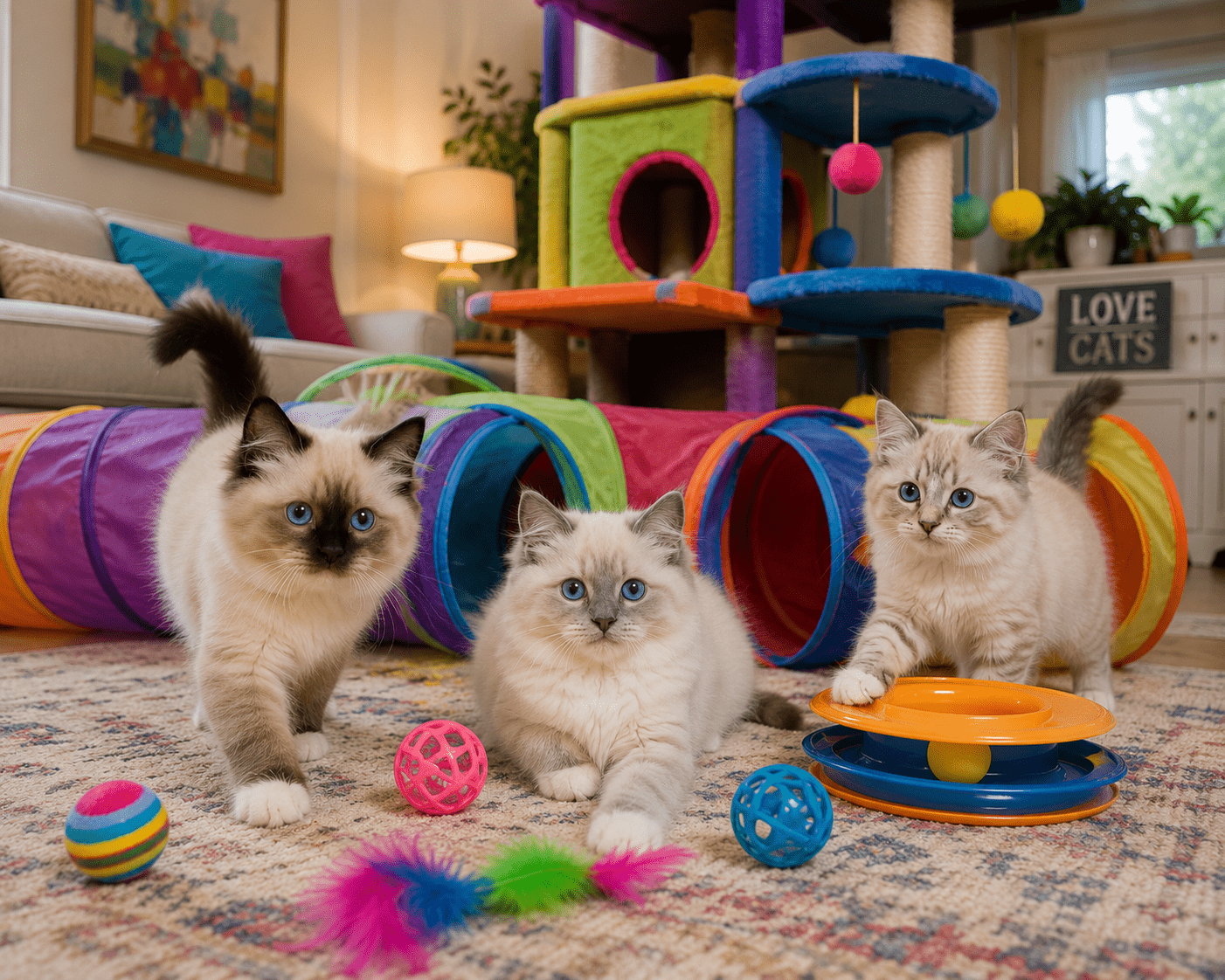
Have you noticed that your Ragdoll kitten seems to change appearance when sitting beside another cat? In one photograph, the kitten may look almost white. In another, the ears and face appear much darker, the coat seems fuller, or the markings suddenly look more defined.
Usually, several ordinary visual details are working together. A Ragdoll kitten’s coat color develops gradually, while lighting, background, posture, and the other cat’s coloring can change how your eyes interpret it. In a household with multiple cats, comparison is unavoidable, but it can also teach you to observe your Ragdoll more accurately.
These seven observations are not a beauty checklist. They are clues for understanding why the same kitten can look surprisingly different from one moment to the next.
Seven overlooked reasons the same kitten can look different
1. The other cat changes your visual reference
Human vision judges color in relation to nearby colors. A pale Ragdoll sitting beside a black or seal-colored cat may look especially light, while the same kitten beside a white cat may appear more strongly shaded. The kitten has not necessarily changed; the neighboring coat has changed the reference point your eyes are using.
This effect is particularly noticeable in Ragdolls because their pointed coloring creates a natural contrast between a lighter body and darker areas on the face, ears, legs, and tail. A second cat can either emphasize or soften that contrast.
2. Point color develops over time
Ragdoll kittens are born with very pale coloring, and their point markings become clearer as they mature. The exact pace varies among kittens, but a young kitten’s face and ears may look noticeably more defined after several weeks or months. In a multi-cat home, the change is easy to spot because you see the kitten every day alongside a cat whose adult coloring is already established.
This is one reason old photographs can be misleading. A kitten may appear to have changed color suddenly when the real change happened gradually between pictures. For a more useful comparison, look at photos taken in similar lighting and notice the general direction of development rather than expecting each image to match.
3. Body temperature influences pointed coloring
Ragdoll coloring is associated with temperature-sensitive pigment production. The warmer central areas of the body tend to remain lighter, while cooler extremities often show deeper color. This helps explain why the ears, mask, paws, and tail can look more pronounced than the torso.
The important everyday point is that this is not a room-by-room color switch. Your kitten is not turning darker simply because it walked across the floor. However, over longer periods, age and temperature patterns can contribute to changes in how the points look. The other cat may make those changes easier to notice by providing a steady visual comparison.
4. Coat direction changes the silhouette
Many Ragdolls have a soft, semi-long coat that can lie close to the body in one moment and catch the light in a fluffier shape in the next. When your kitten is stretched out beside another cat, the coat may look sleek. When the kitten sits upright and looks toward the other cat, the neck hair, chest fur, and side coat can create a fuller outline.
This does not automatically indicate fear or excitement. A change in posture is enough to alter the visible shape of the coat. Watch how the fur lies when the kitten is calmly observing, walking, resting, or greeting the other cat. You may find that what looked like a change in coat density was actually a change in body position.
5. Background colors affect the apparent shade
Floors, blankets, sofas, and walls all influence how a coat appears. A blue-gray rug can make blue-toned points seem cooler, while a warm wooden floor may make cream or chocolate tones appear richer. Bright daylight can reveal subtle shading that a warm lamp conceals.
In a home with another cat, the background may change whenever the cats move together. A Ragdoll lying beside a dark cat on a pale rug will photograph differently from the same pair on a charcoal sofa. If you want to follow your Ragdoll kitten coat color over time, take occasional pictures from the same angle, in the same part of the room, without using a filter.
6. Kitten fluff can disguise the emerging pattern
Young Ragdolls often have a softer, less settled coat than they will carry later. Fine kitten fluff can blur the edges of points, especially around the cheeks and neck. As the coat develops, the color may look cleaner and the texture more organized, even when the basic pattern was visible from the beginning.
The comparison cat can make this especially apparent. An adult cat’s coat usually has a more predictable lay, while a kitten’s fur may stick out in different directions after sleep, play, or close contact. Instead of asking whether your kitten looks exactly like an adult Ragdoll, notice which features are becoming clearer with maturity.
7. Social moments change what you notice first
When two cats are together, your attention often moves to the most active feature: a raised tail, bright eyes, an alert head, or a suddenly visible ruff. The kitten may look more dramatic simply because its posture presents the markings differently. A side profile can emphasize the mask; a lowered head can make the ears look darker; a relaxed sprawl can make the body seem almost colorless.
These small shifts are useful observations in their own right. Rather than immediately interpreting every visual change as a personality signal, first ask what angle, distance, and posture you are seeing. Then consider the kitten’s behavior and the surrounding situation.
How to compare without turning one cat into a standard
A second cat can help you notice changes, but it should not become a measuring stick. Cats develop at different rates, and even Ragdolls with similar colors can differ in point depth, facial markings, coat texture, and pattern.
When you are curious about a visual difference, pause and note:
- Whether both cats are in the same light and on the same surface.
- Whether your Ragdoll is standing, stretching, sleeping, or sitting upright.
- Whether the apparent change is in the whole coat or only in the face, ears, paws, or tail.
- Whether the other cat’s coloring is creating a stronger contrast.
- Whether the kitten is changing gradually as it grows rather than within a single afternoon.
This quiet observation is often more informative than repeatedly moving the cats into brighter light or handling the coat to inspect it. Let the kitten remain comfortable, and look for patterns during normal household moments.
Persian vs. Ragdoll: a visual comparison in a multi-cat home
Persian and Ragdoll kittens can both look different beside another cat, but the reasons are not identical. Persians are often recognized by a long, dense-looking coat and a broad visual outline, so background color and coat direction can strongly affect how large or pale they appear. Their facial structure also changes the way light falls across the face.
Ragdolls are known for semi-long coats and pointed patterns, so contrast between the body and extremities is usually the more noticeable feature. A Ragdoll’s developing points may become clearer with age, while a Persian’s visual change is more likely to be noticed through coat volume, texture, and silhouette. Individual variation matters in both breeds, especially when a kitten is growing.
Let the second cat help you see the first one more clearly
Living with two cats gives you an informal lesson in visual perception. Your Ragdoll kitten may not be changing as dramatically as it appears; your eyes are responding to a new companion, a different surface, a different light source, or a new posture.
Once you recognize those influences, you can appreciate gradual coat development without overinterpreting every photograph. The most interesting details are often the quiet ones: a point becoming easier to see, a ruff catching afternoon light, or a kitten’s coat looking entirely different because it chose to sit beside a different-colored friend.
For more thoughtful guidance on life with Persian and Ragdoll kittens, explore the breed articles and kitten resources at CTkittens.com.

Rachel Cohen is a journalist and producer with a passion for audio storytelling, health and science reporting, and feline companions.
A graduate of Middlebury College, Rachel spends her weekends exploring the mountains and when she isn’t outdoors or chasing a story, she can usually be found hanging out with her cats.