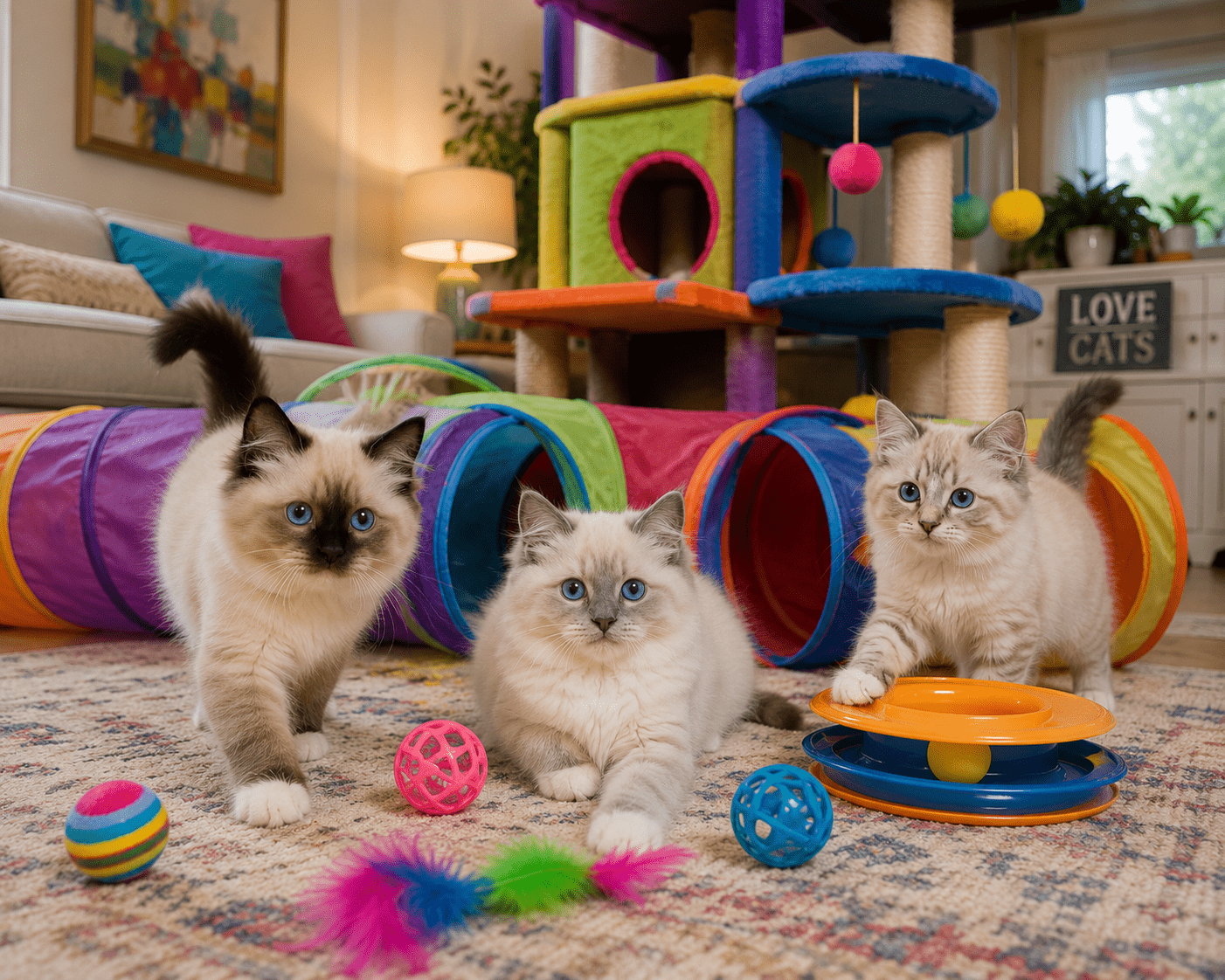

What a Ragdoll Kitten Says Without a Meow
Ragdoll kitten behavior is easy to notice when it involves a dramatic flop or a soft vocalization. The quieter signals are easier to miss: a kitten stopping at a doorway, turning its head to check where you are, or choosing the chair beside you instead of your lap.
Many Ragdolls are gently social without being constantly demanding. Their communication may unfold through distance and timing as much as through sound. On a spring day, when brighter mornings and changing household routines subtly alter the indoor atmosphere, watching those details can reveal how your particular kitten prefers to connect.
Morning: the greeting may be a change in distance
When the household begins moving, a Ragdoll kitten may appear nearby without making an obvious request. It might follow you for part of the way, sit where it can see you, or walk ahead and then pause. These small movements can be more informative than whether the kitten climbs onto you.
One useful observation is what happens when you stop. If your kitten settles a short distance away with a loose body and relaxed ears, it may be satisfied simply to share the space. If it closes the gap, looks toward your hands, or lightly nudges against a leg, it may be asking for more direct interaction. Neither response is automatically more affectionate.
Ragdolls are often described as people-oriented, but that does not mean every kitten wants to be carried or held first thing in the morning. A quiet greeting can still be a warm one. Letting the kitten decide whether to come closer gives you better information than immediately scooping it up.
Late morning: notice the pauses between encounters
As the day becomes active, communication often happens in brief intervals. Your kitten may trail behind you, stop at a threshold, and look back before deciding whether to continue. That look-back can be a simple check on your location, an invitation to follow, or just curiosity. The important clue is whether the sequence repeats in a relaxed way.
Some Ragdoll kittens use soft chirps or trills instead of frequent meows. Others are nearly silent but orient their whole body toward a person when spoken to. Watch for the combination of sound and posture. A kitten that gives a quiet trill while keeping its tail and body loose is communicating differently from one that vocalizes while backing away or flattening its ears.
Another overlooked detail is the response after you answer. Does the kitten remain nearby, move closer, or resume what it was doing? A short exchange followed by comfortable independence may be normal social contact, not a failed attempt to get attention.
Afternoon: spring light can reveal a kitten’s preferred way to be close
Spring brings earlier daylight into many homes, and that can make a kitten’s social choices easier to see. A Ragdoll may rest in a bright patch across the room while keeping its face turned toward the household. It may choose a cool floor near your desk, a rug beside the sofa, or a low perch with a clear view of your movements.
Choosing nearby space instead of physical contact is one of the most misunderstood parts of Ragdoll kitten behavior. A kitten that repeatedly settles near you may be expressing trust in its own preferred way. Its body might point toward the room while its head occasionally turns toward you. That partial attention is not necessarily distraction; it can mean the kitten wants both security and freedom to observe.
Look closely at transitions, too. Some kittens approach directly. Others make a curved path, pause near a piece of furniture, and then arrive at your side. The indirect route may reflect temperament, a desire to inspect the surroundings, or a preference for gradual interaction. It is more useful to notice the pattern than to assign one fixed meaning.
Evening: a retreat can still be part of a conversation
After a busier stretch of the day, your kitten may become more expressive through coming and going. It might sit beside you for several minutes, leave when touched, and later return to the same area. For a Ragdoll, especially one that enjoys company but dislikes being restrained, this can be a way of maintaining connection while controlling the level of contact.
Try pausing when the kitten moves away rather than following immediately. If it glances back, slows down, or settles where it can still see you, the retreat may simply be a request for space. If it disappears and remains settled elsewhere, accept that choice. Respecting the pause often makes future approaches more confident.
Evening is also a good time to compare your kitten’s behavior with its behavior earlier in the day. Is it more talkative after the home quiets? Does it prefer a person who is sitting still? Does it approach hands more readily than a moving body? These answers are individual clues, not rules for the entire breed.
Why two Ragdoll kittens may communicate so differently
Breed tendencies provide a starting point, but kittens within the same litter can have noticeably different social styles. One may be an enthusiastic follower that moves from room to room with a person. Another may observe from a comfortable distance and join only when the household settles. A third may seek touch briefly, then return to independent exploration.
Rather than ranking these styles as friendly or unfriendly, look for consistency and comfort. A reserved kitten may show strong attachment through reliable proximity. A highly demonstrative kitten may still need clear limits around handling. The best response is to learn the individual pattern and answer it calmly.
Small details worth noticing
- Where the greeting happens: A kitten that meets you at a doorway may be more interested in shared movement than in being picked up.
- What happens when you stop: Closing the distance suggests a different preference from settling nearby and watching.
- How the body stays oriented: A relaxed body angled toward you can show social interest even without eye contact or vocalizing.
- Whether the kitten returns voluntarily: Coming back after a break is often more meaningful than tolerating prolonged attention.
- Which person receives the approach: Some kittens choose the quietest or most predictable household member, not necessarily the person offering the most attention.
Persian versus Ragdoll communication in everyday life
In this specific area, Persian and Ragdoll kittens can both be subtle, but their signals may look different. A Persian kitten may communicate through stillness, a focused gaze, or choosing a particular nearby resting place and expecting you to notice. Its interaction can be compact and place-based. Many Ragdoll kittens, by contrast, are more likely to carry communication through movement: following partway, pausing to look back, or repositioning themselves near a person. Ragdolls are often relaxed in social contact, while Persian kittens may be more selective about when and how touch begins. These are tendencies, not guarantees. A quiet Persian can be very outgoing, and a Ragdoll can prefer observation to following. Individual history and temperament matter more than the breed label alone.
Let observation guide your response
The most useful way to understand a Ragdoll kitten is to notice what it chooses when no one is forcing the interaction. Pause before reaching, answer soft sounds, and allow the kitten to return on its own terms. Over several spring days, those repeated choices will tell you whether your companion prefers conversation through movement, closeness, touch, or peaceful shared space.
For more thoughtful guidance on living with Ragdoll and Persian kittens, explore the breed resources and kitten articles at CTkittens.com.

Rachel Cohen is a journalist and producer with a passion for audio storytelling, health and science reporting, and feline companions.
A graduate of Middlebury College, Rachel spends her weekends exploring the mountains and when she isn’t outdoors or chasing a story, she can usually be found hanging out with her cats.