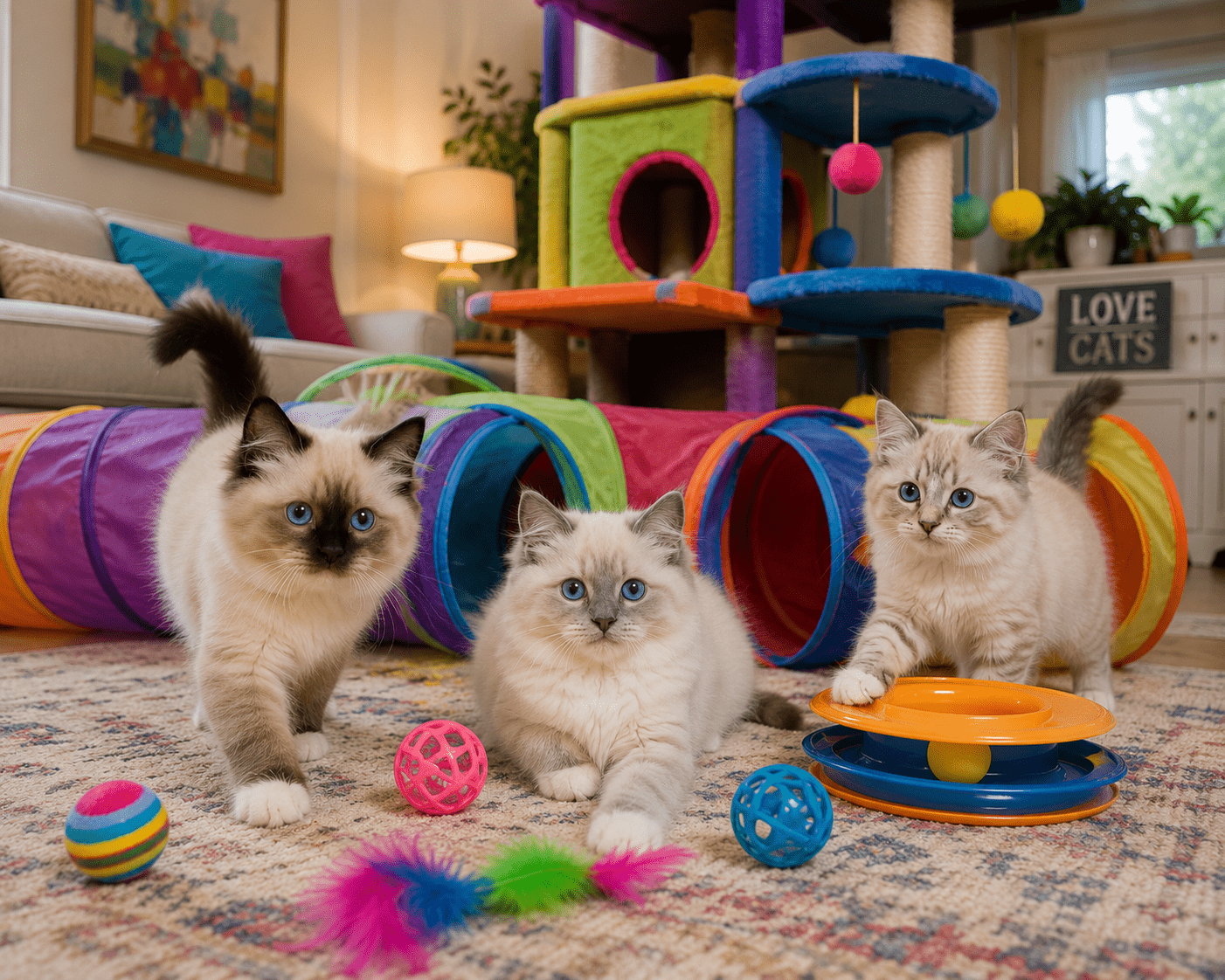

Why a Ragdoll Kitten Acts Differently After Settling In
When a Ragdoll kitten first arrives in a home with another cat, every behavior can look significant. The kitten may trail behind you, sleep in an obvious place, or watch the resident cat from a careful distance. Then, after a few weeks, the pattern changes. The kitten begins spending time in another room, greeting you less dramatically, or choosing a resting place near—but not directly beside—the other cat.
This shift can worry prospective owners who expect the famously people-oriented Ragdoll personality to remain constantly visible. In many cases, however, the change is not a loss of affection. It is the quiet result of a kitten learning that the home, its people, and its feline housemate are predictable.
The overlooked change: confidence can look like distance
During the first days, a kitten has good reasons to stay close to a person. Your movements provide information. Your voice helps identify where safety is. Even your daily habits—making coffee, opening a door, or sitting down—become landmarks in an unfamiliar environment.
As a Ragdoll kitten becomes familiar with the household, it no longer needs to monitor every detail from your side. Instead, it may investigate while you remain seated, nap in a room you have just left, or watch the resident cat without immediately copying its movements. To a human, this can look like reduced bonding. From the kitten’s point of view, it may mean the home has become understandable enough to explore independently.
Ragdolls are often described as gentle and socially engaged, but those qualities do not require constant physical contact. A kitten can be deeply interested in people while expressing that interest through proximity, observation, and predictable check-ins.
How another cat changes the settling-in process
A resident cat gives the newcomer a second source of information. The kitten watches where the other cat rests, which rooms it visits, how it responds to household sounds, and whether it approaches people during busy moments. This can speed up familiarity, but it can also make the kitten’s behavior less straightforward.
For example, a Ragdoll kitten may initially follow you everywhere because you are the safest reference point. Later, it may follow the resident cat instead. That does not necessarily mean the kitten prefers the other cat. It may simply be learning the household’s feline routines before deciding how closely to participate.
One useful detail is the difference between sharing space and sharing a resting surface. A kitten that settles several feet from the resident cat, chooses a nearby chair, or rests on the opposite side of the same room may be showing social comfort without wanting close contact. This is often a more meaningful sign than whether the two cats sleep pressed together.
Small behavior changes worth noticing
Rather than judging the relationship by cuddling alone, look for changes in how the kitten uses ordinary moments. These details are easy to overlook because they are quiet.
- Shorter greetings: The kitten may stop making a long approach and simply appear beside you, touch your ankle, or settle nearby. Familiarity can make greetings less ceremonial.
- More confident crossings: A kitten that once waited for the resident cat to leave may begin walking through the same room while the other cat is present.
- Selective imitation: The kitten may copy the older cat’s use of a scratching surface or favorite room but ignore its sleeping place. This suggests observation rather than blind dependence.
- Private recovery time: After play or a busy household moment, the kitten may retreat to a quiet corner for a short rest and return on its own.
- Delayed attention: Instead of responding immediately when you call, the kitten may finish watching the other cat or exploring a scent before coming over.
These behaviors are especially informative when they appear alongside relaxed body language, normal curiosity, and a willingness to rejoin the household. Individual kittens vary considerably, so the pattern over time matters more than one afternoon.
When affection becomes less obvious
Many people expect a Ragdoll kitten to demonstrate affection through being picked up or sitting on a lap. Some do. Others show attachment in less noticeable ways once they feel secure.
Your kitten might choose a place where it can see both you and the resident cat. It may turn its body toward you while resting, follow you only during certain parts of the day, or wait outside a room until you emerge. It might also bring its play into the same area where you are working without asking to be touched.
This is where observing rather than constantly intervening becomes valuable. If a kitten is repeatedly choosing the same room as you, that choice deserves attention even if it never climbs onto you. Social closeness is not always physical closeness.
There is also a practical implication for people deciding whether a Ragdoll fits a multi-cat lifestyle: an affectionate breed is not necessarily a breed that eliminates the need for feline introductions, separate resources, or personal space. A Ragdoll kitten may be socially adaptable, but it still needs time to form its own relationship with the household and its resident cat.
How to respond without interrupting progress
The best response to a settling kitten is usually consistency. Keep daily interactions available, but do not turn every quiet period into a test of affection. Sit in the room, speak gently, and allow the kitten to choose whether to approach. If it prefers to watch from a nearby surface, that is still useful information.
In a home with another cat, preserve options rather than forcing togetherness. Make sure each cat can move away from the other, rest undisturbed, and reach people without having to pass through a narrow confrontation point. Separate resting places are not evidence of failure; they can help peaceful coexistence develop.
It is also helpful to notice the kitten’s preferred timing. Some Ragdolls become more interactive when the resident cat is resting. Others are more confident when a person is seated rather than walking around. A few quiet observations can reveal when your kitten feels most ready to connect.
Persian kittens and Ragdoll kittens in the same situation
Both Persian and Ragdoll kittens may become less visibly dependent after a home feels familiar, but the change can look different. A Ragdoll kitten may continue to track people through shared rooms or choose a nearby position while becoming less insistent about contact. Persian kittens are often more selective and observant in their social behavior, so a Persian may settle into a preferred quiet area and invite interaction on its own schedule. Coat type is not the deciding factor here; individual temperament and the resident cat’s behavior matter more. In a multi-cat home, a Ragdoll’s commonly people-oriented style may make its confidence easier to notice, while a Persian’s quieter adjustment may be mistaken for detachment. For either breed, calm co-presence, predictable routines, and the ability to retreat are more meaningful than constant cuddling.
A better way to read the new normal
When your Ragdoll kitten changes after settling in, compare its current behavior with its earlier behavior instead of comparing it with an idealized breed description. A kitten that once needed to follow you may now trust you enough to remain elsewhere. A kitten that once copied the resident cat may now make independent choices. A kitten that greets you quietly may be communicating that your return is no longer a major event—it is part of the dependable rhythm of home.
That quieter rhythm is often the most useful thing to learn about life with a Ragdoll. Affection may become less dramatic, but more deliberate. Watch where your kitten chooses to be, what it observes before approaching, and how it shares space with the resident cat. Those small details can tell you far more than a single lap-sitting session.
Explore more practical Persian and Ragdoll kitten insights at CTkittens.com.

Rachel Cohen is a journalist and producer with a passion for audio storytelling, health and science reporting, and feline companions.
A graduate of Middlebury College, Rachel spends her weekends exploring the mountains and when she isn’t outdoors or chasing a story, she can usually be found hanging out with her cats.