

Reading a Ragdoll Kitten’s Changing Coat in a Small Apartment
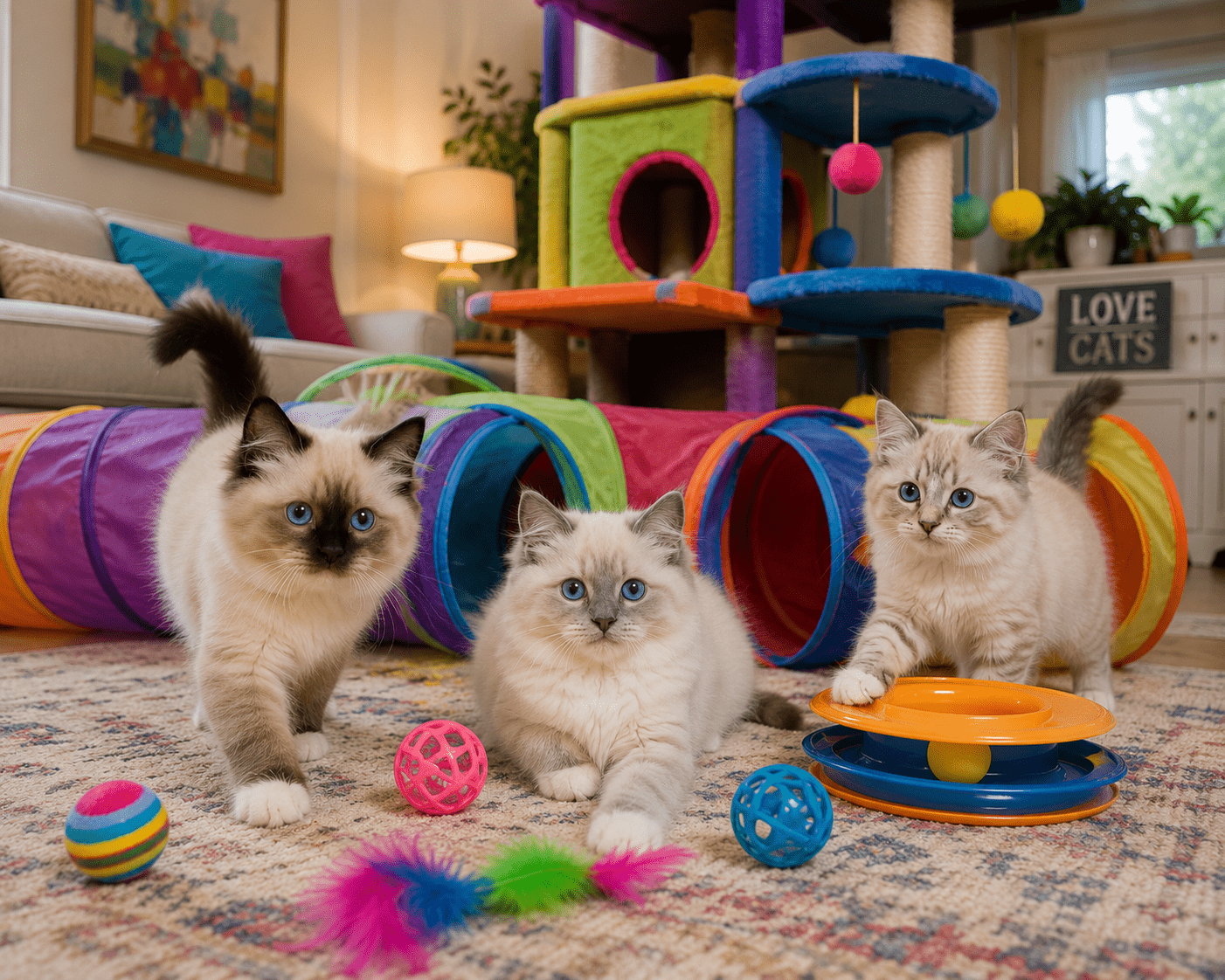
When people picture a Ragdoll kitten, they often imagine a finished cat: pale body, darkening points, bright blue eyes, and a flowing coat. In reality, the visual story develops gradually. A kitten may look almost uniformly cream in one photograph, then show much stronger contrast a few weeks later.
That changing appearance is especially easy to misread in a small apartment, where one room may have a bright window, warm lamps, dark furniture, and very different backgrounds. For someone considering the breed, understanding these small visual differences can lead to more realistic expectations than choosing a kitten from a single polished image.
Why a Ragdoll kitten coat can fool you at first
Ragdolls are color-pointed cats, meaning the ears, face, legs, paws, and tail are generally darker than the torso. Many kittens begin life with very pale coloring, and their points become more defined as they mature. The exact pace and intensity vary between kittens, patterns, and colors.
The coat itself is usually semi-long, soft, and silky rather than forming the dense, rounded outline associated with some other long-haired breeds. A kitten who looks sleek after a nap may appear much fluffier when the tail is raised or the neck fur catches the light. Neither view is necessarily more accurate; they simply show different parts of a developing coat.
Five details prospective owners often overlook
1. Early color is only the beginning
A pale kitten photograph does not always predict how much facial or leg contrast will eventually develop. The mask, ears, and tail often become easier to read over time, while the body can retain a lighter appearance. This is one reason not to compare a young Ragdoll kitten directly with an adult shown online.
Pattern matters as well. A mitted kitten, a bicolor kitten, and a traditional colorpoint can create very different visual impressions even when they share the same breed. If you are choosing between kittens, ask which pattern each kitten is expected to mature into rather than relying only on the current shade of the coat.
2. Apartment lighting can change your impression
The same Ragdoll kitten coat may look warmer under a yellow lamp and cooler beside a window. Dark furniture can make a pale body seem brighter, while a white wall may reduce the apparent contrast around the face. Phone cameras can also alter the balance between cream, gray, beige, and blue-toned areas.
When meeting a kitten, try to view the coat in indirect natural light as well as ordinary indoor lighting. You are not looking for a perfect photograph. You are learning whether the kitten’s coloring is consistently appealing to you in the kind of light your apartment actually has.
3. Soft does not always mean extremely fluffy
People sometimes expect every Ragdoll to look like a miniature cloud. Many have a plush, silky coat, but individual kittens differ in how closely the fur lies to the body. Humidity, static from indoor heating, recent sleep, and movement can all change the outline for a few minutes.
Watch the coat while the kitten walks, turns, and stretches instead of judging it only when the kitten is posed. You may notice that the neck fur separates into soft sections, the tail becomes more obviously feathered during movement, or the body coat lies flatter than expected. These details give a better sense of the adult texture than one still image.
4. Growing bodies can create an awkward visual stage
Ragdolls mature gradually, and a kitten’s body and coat do not always change at the same pace. During a lankier stage, the legs may look long, the chest may seem less full, and the coat may appear uneven simply because the kitten has outgrown one proportion before developing another.
This can be easy to mistake for a permanent lack of coat fullness. A more useful approach is to look at several images over time, preferably from the same breeder or household, and ask how the kitten’s appearance has changed. The goal is not to predict every strand of adult fur, which no photograph can do, but to recognize that temporary awkwardness is part of growing up.
5. A coat is easier to judge when the background is familiar
In a compact home, the kitten’s favorite chair, rug, or window seat may become the place where you notice the coat every day. That repeated view is more informative than a staged image with studio lighting. You might see that the pale body stands out strongly against a charcoal sofa, while the darker tail is easier to appreciate against a light cushion.
This matters when imagining daily life with the breed. A Ragdoll kitten can be visually striking without needing a large home, but semi-long fur will be noticeable on the surfaces the cat uses most. Consider whether you are comfortable with regular, gentle coat care and visible loose hairs on favorite furniture. Square footage is only part of the practical question; your tolerance for ongoing visual maintenance matters too.
What to ask before choosing a kitten
A responsible conversation should go beyond asking whether a kitten is going to be fluffy. These questions can help you understand the coat without treating a prediction as a guarantee:
- What color and pattern is the kitten expected to develop?
- How have the kitten’s points changed since birth or the earliest photographs?
- Can you see recent, unfiltered images in ordinary daylight?
- How does the kitten’s coat compare with the coats of its parents or older relatives?
- What kind of simple coat routine does the breeder recommend for this particular line?
It is also worth remembering that visual appeal and personality are separate decisions. A beautifully marked kitten is not automatically the best match for every household. Observe how the individual kitten responds to people, handling, and the pace of the home, then consider the coat as one part of the larger picture.
Persian kittens versus Ragdoll kittens: coat appearance in an apartment
Persian and Ragdoll kittens can both bring a long-haired look to a small apartment, but their visual signatures are different. A Persian coat is generally longer and fuller, creating a rounder, more cloudlike outline and strong framing around the face. Persian colors and patterns vary widely, so the coat is usually judged through density, length, and facial presentation rather than developing point contrast.
A Ragdoll kitten coat is typically semi-long and silky, with the face, ears, legs, and tail becoming more visually distinct against a lighter body. Ragdoll blue eyes and colorpoint patterns can make lighting especially important. If you prefer a coat whose appearance changes noticeably as the kitten matures, the Ragdoll may be more intriguing; if you prefer an immediately dramatic, full-coated silhouette, a Persian may appeal more. Individual variation remains important in both breeds.
The useful takeaway for a future Ragdoll owner
In a small apartment, you will see your kitten at close range and under ordinary household light far more often than in a professional photograph. Look for the way the coat moves, how the points are developing, and how the kitten’s changing proportions affect its outline. Those everyday observations create a more honest picture of life with a Ragdoll than a single image promising a finished appearance.
For more guidance on choosing and living with Persian and Ragdoll kittens, explore CTkittens.com.

Rachel Cohen is a journalist and producer with a passion for audio storytelling, health and science reporting, and feline companions.
A graduate of Middlebury College, Rachel spends her weekends exploring the mountains and when she isn’t outdoors or chasing a story, she can usually be found hanging out with her cats.

Even in a small apartment, I’d put temperament ahead of how the points photograph. The reminder to watch a kitten move and respond to handling is useful, since coat color can keep changing long after personality is apparent.
The suggestion to watch the kitten move rather than judge a posed photo is especially useful. A feathered tail and shifting neck fur probably reveal far more about the developing coat than a perfectly lit portrait.