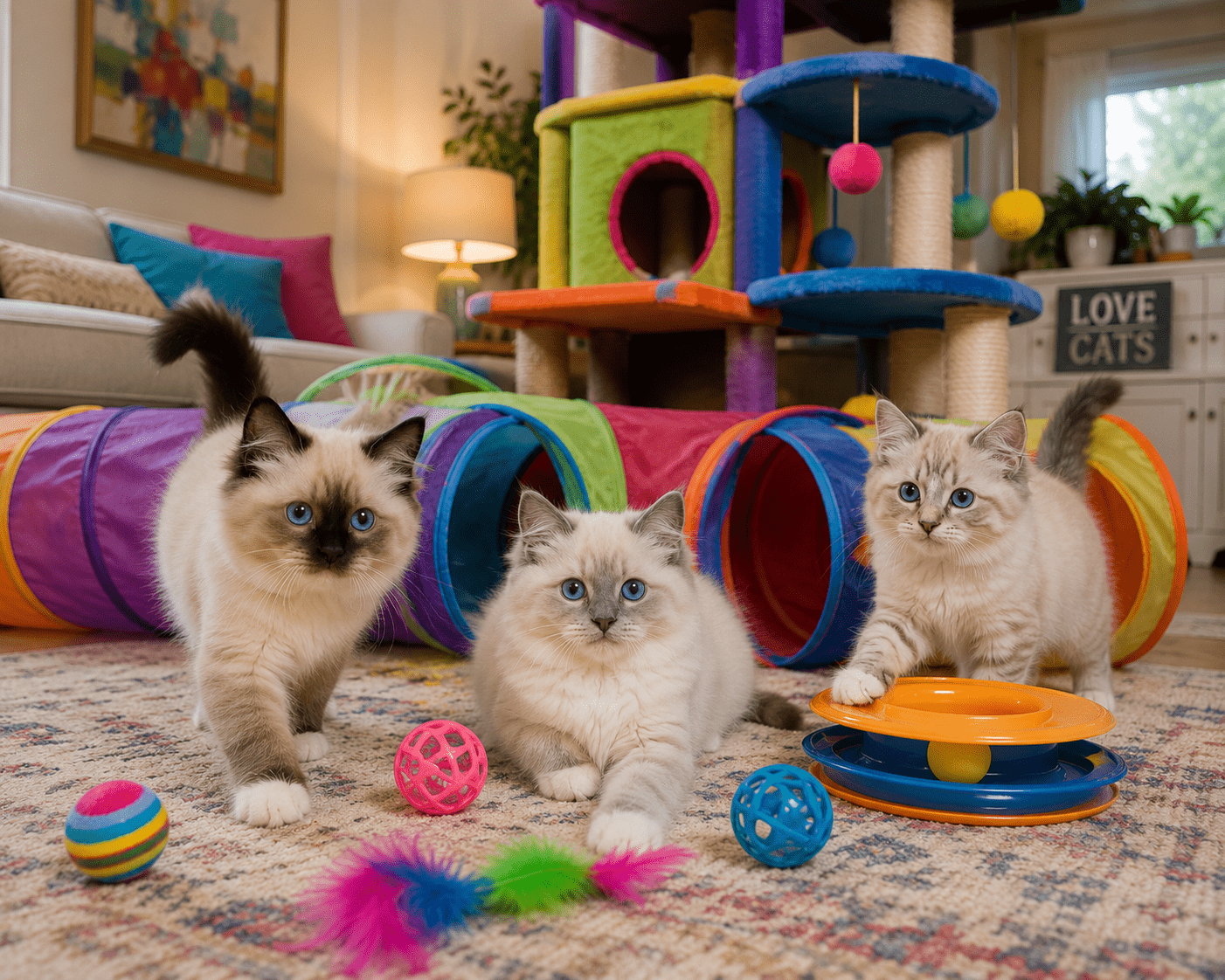

Why Ragdoll Kittens Read a Small Apartment Differently
To a person, a small apartment is measured in rooms, square footage, and storage. To a Ragdoll kitten, it is experienced as a series of openings, blocked views, stable surfaces, narrow passages, and places where a favorite person may appear next.
That difference matters because many Ragdolls are highly interested in household company. They may not need to be on your lap every minute, but they often like knowing where people are. In a compact home, furniture placement can determine whether your kitten feels socially included, comfortably observant, or repeatedly surprised by movement.
If you already live with a Ragdoll kitten in a small apartment, looking at the home from floor level can explain several curious habits without turning every behavior into a problem.
A room is not just a room to a kitten
Human beings tend to see a living room as one open area. A kitten sees a changing landscape. The side of a sofa may hide the center of the room. A coffee table can create a low tunnel. The space between a chair and a wall may be an inviting observation point or an awkward bottleneck, depending on how easily the kitten can turn around.
Ragdolls are often substantial, long-bodied cats, even when young, so broad and predictable routes can be especially appealing. This does not mean every Ragdoll avoids climbing or narrow spaces. Individual kittens vary widely. It does mean that a route that looks perfectly generous from above may feel restrictive when a kitten is carrying a playful burst of energy or trying to follow a person.
Watch where your kitten pauses rather than only where it eventually goes. A pause at the edge of a rug, beside a table leg, or before a half-open door is information about how the space is being read.
The overlooked importance of sightlines
One of the most useful details in a small apartment is what your kitten can see from a resting position. A low bed tucked behind a sofa may be comfortable, but if it removes all view of the room, a social Ragdoll may use it less than expected. The same bed turned slightly toward the doorway can become much more attractive without taking up additional floor space.
Many kittens choose “in-between” locations: beside the sofa rather than under it, at the end of a hallway rather than in a closed room, or beneath a table where they can see both the kitchen and the sitting area. These positions offer partial shelter while preserving awareness of household activity.
In a small apartment, a useful question is not simply, “Where can my kitten hide?” Ask instead, “Where can my kitten see without being in the middle of everything?” That distinction often reveals why a kitten ignores a secluded corner but settles near a doorway or the edge of your work area.
Why social access can matter more than extra space
A larger home is not automatically more interesting or comfortable. For some Ragdolls, the key resource is not distance from people but reliable access to them. If closing a door removes the only view of the household, your kitten may wait outside it, move between rooms, or settle near the door until activity resumes.
This is one reason Ragdoll kittens in a small apartment may appear to “follow” their owners constantly. They are not necessarily demanding continuous handling. They may simply be choosing the shortest route to visual contact. A kitten that lies on the floor while you cook, folds itself beside your desk, or watches from a chair may be participating in household life on its own terms.
Try noticing whether your kitten changes position when you change position. If it relocates just far enough to keep you visible, the behavior may be about social awareness rather than a need for constant attention.
Small details that change how the apartment feels
When you want to make the layout easier to understand, start with observation rather than adding more objects. Look for the places where your kitten regularly hesitates, retreats, or takes a longer route. Then consider what a person might miss from standing height.
- Furniture legs create visual surprises. A chair that is easy for you to walk around may interrupt a kitten’s view and make the route feel less predictable.
- Floor transitions can act like boundaries. Tile, smooth wood, and a soft rug may feel like separate zones to a young kitten learning how quickly it can move and stop.
- Low, stable surfaces can be more useful than tall ones. A broad ottoman or sturdy low bench may provide visibility without forcing a large-bodied kitten to navigate a precarious landing.
- Half-open doors change the whole scene. They create a narrow visual frame, so a kitten may watch for movement before deciding whether to pass through.
- Human traffic matters. A route beside the kitchen may be physically open but uncomfortable if feet, bags, or chairs frequently cross it.
These observations do not require a complete room makeover. Moving one chair a few inches, keeping a passage consistently clear, or turning a resting surface toward the main activity may make the apartment feel more legible.
Persian versus Ragdoll kittens in the same small apartment
Persian and Ragdoll kittens can experience the same apartment quite differently. Many Persians are content to observe from calm, low, easily accessible positions, and their quieter movement may make a tucked-away resting place more appealing. Ragdolls are often more inclined to maintain visual contact with people, so a position near a walkway or beside a desk may matter more than a fully private corner. Their larger frame can also make broad, stable surfaces and uncomplicated routes especially practical. Still, neither breed follows a fixed architectural preference. A confident Persian may investigate every room, while a reserved Ragdoll may favor one quiet base. Compare how your own kitten uses sightlines, surfaces, and social proximity rather than relying on breed labels alone.
Let your kitten show you the apartment’s useful places
The most revealing habit may be your kitten’s repeated choice of a location that seems unremarkable to you. A patch of floor beside the refrigerator could offer a view of both the entrance and the kitchen. The end of a sofa might provide a safe retreat with two escape directions. A spot near your desk may be valuable because your voice and movement are easy to monitor there.
For a few days, notice three things: where your Ragdoll rests after play, which route it takes when joining you, and where it goes when the apartment becomes busy. Patterns will often emerge. Resting after activity may reveal the most comfortable surface. Following behavior may reveal the preferred social route. Retreating behavior may show which parts of the layout feel too exposed or unpredictable.
This kind of observation is particularly helpful with Ragdoll kittens in a small apartment because limited space makes every transition more visible. You can learn whether your kitten values height, quiet, softness, a clear exit, or simply the ability to see the person it trusts. The answer may be different from what you would have designed yourself.
Understanding your kitten’s perspective does not mean surrendering the apartment to cat furniture. It means recognizing that comfort often comes from a clear view, a dependable route, and a place close enough to household life without being crowded by it.
For more thoughtful guidance on living with Ragdoll and Persian kittens, explore CTkittens.com.

Rachel Cohen is a journalist and producer with a passion for audio storytelling, health and science reporting, and feline companions.
A graduate of Middlebury College, Rachel spends her weekends exploring the mountains and when she isn’t outdoors or chasing a story, she can usually be found hanging out with her cats.