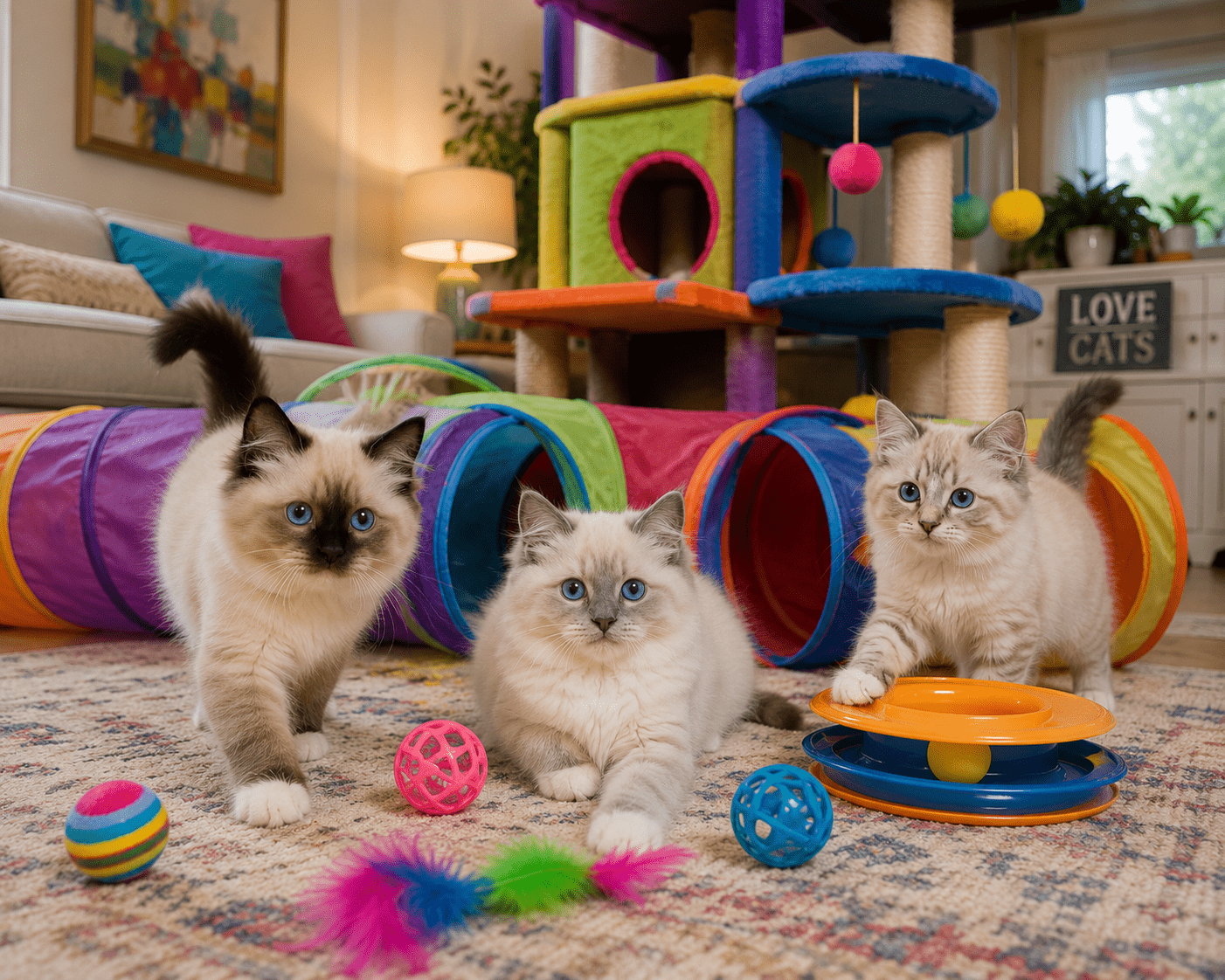

Why Ragdoll Kittens Choose Different Morning Spaces
A Ragdoll kitten that follows you from the bedroom to the kitchen is not necessarily more affectionate than the kitten watching from a quiet corner. One may want to be close without being touched, while another may prefer a clear view of the household before deciding whether to join in. These are useful examples of Ragdoll kitten personality differences that owners can easily overlook.
Morning is an especially revealing time to notice them. The home changes quickly: curtains open, footsteps cross the floor, appliances start, and people begin moving with purpose. Rather than arranging one “perfect” kitten area, it is more helpful to notice how your individual Ragdoll uses distance, visibility, and traffic during this part of the day.
Morning makes individual personality easier to see
Many Ragdolls are comfortable being near people, but “near” does not always mean sitting on a lap. A confident kitten may walk beside your ankles as you prepare breakfast. A more watchful kitten may settle several feet away where it can see you without becoming part of the activity. Both kittens may be socially interested; they are simply choosing different levels of involvement.
The important observation is what happens after you enter a room. Does your kitten approach immediately, pause at the doorway, circle around the activity, or remain in a familiar resting place until the household becomes quieter? That first choice often tells you more about personality than a single affectionate cuddle later in the day.
Three overlooked differences that can influence your layout
The close follower and the edge observer
Some Ragdoll kittens seem to treat a person’s morning route as an invitation to accompany them. They may move from bedroom to hallway to kitchen, stopping whenever you stop. Others prefer to observe from the edge of the route. They may sit beside a doorway, beneath a console table, or at the end of a sofa where they have a broad view but are not in the middle of passing feet.
For a follower, leave a wide, uncluttered path rather than placing a bed directly in the busiest walkway. This reduces the chance that your kitten will be stepped over or repeatedly displaced. For an observer, preserve the viewing position. A low, stable resting place beside—not inside—the main route can allow the kitten to remain socially connected without being jostled.
The touch-seeker and the proximity-seeker
Another subtle difference is the kind of contact a kitten requests. A touch-seeker may press against your leg, reach toward your hand, or climb onto furniture beside you. A proximity-seeker may simply want to occupy the same room. If you repeatedly pick up the second kitten because it looks interested, it may begin choosing a more distant place in the morning.
Home arrangement can respect this distinction. Put a comfortable, easy-to-leave spot near the chair where you drink coffee or check messages, but do not make the spot a dead end. Your kitten should be able to approach, watch, and leave without climbing over you or squeezing past furniture. This small detail gives a socially interested kitten control over the length and style of the interaction.
The quick settler and the morning patrol
Some kittens choose one place and settle soon after waking. Others make a slow circuit, checking several rooms before returning to rest. A Ragdoll’s relaxed reputation can make owners assume that a kitten should immediately choose a favorite bed or sofa. In reality, a kitten that takes ten minutes to survey the home may simply have a more active morning pattern.
For the quick settler, keep the preferred resting place consistent and out of the way of doors or cleaning routines. For the patrol-oriented kitten, avoid blocking every transition between rooms. The goal is not to encourage constant movement; it is to avoid making normal observation unnecessarily difficult. A kitten that can complete its familiar route may settle more readily once the household becomes predictable.
What to watch before moving furniture
Spend several mornings observing without calling your kitten over or rearranging the room immediately. Look for repeated choices rather than one unusual performance. These details are particularly informative:
- Whether your kitten chooses a position facing you, facing a doorway, or facing away from activity.
- Whether it approaches when you sit down but leaves when you reach toward it.
- Whether it prefers the center of a room, a boundary such as a wall or sofa edge, or a place with partial cover.
- Whether it settles after following one person or continues moving when several people begin their routines.
These observations can prevent a common mistake: moving a kitten’s favorite place because it seems inconvenient to a human, then replacing it with a more attractive location that does not offer the same view or escape route. For cats, the position of a resting place can matter as much as its softness.
Arrange for choice instead of one ideal spot
A useful morning layout usually includes more than one kind of social distance. Keep one resting option close to household activity and another in a quieter location. They do not need to be elaborate or placed in every room. The difference may be as simple as a cushion beside the sofa and a familiar bed at the end of a hallway.
Try to preserve three practical features: a clear line of sight, a stable surface, and an easy way out. These features help a cautious kitten stay involved without being surrounded. They also help a highly social kitten pause when the pace of the household becomes too busy.
It is also worth considering the height of the furniture around these spaces. A kitten that likes to watch may prefer the raised edge of a sturdy sofa, while another may be more comfortable at floor level where people can pass without looming overhead. Do not assume that higher is always better. The right position is the one that matches your kitten’s preferred way of monitoring the room.
Persian versus Ragdoll kittens in morning spaces
When the topic is personality and morning layout, Persian and Ragdoll kittens can present different tendencies, although individuals vary widely. A Persian kitten may be more inclined toward a predictable, low-traffic resting position from which it can observe activity without being drawn into every movement. Many Ragdoll kittens, by contrast, are often interested in following people or settling close to the action, even when they do not want constant handling.
The practical distinction is not that one breed is social and the other is not. It is that a Ragdoll may more often make proximity part of its morning routine, while a Persian may place greater value on a calm, settled base. For either breed, watch the kitten’s actual choices. A Persian can be an enthusiastic companion, and a Ragdoll can be a quiet observer.
Let your kitten show you the arrangement
The best home layout for a Ragdoll kitten is rarely based on breed reputation alone. It grows from small repeated observations: where your kitten pauses, how close it wants to be, and what makes it return to rest. Resist the temptation to interpret every following behavior as a request to be held, or every distant behavior as a lack of attachment.
Once you recognize your kitten’s morning style, make modest changes rather than a complete redesign. Keep routes open, offer different distances from activity, and let your Ragdoll decide when observation becomes participation. That approach respects personality while making everyday life more comfortable for both of you.
Want to understand your kitten even better? Explore more breed insights, lifestyle guidance, and helpful Persian and Ragdoll resources at CTkittens.com.

Rachel Cohen is a journalist and producer with a passion for audio storytelling, health and science reporting, and feline companions.
A graduate of Middlebury College, Rachel spends her weekends exploring the mountains and when she isn’t outdoors or chasing a story, she can usually be found hanging out with her cats.