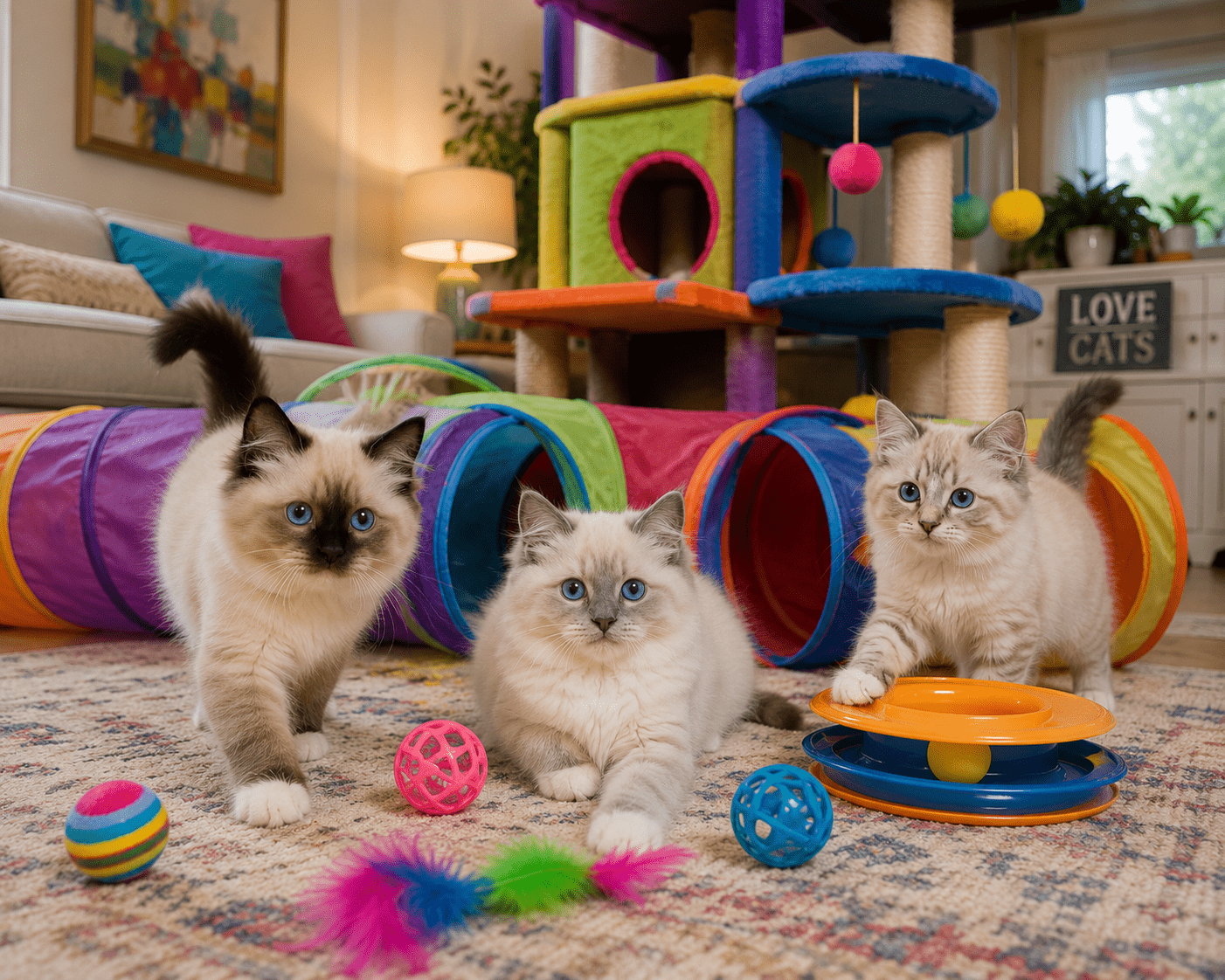

Ragdoll Kittens in a Studio Apartment: A Seven-Day Vertical-Space Plan
Studio living does not automatically mean giving up the idea of a happy, well-enriched home for a kitten. The key is to use height as an additional living area without treating every shelf as a climbing challenge. A good setup gives your kitten places to observe, rest, scratch, play, and retreat while keeping food, water, and litter easy to reach on the floor.
Short answer: create one secure vertical route with a low landing, a stable middle platform, and a comfortable lookout near the part of the studio where you spend time. Build it gradually over seven days, check every attachment, and watch how your individual kitten uses it before adding more height.
This approach reflects the environmental needs described in the AAFP and ISFM feline environmental-needs guidelines, including safe resting places, hiding options, scratching, play, and opportunities to control distance from people and other activity.
Before you begin: design a vertical neighborhood, not a tower
Ragdolls are a substantial cat breed, so a perch that seems perfectly sturdy beneath a small kitten must also be suitable as the cat grows. The Cat Fanciers’ Association Ragdoll profile can help you understand the breed’s adult proportions. Choose furniture with a weight rating appropriate for an adult cat, and account for the force of jumping rather than relying only on the kitten’s current weight.
Start by dividing the studio into three connected zones:
- Low zone: a kitten bed, hideaway, scratching surface, and clear route to the litter box.
- Middle zone: a stable platform or the lower levels of a cat tree for stepping, lounging, and changing direction.
- High zone: one secure lookout where your kitten can watch the room without being placed beside a hot appliance, open window, or busy doorway.
The vertical route should feel like a set of easy choices rather than a forced course. A kitten should be able to climb down safely, turn around on each platform, and retreat to a quiet low-level space. Keep the main path away from the stove, heater, ceiling fan, fragile decorations, and the front door.
A seven-day plan for using vertical space beautifully
Day 1: Map the studio and observe your kitten
Before buying shelves, sketch the room. Mark windows, doors, heating and cooling vents, cords, fragile objects, and the places where you naturally sit. Then choose one wall or corner that is visible from the sofa or desk but does not sit in the busiest traffic lane.
If your kitten has already arrived, observe rather than rearrange everything at once. Does it prefer watching from the edge of the room, hiding beneath furniture, or staying close to you? That information will help you place the high perch where it will actually be used. If the kitten is new, begin with a simple, kitten-proofed home base and expand access gradually.
Day 2: Install the secure foundation
Place a heavy, stable cat tree or a low platform in the chosen area. A freestanding unit should have a broad base and, if recommended by its manufacturer, an anti-tip attachment. Wall-mounted shelves must be fastened into suitable structural points with hardware appropriate for your wall type. If you rent, ask for permission before drilling.
Do not assume adhesive strips are suitable for weight-bearing shelves unless the product manufacturer specifically says so. Add a washable mat, but avoid thick or slippery bedding that can slide when a kitten jumps onto it. Put a tall, stable scratching post nearby; it should allow a growing Ragdoll to stretch upward without wobbling.
Day 3: Add a middle landing
Today, build the transition between floor and lookout. Add one or two broad, non-slip platforms or use the middle levels of a cat tree. Arrange them so your kitten can step between them rather than needing to make a long leap. Every platform should have enough room for four paws, a turn, and a comfortable resting position.
Keep the first route modest. A kitten that can reach a high shelf may not yet know how to get down safely. Supervise early exploration and temporarily block access to any level that causes hesitation, slipping, or unsafe launching.
Day 4: Create the window lookout safely
A window can provide valuable visual enrichment, but it also introduces one of the biggest safety risks in a studio. Install a secure perch well away from an unlocked window, and inspect the screen rather than treating it as a barrier. A screen can keep insects out; it is not necessarily designed to stop a cat’s body weight.
Keep blind cords, curtain loops, and dangling ties out of reach. Do not place the perch directly above a radiator, cooktop, or unstable side table. If the window cannot be made reliably secure, choose an interior lookout instead. A view is useful, but safety comes first.
Day 5: Connect the route and remove hazards
Look at the setup from your kitten’s perspective. Can it move from the low bed to the middle landing and then to the lookout without crossing a slippery surface? Is there a safe way down? Is the high point far enough from shelves containing breakable objects?
Anchor tall bookcases and cabinets to the wall. Move heavy or fragile decorations away from the route, secure loose cables, and remove plants that may be toxic to cats. The ASPCA’s cat plant list is a useful reference, but it is safer to identify every plant in the home rather than guessing from appearance.
A beautiful studio setup often looks less cluttered when the cat route follows one visual line: a wood-toned tree, two matching platforms, and a single washable cushion. Hidden cable management and closed storage can protect both your kitten and the room’s appearance.
Day 6: Add play, scratching, and choice
Vertical space works best when it supports several behaviors, not just climbing. Place a scratching surface near the route, because cats often scratch after waking or when moving between areas. Offer a few toys rather than covering every platform with them. Rotate toys every few days to keep the environment interesting.
Use wand toys only while you are present, and store them afterward so string and feathers cannot be swallowed or tangled. Food puzzles can add activity at floor level, where they are easier to supervise. Keep food and water away from the litter box, and keep the litter box in a quiet location with a clear exit.
If your kitten seeks company, position one comfortable perch near your usual chair or desk. A high resting place should not force social isolation; the best lookout may be the one that lets your cat be near you while still choosing distance.
Day 7: Test, observe, and refine
Spend a day watching what happens naturally. Which platform is used for sleep? Which one is used for watching? Does your kitten climb up but avoid coming down? Does the scratching post attract attention, or is another corner more appealing?
Make small changes based on those observations. Move a cushion, improve traction, lower a platform, or shift the scratching post a few inches. Do not add more height simply because an empty wall remains. The best vertical design is the one your kitten uses confidently and the one you can inspect and clean regularly.
Keep floor resources separate from the climbing route
Vertical enrichment should supplement, not replace, the essentials. In a studio, the following arrangement is practical:
| Resource | Best placement | Why it matters |
|---|---|---|
| Litter box | Quiet floor area with an unobstructed exit | Easy access reduces the temptation to avoid or delay use. |
| Food and water | Clean floor area away from litter | Kittens can eat and drink without passing through a toilet area. |
| Bed or hideaway | Low, calm corner | Provides a retreat when the room feels busy. |
| Scratching post | Near a sleep area or commonly used route | Matches natural scratching opportunities after rest or movement. |
For one cat, many feline-care guidelines use one litter box per cat plus one as a starting point. A studio may make that difficult, but it is still worth offering more than one clean, accessible option if you can do so safely. Never place a litter box on a high shelf or in a location that requires a kitten to cross a risky route.
Safety checks for Ragdoll kittens and elevated furniture
- Use hardware and anchors suited to the wall and follow the furniture manufacturer’s assembly and weight instructions.
- Choose platforms with a stable surface and enough room for an adult Ragdoll to rest and turn.
- Supervise the first climbing sessions; a calm temperament does not guarantee mature coordination.
- Keep open windows, balconies, hot surfaces, blind cords, medications, small swallowable objects, and toxic plants out of reach.
- Inspect screws, fabric, sisal, and wall connections regularly, especially after enthusiastic jumping.
- Keep a low retreat available so your kitten can leave the elevated area without being cornered.
For broader indoor-cat guidance, the Ohio State University Indoor Pet Initiative offers practical information about feline housing and enrichment. If your kitten repeatedly avoids the litter box, seems painful when jumping, or stops eating and playing normally, contact a veterinarian rather than trying to solve the change with furniture alone.
Frequently asked questions
Can a Ragdoll kitten be happy in a studio apartment?
Yes, provided the home offers safe resting places, appropriate play, scratching, predictable care, and clean, accessible resources. Floor area is only one part of a cat’s environment. A well-planned studio can give a kitten more useful territory than a larger but empty room.
How high should a Ragdoll kitten’s perch be?
There is no universal height that is safe for every kitten or apartment. Prioritize secure attachment, broad surfaces, intermediate landings, and a safe way down. Start lower while your kitten is learning, then adjust according to confident use and the product’s adult weight rating.
Should food or the litter box go on a shelf?
Usually, no. Keep the litter box on the floor in a quiet, easy-to-reach location. Food and water are also best kept on a stable floor surface, away from litter. Vertical space is most useful for resting, observing, scratching, and play.
A small space can still feel generous
A successful vertical plan does not need to fill every wall. One safe route, one inviting lookout, a low retreat, and well-placed essentials can make a studio feel larger from your kitten’s point of view while keeping the room attractive for people.
Ready to learn more about Ragdoll kittens and thoughtful cat care? Explore CTkittens.com for more kitten information and resources.
Sources and further reading

Rachel Cohen is a journalist and producer with a passion for audio storytelling, health and science reporting, and feline companions.
A graduate of Middlebury College, Rachel spends her weekends exploring the mountains and when she isn’t outdoors or chasing a story, she can usually be found hanging out with her cats.