
Ragdoll Kittens: Ten Gentle Upgrades for a Slow-Blink Hello for Preschoolers
Short answer: Teach a preschooler to offer a slow blink by sitting quietly, softening their gaze, closing and opening their eyes slowly, then waiting. The child should keep their hands still and let the Ragdoll kitten decide whether to look back, come closer, or leave.
The most useful lesson is not getting a particular response. It is learning that a cat is a small companion with choices. A relaxed kitten may return the blink, glance away, stretch, or simply continue resting. All of those responses are worth respecting.
Why a slow blink makes a good first hello
Cats often communicate with their eyes, posture, ears, whiskers, and tails rather than with obvious gestures. A slow closing and opening of the eyes can be a friendly, low-pressure signal. It is very different from a sustained stare, which some cats may find uncomfortable.
There is research behind the idea, although it is not a promise that every cat will respond. A 2020 study published in Scientific Reports found that cats were more likely to narrow their eyes after a person used a slow-blink expression, and were more likely to approach after a slow-blink interaction than after a neutral expression. You can read the study, The role of cat eye narrowing movements in cat-human communication, for the full methods and limitations.
That distinction matters with preschoolers. A slow blink is an offer of friendliness, not a command to cuddle, a test the kitten must pass, or proof that the kitten wants to be touched.
Start with the right expectations for a Ragdoll kitten
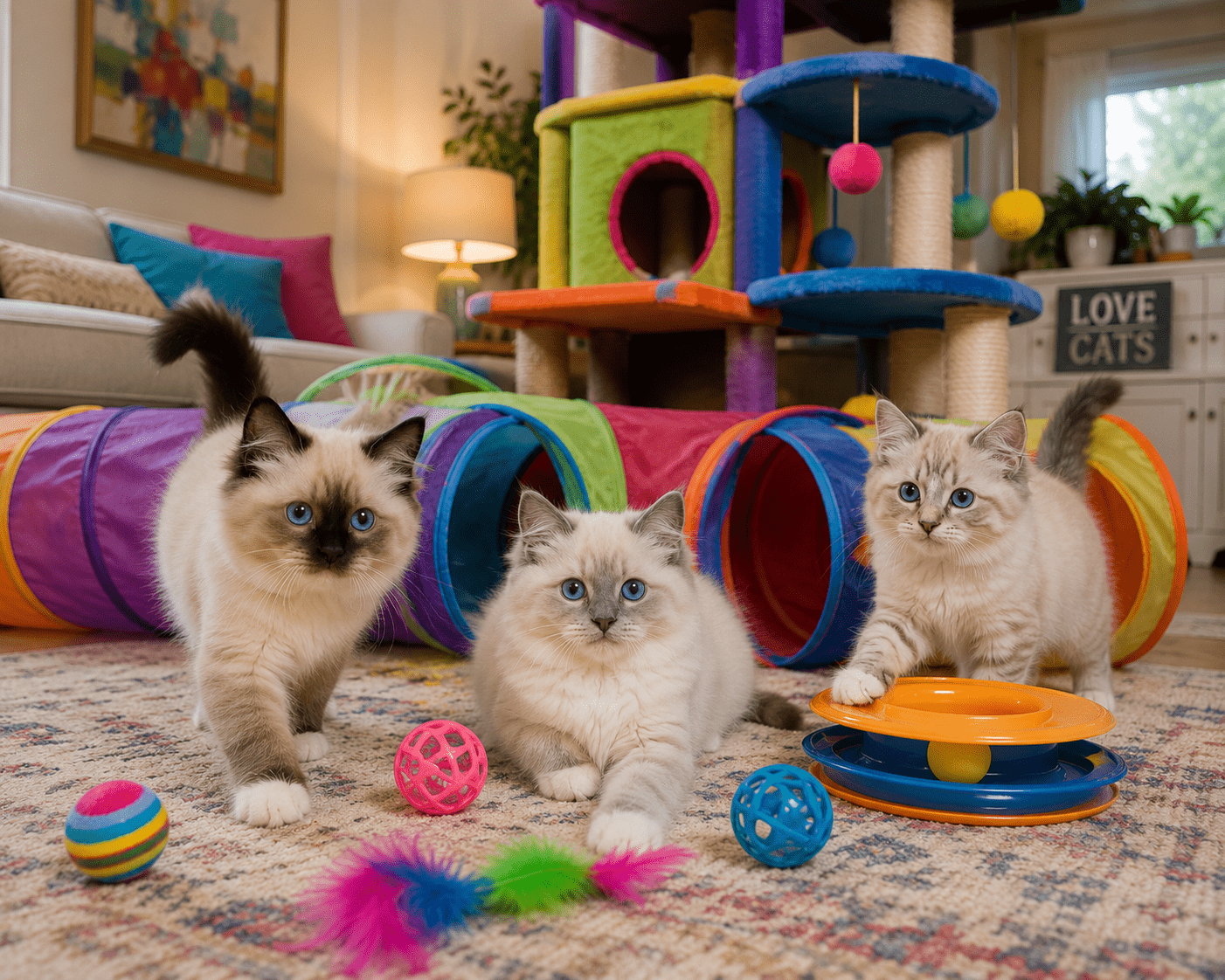
Ragdolls are known for blue eyes and a soft, semi-long coat, and breed descriptions often emphasize a relaxed temperament. Those characteristics do not replace individual personality, early socialization, or careful supervision. A Ragdoll kitten can be confident, shy, playful, tired, or overwhelmed—sometimes all in the same day.
The Cat Fanciers’ Association provides a useful Ragdoll breed profile, but no breed profile can predict how one kitten will feel in one moment. Let the kitten’s behavior guide the lesson.
Prepare a calm, kitten-friendly setting
Choose a quiet time when the kitten is awake but not racing around, eating, using the litter box, or settling down for sleep. Have the child sit on the floor or on a low, stable seat. The kitten should have an open route to a bed, cat tree, doorway, or other safe retreat.
An adult should remain close enough to guide the interaction. Preschoolers should not be left alone with a kitten, even when the kitten seems gentle. Young children may act quickly, and kittens are physically delicate. Keep the child’s hands in their lap at first; the slow-blink hello does not require touching.
Ten gentle upgrades for teaching the slow-blink hello
1. Call it a hello, not a trick
Use simple language such as, We can say hello with our eyes.
Avoid framing the exercise as something the kitten must do. This helps a child understand that communication goes both ways and that the kitten is not a toy or a performer.
If the child asks whether the kitten will blink back, answer honestly: Maybe. We can wait and see.
That turns uncertainty into part of the lesson rather than a disappointment.
2. Let the adult demonstrate first
Preschoolers learn by copying. Sit at a comfortable distance, turn your body slightly sideways, relax your shoulders, and look near—not intensely at—the kitten. Slowly close and open your eyes once. Then look slightly away and wait.
One clear demonstration is better than several rapid attempts. The child can watch your hands, voice, and body stay quiet while the kitten decides what to do.
3. Begin with distance instead of leaning in
A child’s face moving close to a kitten’s face can feel intrusive, even when the child means well. Start across the room or at the distance where the kitten already appears comfortable. The child can slowly blink from there.
If the kitten approaches, the child should remain still rather than reaching immediately. The kitten’s movement is an invitation to observe, not automatic permission for a hug or a lift.
4. Replace a hard stare with soft eyes
Show the child the difference between staring and soft eyes. A stare is wide, fixed, and intense. Soft eyes are relaxed, with a gentle glance and no leaning forward. You can make it playful by asking the child to pretend they are looking at a floating feather rather than trying to win the kitten’s attention.
If the child finds it difficult to keep their gaze gentle, have them look beside the kitten and blink slowly. A calm body is more important than perfect eye contact.
5. Make the blink slow, small, and natural
Teach one relaxed cycle: eyes gently close, pause briefly, then open. There is no need to squeeze the eyelids shut, exaggerate the movement, or repeat it over and over. A preschool-friendly cue is: Close like sleepy eyes, open, and wait.
The child can say a quiet hello before or after the blink, but silence is fine too. Loud greetings, clicking sounds, and repeated calling may make the kitten more alert instead of more comfortable.
6. Add the most important step: waiting
Children naturally want to fill silence. Give the child a small waiting job: count slowly to three, watch the kitten’s ears, or notice whether the kitten stays, moves, or looks away. Waiting teaches that the response belongs to the kitten.
A return blink may be subtle. It might look like relaxed eyelids rather than a dramatic wink. Do not ask the child to keep trying if there is no response. One friendly offer is enough.
7. Keep hands still during the first practice
Fast hands can undo a calm introduction. Ask the child to place both hands on their knees while they blink. This creates a clear boundary: eyes can say hello while hands wait.
If the kitten later rubs against the child or stays nearby, an adult can decide whether a brief, gentle stroke is appropriate. Guide the child toward the shoulder or side of the body, not the belly, paws, tail, or face. The child should never pull fur, restrain the kitten, or pick it up without adult direction.
8. Teach stop signals before starting
Give the child a simple rule: When the kitten says stop, we stop.
Useful stop signals can include walking away, hiding, crouching, flattening the ears, a rapidly swishing or lashing tail, hissing, growling, swatting, or trying to escape.
Some signals are quieter. A kitten that repeatedly turns its head away, licks its nose, freezes, or presses its body low may need more space. These signs are not a puzzle for the child to solve; they are a reason for the adult to end the interaction gently.
9. Make each practice brief and easy to finish
One or two slow blinks may be enough for a preschool lesson. End while the kitten is still comfortable rather than waiting for restlessness. The child can say, Thank you, kitty,
and move to another activity.
Short sessions also prevent the child from turning a quiet greeting into a chase. If the kitten walks away, the lesson has succeeded: the child has practiced noticing and respecting a boundary.
10. Celebrate observation, not affection
Praise what the child noticed instead of promising what the kitten felt. Try, You saw that her ears changed,
or, You kept your hands still while he walked away.
Avoid saying, She loves you because she blinked,
since a single behavior cannot explain a cat’s entire emotional state.
Over time, the child can learn a richer vocabulary: relaxed, sleepy, curious, finished, and needs space. That is a more valuable skill than producing a repeatable trick.
A preschool-friendly slow-blink script
- Ask the child to sit quietly with hands in their lap.
- Check that the kitten is awake, relaxed, and free to leave.
- Say hello in a soft voice or remain quiet.
- Look gently toward the kitten without leaning forward.
- Close and open the eyes slowly once.
- Look slightly away and wait.
- Notice the kitten’s whole body.
- Stop immediately if the kitten disengages or shows discomfort.
This sequence works even when the kitten does not blink back. The child has practiced patience, self-control, and consent-based interaction.
How to read the kitten’s full message
Eyes are only one part of feline body language. A loose body, neutral ears, a resting tail, and a kitten that chooses to remain nearby generally suggest that the interaction is not causing obvious distress. They do not automatically mean the kitten wants to be petted.
| What you notice | What the child should do |
|---|---|
| Kitten stays relaxed, looks away, or moves normally | Keep hands still and allow space. |
| Kitten comes closer but does not touch | Do not reach; let the kitten choose the next step. |
| Kitten turns away repeatedly or tries to leave | End the greeting and do not follow. |
| Ears flatten, tail lashes, body crouches, or the kitten hisses | Stop immediately and give the kitten a quiet retreat. |
A purr should not be treated as the only measure of comfort. Look at the whole body and the situation. A sleepy kitten may close its eyes because it is tired, not because it is answering the greeting.
Safety reminders for children and kittens
- Supervise every preschooler-kitten interaction.
- Do not allow hugging, chasing, tail pulling, rough play, or face-to-face contact.
- Leave the kitten alone while it eats, sleeps, uses the litter box, or hides.
- Wash the child’s hands after handling the cat and before eating.
- Keep the kitten’s food, litter area, carrier, and retreat spaces out of the child’s play zone.
- If a scratch or bite breaks the skin, wash the area promptly and tell an adult. Seek medical advice for a deep wound, increasing redness or swelling, fever, or uncertainty about the cat’s health and vaccination status.
For general guidance about cats, hygiene, scratches, bites, and other health considerations, consult the CDC’s information on cats and healthy pets. Your veterinarian can also advise on kitten wellness, parasite prevention, and the safest way to introduce a new pet to your household.
Are Ragdoll kittens a good match for preschoolers?
There is no breed-based guarantee. A good match depends on the individual kitten’s temperament, the child’s ability to follow directions, the adults’ availability to supervise, and the home’s ability to provide quiet escape spaces. Ragdolls may be appealing because of their appearance and often calm reputation, but a gentle family cat still needs boundaries.
Before bringing any kitten home, ask how it has been handled and socialized, observe whether it can recover from mild novelty, and discuss health records with the breeder, rescue organization, or veterinarian. A slow-blink lesson should support a thoughtful pet match—not be used to prove that a kitten is suitable for every child.
FAQ
Does a slow blink mean the kitten wants to be petted?
No. It can be a friendly or relaxed exchange, but it is not blanket permission to touch. Check the kitten’s body language and let the kitten initiate or decline further contact.
What if the kitten never blinks back?
That is completely fine. The kitten may be distracted, sleepy, cautious, or simply communicating in another way. The child can offer one calm blink and then move on.
Should a preschooler practice with a kitten every day?
There is no required schedule. Brief, occasional practice is enough. Stop before the kitten becomes restless, and never repeat the exercise to force a response.
Can children slow-blink at adult cats too?
Yes. The same low-pressure greeting can be offered to an adult cat, provided the cat has space and the child is supervised. The lesson is about respectful communication, not about a particular breed.
A small hello with a lasting lesson
The slow-blink hello is valuable because it gives a preschooler something gentle to do—and something even more important to learn: affection is not taking control. With a calm setting, quiet hands, and close attention to the kitten’s choices, a Ragdoll kitten can become part of a child’s earliest lessons in patience and care.
Ready to learn more about welcoming a Ragdoll into your family? Explore the kitten care and Ragdoll resources at CTkittens.com.

Rachel Cohen is a journalist and producer with a passion for audio storytelling, health and science reporting, and feline companions.
A graduate of Middlebury College, Rachel spends her weekends exploring the mountains and when she isn’t outdoors or chasing a story, she can usually be found hanging out with her cats.